
Building a custom home in Southwest Florida is all about creating a sanctuary that stands up to our unique climate. When it comes to keeping that home cool, comfortable, and energy-efficient, there’s one number that matters more than almost any other: the insulation R-value.
Think of R-value as a thermal shield for your house. It’s a straightforward concept: a higher number means greater protection from the relentless Florida sun. Understanding R-value is the first step toward creating a home that not only keeps your energy bills low but also serves as a resilient sanctuary during our intense summer heatwaves and powerful storm seasons.
Decoding R-Value For Your Florida Custom Home
When you're planning a new custom home in Southwest Florida, the conversation naturally turns to hurricane impact windows, flood elevation, and the necessity of a whole-house generator. But there's an invisible shield working around the clock to protect your comfort and your wallet—your home's insulation.
The secret to its effectiveness is the R-value, which is simply a measurement of how well a material can resist heat from passing through it.
Simply put, a higher R-value means the insulation is doing a better job of keeping your cool, conditioned air inside and the oppressive summer heat outside. This isn't just builder-speak; it's a fundamental part of modern building science that directly impacts everything from your monthly utility bill to your home’s ability to remain a safe haven during a power outage after a hurricane.
Why R-Value Is A Builder’s Priority
For a custom home builder in places like Cape Coral or Fort Myers, choosing the right insulation R-value isn't just about ticking a box to meet building codes. It's about delivering a fundamentally better home. A well-insulated house is the backbone of what we call a high-performance building envelope—a key trend in modern custom construction.
This guide is designed to pull back the curtain on R-value, helping you make smart, informed decisions for your custom home. We'll walk through:
- The Science Behind the Number: What R-value really is and why it's so critical for performance in our climate.
- Material Choices: How different types of insulation, like spray foam and fiberglass, offer different R-values and unique benefits for Florida homes.
- Florida-Specific Needs: Why our state's punishing humidity and long storm season make excellent insulation non-negotiable for resilience.
- Cost vs. Benefit: How a smart investment in a higher R-value pays for itself over and over in energy savings and pure comfort.
A home’s thermal performance is only as strong as its weakest link. Proper R-value insulation, installed correctly, ensures there are no weak links. It creates a consistent, unbroken barrier against the intense Florida heat and humidity.
By the end of this guide, you’ll have the knowledge you need to talk insulation confidently with your builder. Understanding R-value empowers you to see the critical details that transform a standard house into a true Sinclair Custom Home—one built with integrity, quality, and an unwavering commitment to lasting value. It’s the first step toward a home that isn't just beautiful, but is also smart and resilient enough for life in Southwest Florida.
What R-Value Actually Measures and Why It Matters
When you hear builders talk about R-value, it's easy to get lost in the technical jargon. But at its heart, the concept is incredibly simple. The "R" just stands for resistance. It’s a grade that tells you how well a material stops heat from moving through it.
Here in Southwest Florida, that means one thing: keeping the intense, humid heat outside and your cool, conditioned air inside. The higher the R-value number, the better the insulation is at doing its job.
Think of it this way: holding a hot coffee with a thin paper sleeve versus a proper insulated travel mug. The paper sleeve has a low R-value, and you feel the burn almost instantly. The travel mug, on the other hand, has a high R-value, creating a strong barrier that keeps the heat where it belongs.
In your home, the "heat" is the Florida sun hammering down on your roof and walls. Your insulation is the "mug." A high R-value insulation system is your number one defense against that relentless heat. For a more detailed look at the science, this guide offers a solid foundation for understanding R-value insulation.
The Standard for Measuring Performance
The R-value wasn't just pulled out of thin air. It became an industry benchmark as builders and homeowners started getting serious about energy efficiency. The idea was first put forward way back in 1945 by Everett Shuman at Penn State, which paved the way for the standardized tests we rely on today. This history is why we, as builders, can confidently compare a roll of fiberglass from one brand to a spray foam from another and know exactly what we're getting.
This single number is absolutely critical in modern custom home building. It allows us to move past guesswork and engineer a home that will perform predictably in our unique climate. For you, the homeowner, it turns a complex scientific principle into a simple score that directly impacts your comfort and your monthly power bill.
The Law of Diminishing Returns
Now, while a higher R-value is always better at blocking heat, it doesn't mean we should just stuff every wall with the thickest insulation money can buy. This is where a critical building principle comes into play: the law of diminishing returns.
Adding insulation gives you huge benefits up to a certain point, but each additional inch of material offers less and less of a boost.
- Going from no insulation (R-0) to some (say, R-13) is a night-and-day difference.
- Upgrading from R-13 to R-19 delivers another solid, noticeable improvement.
- But jumping from R-38 to R-49? The performance gain is much smaller, while the cost can be significant.
Building smart is about finding the sweet spot. It's the point where you get exceptional performance and comfort without overspending on an R-value that gives you very little extra benefit. An experienced builder focuses on a balanced, holistic approach, not just chasing the highest number on a spec sheet.
This is a vital concept when planning your custom home budget. It's often much smarter to invest in a slightly lower R-value combined with meticulous air sealing and high-performance, hurricane-impact windows than it is to sink the entire budget into maxing out the R-value in the attic alone. This balanced strategy is what creates a truly high-performing home built for the realities of life in Southwest Florida.
Choosing the Right Insulation for Your Florida Home
When you're building a custom home in Southwest Florida, picking the right insulation isn't as simple as just grabbing the one with the highest R-value off the shelf. Our climate is a different beast altogether. We've got intense, sticky humidity, a cooling season that feels like it never ends, and the ever-present risk of hurricanes.
It’s not about finding what works best in a controlled lab environment. It's about choosing materials that stand up to real-world Florida conditions, year after year.
Not all insulation is created equal, especially down here. Each type has a unique job to do in a high-performance home. The three workhorses of modern construction are spray foam, fiberglass batts, and rigid foam board. Each strikes a different balance between stopping heat, managing moisture, and sealing out unwanted air.
Understanding how they differ is crucial to building a home that’s both comfortable and built to last. For instance, a new design trend is to use closed-cell spray foam not just for insulation, but also for its structural benefits, especially in homes built to higher elevations.
Comparing Popular Insulation Types
To really get a handle on the best choice for your home's design, it helps to see them side-by-side. Each of the main options brings its own set of strengths and weaknesses to the table in a coastal environment like ours.
A great way to visualize this is to compare the most common materials used right here in Florida. We've put together a simple table to break down the key differences.
Insulation Types Comparison for Florida Custom Homes
| Insulation Type | R-Value Per Inch | Moisture Resistance | Air Sealing | Best Use in Florida |
|---|---|---|---|---|
| Open-Cell Spray Foam | ~R-3.8 | Moderate | Excellent | Attics (unvented), wall cavities. Great for sound dampening. |
| Closed-Cell Spray Foam | ~R-7.0 | Excellent | Excellent | Roof decks, walls, floors. Adds structural rigidity for hurricane resilience. |
| Fiberglass Batts | ~R-3.5 | Poor | Poor | Cost-effective for wall cavities when paired with a separate air barrier. |
| Rigid Foam Board (XPS/EPS) | ~R-4.0 to R-5.0 | Excellent | Good (seams must be taped) | Exterior sheathing, below-grade foundations on elevated homes. |
As you can see, the choice isn't just about R-value. A material's ability to block humid air and resist moisture is just as important in preventing long-term problems.
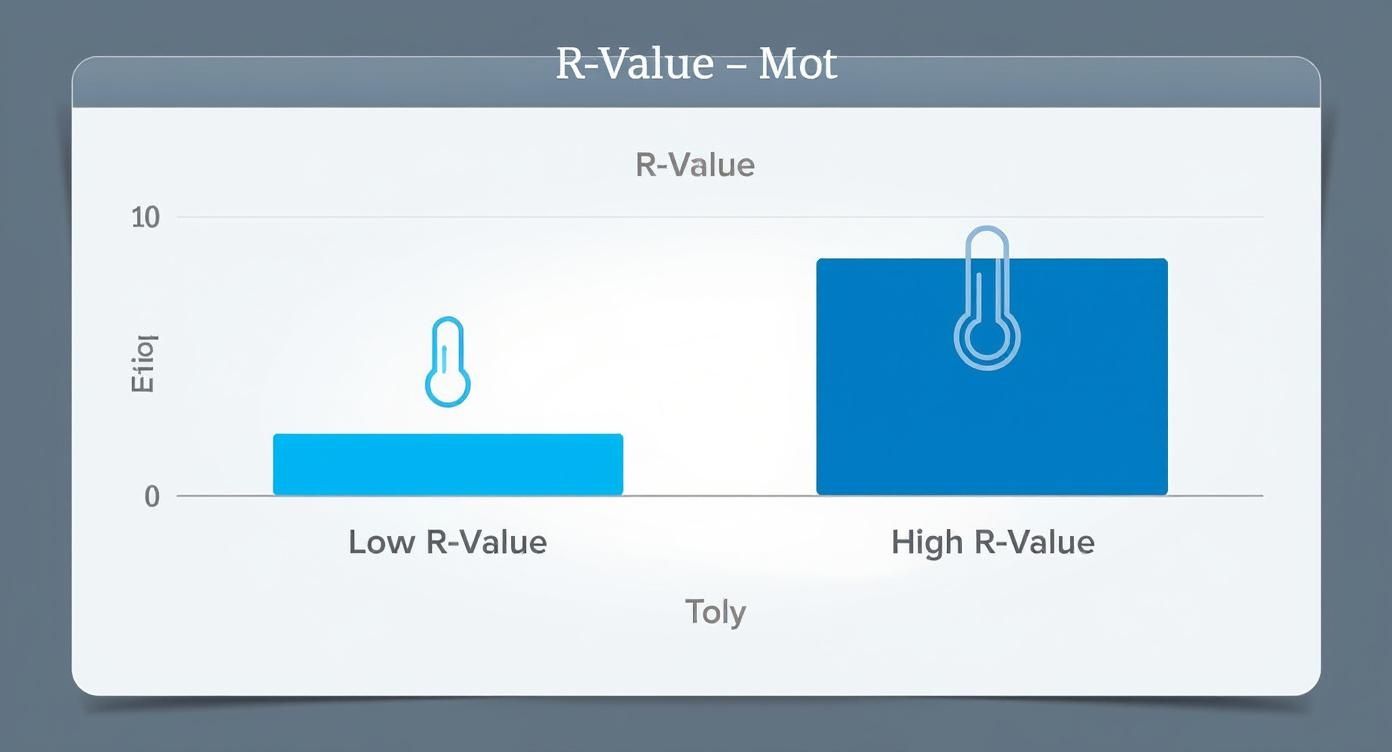
This visual shows a simple truth: the higher the R-value, the better the material is at resisting the flow of heat, keeping your cool air inside where it belongs.
Beyond R-Value: Hurricane Resilience and Air Sealing
For anyone building a home in Cape Coral or Fort Myers, preparing for hurricanes is just part of life. This is where some insulation choices offer incredible benefits that go way beyond just keeping your house cool.
Take closed-cell spray foam, for example. It does much more than just insulate. When we apply it to the underside of a roof deck, it expands and hardens into a dense, rigid material. It literally glues the roof sheathing to the trusses. This single application can boost a roof's structural strength by up to 300%, giving it a massive defense against the violent uplift forces of hurricane winds.
In a major storm, that added structural glue can be the difference between a few lost shingles and a catastrophic roof failure. It’s a perfect example of a modern builder trend: using materials that pull double—or even triple—duty. You get a high-impact feature, superior insulation, and air sealing all in one product.
On top of that, air sealing is absolutely critical in Florida. Tiny, uncontrolled air leaks can drive up your cooling costs and pump sticky, humid air into your home, creating a recipe for moisture and mold problems. Spray foam is the champion here, creating a single, solid barrier that stops drafts and leaks in their tracks. Fiberglass, on the other hand, only slows heat; it doesn't stop air from moving right through it. To be effective, it must be paired with a perfectly installed air barrier.
Ultimately, the best choice depends on your home’s specific design, your budget, and what you want to achieve. Once you've landed on the right R-value and insulation type, you might consider professional insulation repair, upgrade, or installation services to ensure it’s done right. A quality builder will walk you through these choices, making sure your investment improves not only your energy bills but also the strength and safety of your home for decades to come.
How Florida's Climate Affects Insulation Performance
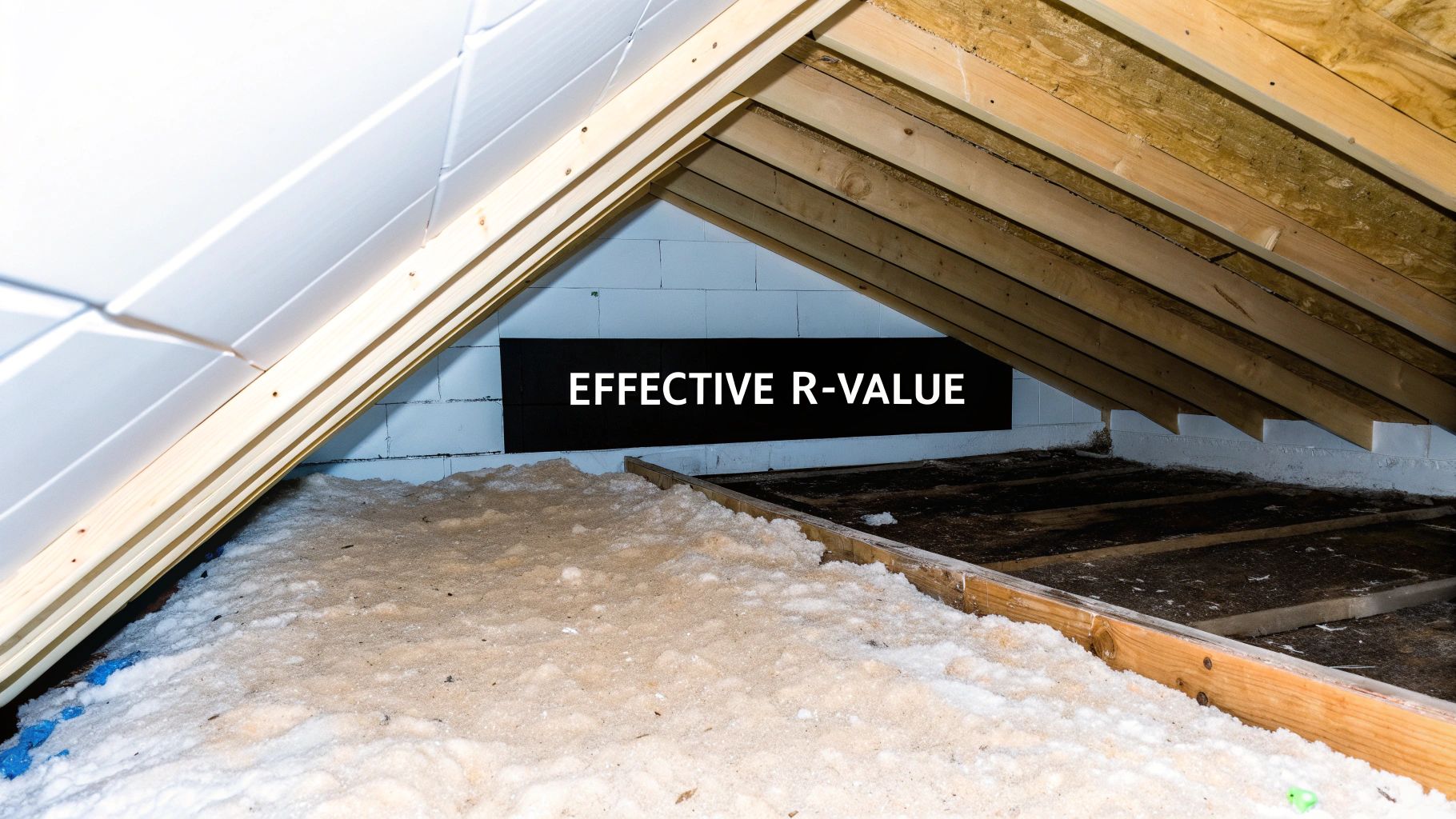
An insulation's official R-value is measured in a perfect, climate-controlled lab. But here in Southwest Florida, that number gets put to the test every single day by our relentless heat, sticky humidity, and torrential summer storms. This is where we see the crucial difference between a product’s advertised R-value and its effective R-value.
The hard truth is, not all insulation holds up once it’s installed in a real Florida home. Our climate is a unique beast, and two big factors—moisture and heat transfer through the structure itself—can seriously weaken your home's thermal defense. Understanding these enemies is the first step to building a truly efficient and durable custom home.
The Hidden Impact of Humidity on R-Value
Moisture is the number one enemy of most common types of insulation. In a place as humid as Southwest Florida, that’s not a small detail—it's a massive performance killer.
Think of it like this: traditional fiberglass insulation is like a big, fluffy sweater. When it's dry, it traps air and keeps you comfortable. But what happens when that sweater gets wet? It gets heavy, mats down, and loses all its ability to keep you warm. Fiberglass works the exact same way. When it soaks up moisture from our humid air, its thermal resistance takes a nosedive.
And we're not talking about a small drop. Research has confirmed that moisture can absolutely destroy insulation's effectiveness. Fiber-based materials like fiberglass are particularly vulnerable; getting damp can slash their R-value by 50% or more. Under the right conditions, they can become almost useless. This is why forward-thinking builders are trending toward moisture-impermeable materials like closed-cell spray foam, which holds its R-value year after year, even in our damp climate.
Uncovering The Energy Thief: Thermal Bridging
There's another silent saboteur that degrades your home's real-world R-value: thermal bridging. This happens when heat finds an easy path, bypassing your insulation by traveling through more conductive materials—namely, the wood studs in your walls and the joists in your attic and floors.
Imagine you have a high-tech cooler, but it has a solid metal handle that runs from the outside straight to the inside. Even with super-thick walls, the heat will zip right through that metal handle and warm everything up. In your home, every single wood stud acts like that metal handle, creating a "bridge" for heat to flow right through.
A standard wood stud has an R-value of only about R-4.4, while the insulation in the wall cavity right next to it could be R-13 or even R-19. This creates a whole network of weak spots across your home, quietly letting all your expensive cool air escape.
Thankfully, modern building science has given us smart ways to fight this. Some builders use advanced framing techniques with less lumber, which leaves more room for insulation. But the real game-changer is adding a layer of continuous exterior insulation. This means wrapping the entire outside of the home in rigid foam board before the siding goes on, creating an unbroken thermal blanket that covers up the studs and stops thermal bridging cold.
This approach is a key new design feature, especially for the elevated custom homes we often build in coastal areas. Properly insulating these raised structures is key to the home's overall efficiency. By tackling both moisture and thermal bridging head-on, we make sure the R-value you pay for is the R-value your home actually delivers—keeping you comfortable and your energy bills low for decades.
Navigating Florida's Building Code R-Value Requirements
Think of the Florida Building Code as the official rulebook for construction. It sets the absolute minimum standards for safety, efficiency, and durability. For insulation, the code spells out the baseline R-values required for different parts of a new home.
But here’s the thing about building a high-performance custom home in Southwest Florida: just meeting the minimum is like aiming for a C- on a test. It’s a pass, but it’s not excellence. We see these codes not as a target to hit, but as a starting point to blast right past. The real goal is to build a home that performs exceptionally in our tough coastal climate, giving you superior comfort and real, long-term savings.
Understanding Florida's Climate Zone Requirements
Southwest Florida, from Cape Coral to Fort Myers and beyond, sits squarely in Climate Zone 1. It’s the hottest region in the state, and that classification comes with specific R-value minimums that every builder has to follow.
Here’s a look at the typical baseline requirements:
- Ceilings/Attics: The code typically requires an R-value of R-38. This makes sense—your roof gets blasted by direct sun all day, making the attic a critical defense line.
- Frame Walls: For standard wood-frame walls, the requirement is usually R-13 to manage heat coming through the sides of the home.
- Floors: If you have floors over unconditioned spaces like a garage or in an elevated home, the code often starts at R-13.
Getting the paperwork right and ensuring full compliance is a huge part of any build. If you want to get into the weeds of the local administrative side, you can check out our guide on Cape Coral building permits.
Why Exceeding the Code is the New Standard
Sure, an R-13 wall and R-38 ceiling will get a passing grade from the inspector. But those numbers represent the floor, not the ceiling, of what's possible with modern building science. A builder who’s truly focused on quality and longevity will strategically go above and beyond to create a high-performance home.
A home built only to code is the least efficient home you can legally build. A custom home should be an investment in future performance, which means building beyond today’s minimum standards to prepare for tomorrow’s energy costs and climate challenges.
This is exactly why you'll see builders like Sinclair Custom Homes using solutions like closed-cell spray foam. It doesn't just hit higher R-values; it also air-seals the home and adds structural strength—huge hurricane impact features the code doesn't even measure.
The FTC's R-Value Rule Protecting Homeowners
This isn't just a local trend. The focus on standardized performance is backed by federal rules designed to protect you, the homeowner. R-values are a big deal for energy conservation, so they are tightly regulated. Way back in 1979, the Federal Trade Commission created the 'R-value Rule,' which requires insulation makers to disclose R-values based on uniform testing.
This rule ensures you get a clear, honest number to judge a product's performance. It lets you make fair, apples-to-apples comparisons when deciding how to insulate your home. You can learn more about the history of R-value regulations and performance standards. Building beyond the code isn’t just about stuffing in more insulation; it’s about making a smarter, more informed choice for a home that will be comfortable and resilient for years to come.
Building a Resilient Home Beyond the Code
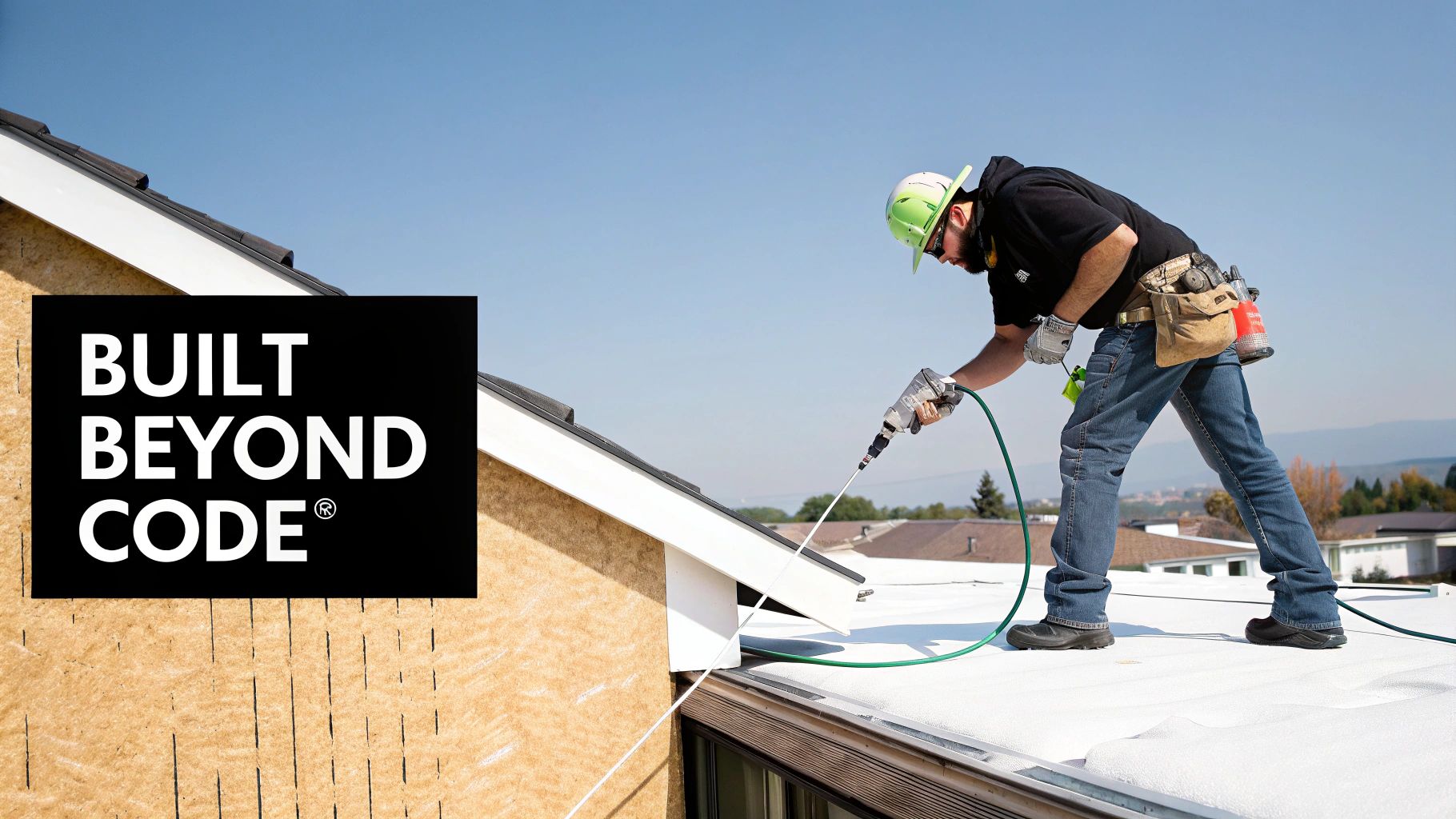
True expertise in custom home building isn’t about just meeting the minimums—it’s about seeing the bigger picture. Understanding R-value is a crucial piece of a much larger puzzle: creating a complete, high-performance building envelope. This modern building philosophy treats your home as one integrated system, where every single component works together in harmony.
Insulation isn't just something you stuff in the walls. It’s a strategic layer in a complex system designed for resilience, efficiency, and your family's comfort. This approach turns a house from a simple collection of parts into a cohesive, high-functioning sanctuary, perfectly tuned for the demands of life here in Southwest Florida. It’s a core principle that guides every stage of our custom home building process.
The Power of an Integrated System
A high-performance home doesn't just happen. It’s the result of deliberate choices, where materials are selected to pull double or even triple duty. This is where a deep understanding of R-value insulation really pays off, delivering tangible benefits you can feel every day.
One of the best examples of this is how we strategically use closed-cell spray foam on the underside of a roof deck. This one application delivers three incredible advantages at once:
- High R-Value: It provides a superior thermal barrier (R-7 per inch) that blocks the intense solar heat that absolutely hammers Florida roofs.
- Air Sealing: It creates a powerful, airtight seal. This stops hot, humid air from sneaking into your attic and prevents the energy loss that drives up your cooling bills.
- Structural Reinforcement: It literally "glues" the roof sheathing to the trusses. This dramatically increases the roof's resistance to the powerful uplift forces common in hurricanes, making it a critical hurricane impact feature.
This single smart decision transforms your attic from a super-heated liability into a semi-conditioned buffer zone. That puts far less strain on your HVAC system and protects any equipment housed up there. It’s a perfect illustration of building smarter, not just stronger.
The goal of a high-performance building envelope is to create a home that is more than the sum of its parts. It’s about building a system where the insulation, windows, air sealing, and structure work in harmony to deliver superior comfort, lower energy bills, and peace of mind during a storm.
Tangible Benefits for Florida Homeowners
When your builder moves beyond simply checking code boxes and embraces a complete building envelope strategy, the results are immediate and lasting. This isn't just about technical specs on a blueprint; it's about the quality of life you get to experience every single day.
The real-world outcomes are what matter:
- Dramatically Lower Energy Bills: An airtight, well-insulated home simply requires less energy to cool, leading to substantial savings month after month.
- Consistent Indoor Comfort: You can finally say goodbye to those annoying hot spots and rooms that never seem to cool down. Every space remains consistently comfortable, no matter how hot it gets outside.
- Superior Indoor Air Quality: By controlling air and moisture infiltration, you dramatically reduce the risk of mold and allergens, creating a healthier living environment for your family.
- Enhanced Storm Resilience: A structurally reinforced and properly sealed home is far better prepared to withstand Florida’s unique weather challenges, especially during hurricane season.
Ultimately, understanding R-value is about seeing its critical role in a holistic building strategy. It’s a key investment that pays dividends for years to come in efficiency, comfort, and the long-term resilience of your custom Florida home.
Frequently Asked Questions About R-Value Insulation
We've covered a lot of ground, from the science of R-value to the materials we use and the codes we follow. Now, let's get down to brass tacks and answer some of the most common questions we hear from homeowners building a custom home in Southwest Florida.
This is where the rubber meets the road—applying all this knowledge to our unique climate.
Is a Higher R-Value Always the Best Choice?
You'd think so, right? While a higher R-value does mean better heat resistance, it's really about making a smart investment. At a certain point, you hit a wall of diminishing returns, where the extra cost of piling on more insulation just doesn't deliver a meaningful boost in performance.
For a Florida home, it's far smarter to strategically exceed the code minimums and, more importantly, choose the right material for the job. For instance, putting your budget toward superior air sealing with spray foam often pays off much more in the long run than just chasing the highest R-value number with traditional materials. That same money might be better spent on high-impact windows or a more efficient HVAC system.
How Does Great Insulation Help During a Hurricane?
This is a key consideration for any custom home in Florida. High-performance insulation is a critical piece of building a resilient home. A well-insulated, air-sealed house slows down heat gain significantly. If the power goes out after a storm—a common occurrence—your home will stay cooler for much longer, even if you're running on a whole-house generator. This makes for a safer, more comfortable shelter when you need it most.
But there's more to it. Certain materials, like closed-cell spray foam, actually add significant structural strength to your roof deck and walls. This is a powerful hurricane impact feature that helps your home stand up to hurricane-force winds and lowers the risk of catastrophic damage. Your insulation becomes an active part of your home's defense system.
What is the Difference Between R-Value and an Air Barrier?
This is a critical distinction, and one every homeowner in the custom home industry should understand. R-value measures how well a material resists heat moving through it, like sunshine warming up your drywall. An air barrier, on the other hand, stops air from leaking around and through the gaps in your home's structure.
Here in Florida, with our humidity, uncontrolled air leaks are a huge source of energy waste and a prime cause of moisture problems. A modern, effective thermal strategy needs both high R-value and a continuous, unbroken air barrier.
Here’s a quick way to think about it:
- Spray Foam Insulation: This is an all-in-one solution. It provides both a high R-value and creates a perfect, seamless air barrier in a single application—a popular new builder trend.
- Fiberglass Batts: This material only provides R-value. To work correctly, it needs a separate, perfectly installed air barrier, because air (and the moisture it carries) can flow right through it.
At Sinclair Custom Homes Inc, we don't just build to code; we build for the real world. We integrate a complete building envelope strategy to make sure your home is efficient, comfortable, and ready to stand strong for decades to come. Start your custom home journey with us today.