
Building a custom home in Southwest Florida is an exciting journey, but even the best-laid plans can change. That’s where a construction change order comes in. It isn't just a casual request; it’s a formal amendment to your contract that can directly impact your budget and schedule. Getting a handle on construction change order management is all about steering these modifications smoothly to keep your dream home on track.
The True Cost of Changes in SW Florida Home Building
Starting a custom home build in communities like Cape Coral or Fort Myers means you’re working with a unique set of local variables. It’s a dynamic process, and let’s be honest, changes are almost guaranteed. These shifts can come from a sudden stroke of design inspiration, a new building trend you want to incorporate, or the realities of building in our coastal environment.
Every one of these adjustments gets documented in a change order. This document outlines the new scope of work, lays out the costs, and details any effects on the project timeline. Knowing why they happen is the first step to managing them without stress.
When Your Vision Evolves Mid-Build
More often than not, the person initiating a change order is you, the homeowner. It's completely normal. As you see your home take shape, you might get new ideas for design features or decide on an upgrade that wasn't in the original plans.
Here in Southwest Florida, we see a few common themes for these kinds of requests, often driven by recent news and storm seasons:
- Upgrading for Hurricanes: After a rough storm season, you might decide to swap out standard windows for high-velocity hurricane zone (HVHZ) rated impact windows. It’s a smart move for peace of mind and can positively affect insurance rates.
- Adding Power Security: Seeing neighbors go without power for days after a hurricane makes a whole-home generator a top priority. This popular change order requires new electrical planning, a concrete pad, and gas line work.
- Expanding Outdoor Living: Once the lanai is framed out, it’s easy to start dreaming bigger. Many clients decide to add a more elaborate outdoor kitchen with high-end appliances, which means altering gas lines, electrical plans, and cabinetry designs.
- Integrating New Design Features: You might see a new trend like a hidden pantry, a dedicated pet-washing station, or smart home automation features that you decide you can't live without.
These are all fantastic improvements that add real value to your home. The key is to run them through the formal change order process to keep everyone on the same page and prevent budget surprises.
Here's a reality check: The Dodge Construction Network found that about 10% of a project's total cost often comes from change orders. What's more, over half of these changes can take between 5 to 15 days to get sorted out, which can definitely slow things down.
When the Unexpected Happens
Not all changes come from you. Sometimes, the unique conditions of Southwest Florida throw a curveball, and your builder needs to initiate a change order. These are usually for unforeseen issues that are critical for the structural integrity and safety of your home.
This is where having an experienced local builder really pays off. A good builder stays on top of new legislation and building trends, anticipating many potential issues, but some things just can't be known until you break ground.
To help you know what to look out for, we've put together a table of the most frequent triggers we see for change orders in our area.
Common Change Order Triggers in SW Florida Custom Homes
| Change Trigger | Example Scenario | Potential Impact |
|---|---|---|
| Unforeseen Site Conditions | The excavation crew hits a patch of muck or unstable soil not found in the initial survey. | Requires deeper footers or engineered fill, adding material and labor costs. |
| Evolving Building Codes | A new FEMA flood map is released or wind-resistance regulation is passed mid-project. | The home’s design may need to be modified, such as raising the finished floor elevation. |
| Supply Chain Issues | A specific designer tile is suddenly discontinued, or a major appliance like a generator backorders for months. | Your builder will present alternatives that may have a different cost and lead time. |
These scenarios are just part of building in a dynamic place like Florida. They aren’t cause for panic, but they do highlight why a clear, organized process is so important.
Ultimately, whether a change comes from a new idea or a necessary adjustment, it all circles back to the importance of solid home construction project management. A transparent system ensures every change is handled with clarity, protecting both your investment and your move-in date.
How a Change Order Actually Works
So, you’ve decided you want to make a change. It happens on almost every custom build. Maybe you’re standing in the newly framed living room and realize that a full wall of sliding glass doors would capture that amazing canal view perfectly—a classic "aha!" moment for homeowners in places like Cape Coral and Fort Myers Beach.
But what happens next is more than just a quick chat with your builder. It’s a formal process designed to protect everyone involved. This is where a solid construction change order management plan kicks into gear.
The absolute first step is to get your idea to your project manager in writing. Sending a clear email is the best way to go. Resist the temptation to just casually mention it to a subcontractor on site, like asking the electrician to pop in another outlet. That can turn into a "constructive change"—unapproved work that nobody accounted for, leading to a real headache when the bills come due. A simple email creates a paper trail right from the start.
From Your Idea to an Official Plan
Once you hit 'send,' your builder's team gets busy figuring out the real-world implications of your request. It's never as simple as just the cost of the new materials; there's a whole chain reaction they need to map out.
Here’s a peek behind the curtain at what they're doing:
- Getting Real-World Quotes: They’ll contact their suppliers and trade partners for firm pricing. Thinking about adding a whole-home generator (a popular upgrade in Southwest Florida, especially after storms)? They're not just pricing the unit itself. They're getting quotes for the concrete pad, the electrician's hours, and the plumber needed to run the gas line.
- Checking the Calendar: They have to figure out how this change will ripple through the project timeline. Will ordering those custom-sized, hurricane-impact doors add six weeks to the schedule? If so, does that delay the stucco crew, the painters, and everyone else down the line?
- Calculating the Ripple Effect: Sometimes there are hidden costs. If the original windows were already ordered, there might be a restocking fee to send them back. If a wall needs to be reframed to accommodate the new doors, you have to account for the labor to tear out the old work and redo it.
This deep dive isn't meant to slow things down; it's to make sure you have a complete picture with no surprises. It transforms your idea into a concrete plan with a clear price tag and an updated schedule.
Making Sense of the Change Order Form
After all that homework is done, you’ll get a formal change order document. Think of it less like an invoice and more like an amendment to your original contract. It's built for total transparency, laying everything out so you know exactly what you’re agreeing to.
A proper change order leaves zero room for interpretation. It spells out the change, the exact cost, and the impact on your move-in date. This single piece of paper is your best defense against misunderstandings.
Let's walk through a common scenario here in coastal Florida. Say you decide to raise your home's foundation by another foot to be safer in the new flood zones—a smart move given recent storm surge news.
Sample Change Order Breakdown:
- Scope Description: "Increase finished floor elevation by 12 inches above original plans. This will require additional courses of foundation block, engineered fill, and stem wall labor. It also includes revisions to front entry steps and the driveway slope."
- Cost Breakdown:
- Additional Concrete & Block: $X,XXX
- Engineered Fill & Compaction: $X,XXX
- Extra Labor (Masonry & Framing): $X,XXX
- Architectural/Engineering Redraw Fee: $XXX
- Builder Markup (e.g., 20%): $XXX
- Total Cost of Change: $XX,XXX
- Schedule Impact: "This change will add an estimated 14 working days to the project schedule. This accounts for new material delivery lead times and additional required inspections."
Once you sign this document, you're giving the green light. It officially gives the builder permission to do the new work and formally adjusts the contract price and completion date. No work on this change should ever start until it's signed by everyone, making sure you're all on the same page.
Uncovering the Hidden Costs and Delays
The price you see on a change order form is just the beginning. To really manage a construction project well, you have to look past the obvious costs for materials and labor. You need to understand the full ripple effect a single tweak can have, especially here in Southwest Florida, where project timelines are already tight and getting materials requires careful planning.
Think of a change order as a domino effect. The direct costs are easy to spot—the price of that upgraded appliance or the fancy tile you just had to have. But it's the indirect, hidden costs that can really strain a budget and throw the schedule off track. These are the knock-on effects that disrupt the carefully choreographed dance of construction.
Let's walk through a common scenario. Say you decide midway through the build to add an outdoor kitchen to your lanai. It seems simple enough on the surface.
Direct vs. Indirect Impacts
The direct costs are straightforward: the grill, the outdoor fridge, the granite, and the crew to put it all together. But the indirect impacts? They run much deeper.
- Subcontractor Rescheduling: The paver team, who was supposed to start next week, now has to be put on hold. Your builder now needs to get a plumber and an electrician out to run new lines to the lanai before any pavers can go down. Just like that, their schedule is pushed back.
- Material Lead Times: That specific outdoor-rated cabinetry you picked out? It could have a 6-week lead time. This doesn't just hold up the outdoor kitchen; it brings the final grading and landscaping for that whole side of your property to a standstill.
- Redoing Completed Work: If the concrete for the lanai was already poured, crews may have to cut into it to run the new plumbing and electrical lines. That means new costs for demolition, trenching, and patching the concrete back up.
Suddenly, this one "simple" change has thrown a wrench in the works for at least four different trades (pavers, plumbing, electrical, landscaping), introduced new material delays, and created rework. Those are all costs and delays that weren't itemized on the initial change order for the grill itself.
This infographic shows the typical path a change order takes, from the initial idea to the final sign-off.
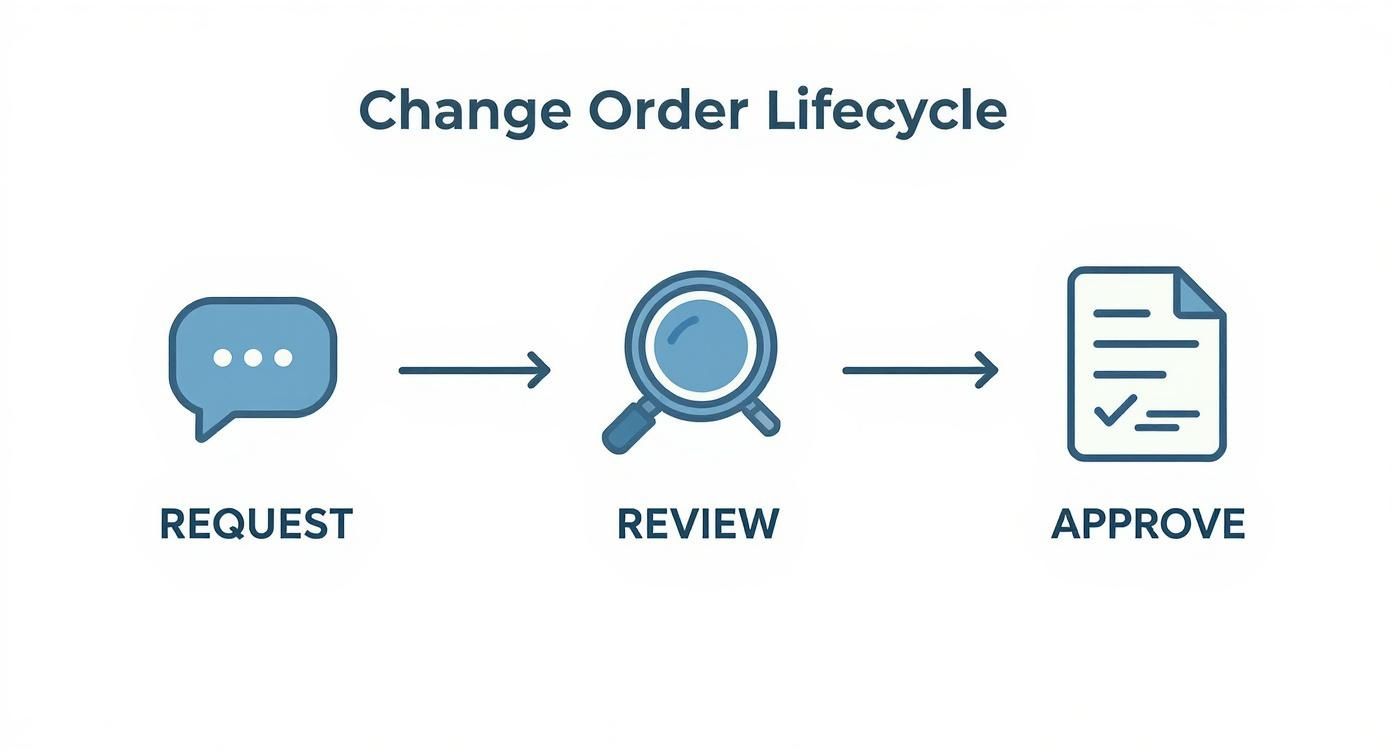
Every single step in this process takes time. And in the real world, the clock on scheduling delays often starts ticking long before the final approval is even signed.
The Cascade Effect of Major Changes
Now, let's look at something bigger, a change driven by Florida's ever-evolving building codes. Imagine you decide to elevate your new home an extra foot to be safer than the updated FEMA flood zone maps require. It’s a smart move for long-term peace of mind and better insurance rates.
But that one decision unleashes a massive cascade of changes. The foundation engineering has to be completely redone and sent back to the county for a new permit. From there, everything else is affected:
- The amount of fill dirt required goes way up.
- More courses of concrete block are needed for the stem wall.
- The total square footage of exterior finishes like stucco and siding increases.
- The design of your front entry stairs and the slope of your driveway have to be totally re-engineered.
A change order isn't an isolated event; it's a disruption to a complex, interconnected system. Understanding this helps you and your builder accurately assess the true cost and time required, ensuring the decision is fully informed.
Each one of those bullet points turns into its own mini-project, complete with its own costs and schedule impacts. This is a perfect example of why it's so critical to understand how long it takes to build a custom home and how even well-intentioned changes can stretch that timeline. A properly managed change order process will account for every one of these downstream effects, giving you a clear, honest picture before you sign on the dotted line.
How to Minimize Change Orders from the Start

Here’s a hard-earned truth from years in the field: the best way to manage construction change orders isn't about shuffling paperwork efficiently. It's about doing everything you can to prevent them from ever being needed.
This all comes down to intensive, detail-obsessed planning before a single shovel ever breaks ground. I can't stress this enough: the time you invest here will pay you back tenfold over the entire course of your custom home build. This is where your vision gets translated from a dream into a precise, actionable blueprint. Now is the time to be decisive.
Every single decision you lock in now—from the exact model of hurricane-impact windows to the placement of every light switch—is one less potential change order waiting to ambush your budget and timeline down the road.
Lock in Decisions with a Comprehensive Spec Book
Think of a “spec book,” or specification sheet, as your project’s bible. This document goes way beyond a simple floor plan. It’s a detailed inventory of every single material, finish, and fixture destined for your home, leaving zero room for interpretation. It’s a powerful tool that gets you, your builder, and every trade contractor on the same page.
A truly solid spec book leaves nothing to chance. We're talking details like:
- Exterior Finishes: The specific brand and color of stucco, the profile of your roof tiles, and the model numbers for all hurricane-impact doors and windows.
- Interior Details: The species and stain of your wood flooring, the exact paint codes for every room (trim included!), and the style of your interior doors and hardware.
- Fixtures and Appliances: The model numbers for your kitchen appliances, faucets, showerheads, lighting fixtures, and even your whole-home generator.
This level of detail means that when your builder places an order, they're getting exactly what you envisioned. It turns a subjective wish into a documented fact, slashing the risk of mid-project changes.
A detailed spec book is your first and best line of defense against scope creep. When every decision is documented upfront, there's just less room for those "what if" ideas that sneak in and wreak havoc on your budget.
Plan for the Inevitable with a Contingency Fund
Even with the most meticulous planning, surprises happen. That's just the nature of construction, especially here in Southwest Florida. A contingency fund is a dedicated slice of your budget set aside specifically for these curveballs. This isn't a slush fund for upgrades; it's a safety net for necessary, unforeseen costs.
A healthy contingency is typically 5% to 10% of the total construction cost. This fund is what covers you if we hit a patch of bad soil during excavation or have to adjust plans for a newly announced building code or change in flood elevation—both real-world scenarios in our area. Having this money earmarked from day one means a surprise won't derail your entire financial plan.
Your Pre-Construction Decision Checklist
Before you give your builder the final green light, it's time for one last, thorough review. This is your final opportunity to spot potential change-order hotspots while they're still just lines on paper, not concrete and drywall.
To help guide you, we’ve put together a checklist of key decisions to review with your builder and architect before construction starts. Taking the time to walk through these items can save you a world of headaches later.
Your Pre-Construction Decision Checklist
| Category | Key Decisions to Finalize | Expert Tip |
|---|---|---|
| Site & Foundation | Finalize home placement, driveway layout, landscaping, and finished floor elevation. | Walk the lot with your builder to visualize sun angles, views, and how the elevation impacts your yard and approach. |
| Structural | Confirm all window and door locations and sizes. Finalize ceiling heights and any special architectural features like vaults or trays. | Ensure all exterior openings are specified with the correct hurricane impact ratings for your specific zone. |
| Mechanical Systems | Lock in HVAC system type and zones. Pinpoint locations for outlets, switches, light fixtures, data ports, and your generator transfer switch. | Think about furniture placement. Ensure outlets are where you'll actually need them for lamps, TVs, and chargers. |
| Exterior Finishes | Select final roof material/color, stucco/siding color, window frame color, and front door style/finish. | Get physical samples. A color chip can look completely different in the Florida sun than it does in a showroom. |
| Interior Finishes | Finalize all flooring, tile, countertops, cabinet styles/colors, paint colors (by room), and trim/molding profiles. | Create a "mood board" for each room with samples of all your finishes to ensure they work together cohesively. |
| Plumbing & Appliances | Choose all specific models for sinks, faucets, toilets, tubs, and every single kitchen appliance. | Provide spec sheets for all appliances to your cabinet maker to ensure a perfect, custom fit. |
This process is really about stress-testing your design. Use a comprehensive guide like our Building a Custom Home Checklist to walk through the plans room by room, imagining how you’ll live there. Are the kitchen outlets where you need them? Is the lanai big enough for your future patio set? Answering these questions now is free; changing them later is not.
To keep your project on track, it’s also crucial to understand and implement effective strategies for stopping scope creep, which is one of the biggest drivers of budget overruns. Ultimately, putting in this focused effort before construction begins is the single most effective way to keep your project smooth, on time, and on budget.
Navigating Disagreements and Keeping Your Project Moving
Even with the best plans, a disagreement over a change order can feel like it's slamming the brakes on your custom home build. It happens. The real test is how you navigate these bumps in the road.
The goal isn't just to "win" the argument; it's to keep the project moving forward while preserving the vital relationship you have with your builder. After all, you're partners in this.
When a dispute pops up, things can get heated. The first and most important step is to take a breath. Don't try to sort out a complex cost issue over a quick text message or in the middle of a noisy, chaotic job site. Instead, schedule a proper sit-down meeting with your project manager to talk things through calmly.
This is where your signed contract and the detailed change order paperwork become your best friends. They cut through the emotion and bring the conversation back to the facts everyone agreed upon.
A Framework for Constructive Conversations
When you meet with your builder, you’re there to solve a problem together, not to point fingers. To have a productive chat, you both need to be on the same page about what the core issue actually is.
A classic example here in Southwest Florida involves unforeseen site conditions. Let's say the crew hits a patch of sugar sand or rock that wasn't on the survey and requires a beefier foundation. You might feel the builder should have anticipated this, while they see it as an unavoidable extra cost that wasn't in the original scope.
This is the moment to lean on your documents:
- Go Back to the Contract: What does your agreement say about unforeseen conditions? A well-written contract will have a clause that lays out the exact process for this scenario.
- Dissect the Change Order: Is the cost breakdown crystal clear? It should detail every line item—specific materials, labor hours, and any special equipment needed to fix the problem.
- Ask Smart Questions: Instead of starting with "This is way too expensive," try a different approach. Ask, "Can you walk me through how the labor was calculated?" or "Are there any alternative, more cost-effective materials we could look at?"
This method keeps the discussion grounded in facts and focused on finding a solution, not assigning blame. Honestly, most disagreements can be smoothed over when you have solid paperwork to fall back on. It’s a cornerstone of effective Construction Contract Management.
The goal is mutual understanding, not winning an argument. A builder-homeowner relationship is a long-term partnership. Preserving that trust is essential for the successful completion of your dream home.
When You Reach an Impasse
Sometimes, even with the best intentions, you and your builder might get stuck. Before you even let the word "lawyer" enter your mind, there's a much better, more practical step to take: mediation.
Mediation brings a neutral, third-party expert to the table to help you both talk it out and find common ground. It’s a formal but friendly process that’s worlds away from the cost and stress of legal action. Think of the mediator as a professional problem-solver who can offer an objective perspective and suggest solutions neither of you had considered.
Opting for mediation shows you’re committed to resolving the issue fairly, which goes a long way in rebuilding trust and getting your project back on track. It keeps the focus right where it should be—on finishing your beautiful Southwest Florida home, not on getting bogged down in a dispute. By staying calm, relying on your documents, and being open to compromise, you can resolve nearly any disagreement without derailing the project or souring the relationship.
Common Questions About Change Orders
Building a custom home in Southwest Florida is an exciting journey, but it's natural to have questions, especially when it comes to the change order process. Getting a handle on these details can make everything run much more smoothly. Here are a few of the most common things we get asked about construction change order management.
What Is a Constructive Change and How Is It Different?
A constructive change is basically an informal directive that changes the scope of your project without a formal, written change order. It might seem harmless. You're on-site, you see the electrician, and you ask him to add an outdoor outlet by the lanai. It feels like a small, easy request.
The problem is, that verbal instruction just created unapproved work and costs. Unlike a properly documented change order, its impact on cost, schedule, and even other trades hasn't been priced, approved, or tracked. This is how surprise charges end up on your next invoice, often leading to confusion and disputes. To protect your budget and your timeline, every single tweak—no matter how small—has to go through the formal process.
Can I Refuse a Change Order I Did Not Approve?
Absolutely. The whole point of signing a change order is to lock in mutual agreement before any extra work starts. If a builder moves forward with a change without your explicit, written approval, you are generally not on the hook to pay for it. It falls outside the scope of what you both agreed to in the contract.
Now, there can be exceptions, so it's always smart to check your contract for any clauses about verbal approvals or changes required by a building inspector (e.g., an unexpected structural requirement to pass an inspection). Your best defense is a simple one: insist on signing every single change order before any related work begins. That clear, written record is your strongest protection.
What Is a Fair Markup for a Change Order?
For a builder's overhead and profit, a fair and typical markup on a change order usually falls somewhere between 15% and 25%. This isn't just pure profit; it covers the builder’s administrative time, project management, and the coordination effort it takes to integrate the new work with subcontractors and suppliers, especially in a tight labor market like Florida's.
Crucially, this percentage should be spelled out clearly in your initial construction contract. If it’s not in there, it’s a critical point to discuss and agree upon in writing before you sign the main agreement. In a competitive market like Southwest Florida, having this term be transparent from day one is essential for a healthy and trusting relationship with your builder.
A change order isn't just about the cost of materials; it's about the cost of managing disruption. The markup compensates your builder for the complex task of integrating new work into a finely tuned schedule.
How Are Unforeseen Site Conditions Handled?
Unforeseen site conditions are a classic reason for necessary change orders, especially here in Florida. You might hit unexpected rock during excavation, discover a surprisingly high water table, or find unstable "sugar sand" that wasn't flagged in the initial soil tests. These are common challenges that are nearly impossible to predict.
Your contract should have a specific clause detailing how these situations are handled. Typically, the builder will document the issue with photos or engineering reports, propose a clear solution, and present you with a change order detailing the costs and schedule adjustments needed to fix it right.
This is exactly why having a contingency fund is so important. It’s set aside to cover these kinds of unavoidable, no-fault changes without derailing your entire project budget. Think of it as a financial safety net for the unique challenges that come with building on Florida soil.
At Sinclair Custom Homes Inc, we believe that transparent and proactive communication is the key to successfully managing any change. Our process is designed to give you clarity and confidence every step of the way, ensuring your custom home journey in Southwest Florida is as smooth as possible.
Ready to build a home with a partner who prioritizes integrity and clear communication? Start your custom home journey with us today.