


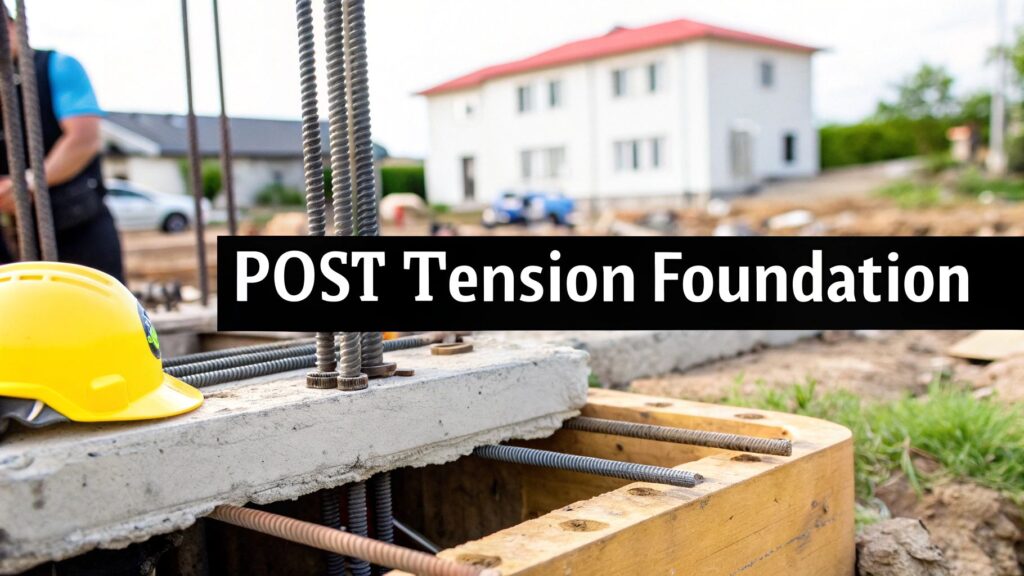
A post tension foundation is a high-performance concrete slab that's actively compressed with high-strength steel cables (we call them tendons) after the concrete has been poured. This process creates an incredible amount of internal strength, making the foundation highly resistant to the cracking and shifting that can plague custom homes built on Southwest Florida's challenging soils.
Imagine squeezing a row of books together on a shelf. If you squeeze them tightly enough, you can lift the entire row as a single, solid beam that won’t fall apart. That's the basic idea behind post-tensioning—it turns the concrete slab into a monolithic, super-strong unit, a critical feature for modern home design in our region.
Understanding This Superior Foundation Technology
When you're building a custom home in Southwest Florida, what's underneath the house is just as important as the design itself. Our region's expansive soils and high water tables create unique challenges that demand a smarter, more advanced engineering solution. This is why understanding what a post tension foundation is becomes so critical for any homeowner building here.
Unlike traditional foundations that just have passive steel rebar sitting inside the concrete for support, a post-tensioned slab is an active system. It's constantly working to hold itself together, making it a leading trend for new home builders focused on resilience.
The process starts by laying out a carefully engineered grid of steel tendons within the formwork before any concrete arrives. Once the concrete is poured and cures to a specific strength, hydraulic jacks are used to pull—or "tension"—these tendons with immense force. This tensioning creates a massive compressive force that squeezes the entire slab together.
For building in places like Cape Coral and Fort Myers, this active compression gives us several huge advantages:
- Superior Crack Resistance: The constant internal compression actively fights against the tensile forces from soil movement that would normally crack a standard foundation.
- Enhanced Strength and Durability: This process makes the concrete significantly stronger, allowing for thinner slabs that can support modern open-concept designs without cracking.
- Long-Term Stability: It creates a rigid, unified platform that resists differential settlement, ensuring your home remains level and stable for decades to come, even through intense storm seasons.
Post-tensioned foundations have been a true game-changer in modern home construction, especially here in Florida. In fact, residential foundations built on expansive soils now account for more than half of all post-tensioning tonnage sold in the U.S. That’s more than buildings, bridges, and all other uses combined, which really highlights how dominant and effective this technology is for building resilient homes.
To get a feel for how post-tensioning fits into the broader world of structural engineering, you can explore different approaches to shallow and deep foundation design. But for our purposes in Florida, this technology isn't just a trend; it's a core element of building resilient, hurricane-ready custom homes.
Post Tension Foundation Vs Traditional Foundation At a Glance
To make the differences even clearer, it helps to see a direct comparison. Homeowners often wonder how this modern approach stacks up against the old-school method of using only rebar.
Here's a simple breakdown of the key distinctions between a post-tension slab and a conventional foundation.
| Feature | Post Tension Foundation | Traditional Foundation (Rebar Only) |
|---|---|---|
| Reinforcement | Active system using high-strength steel tendons under tension. | Passive system using steel rebar for tensile strength. |
| Crack Control | Actively compressed to prevent cracks from forming. | Prone to hairline cracks from soil movement and concrete shrinkage. |
| Strength | Higher strength-to-weight ratio, allowing for thinner slabs. | Requires a thicker slab for comparable strength, adding weight and cost. |
| Soil Suitability | Excellent for expansive or problematic soils, like Florida's. | Less effective at resisting differential soil settlement. |
| Span Capability | Can span longer distances without intermediate supports. | Limited span capability, requiring more support beams. |
| Construction Time | Often faster to install due to less material and formwork. | Can be more time-consuming due to placing extensive rebar grids. |
Ultimately, while traditional rebar foundations have served their purpose, the active reinforcement of a post-tension system offers a far more robust and durable solution specifically designed to handle the pressures of Southwest Florida's unique ground conditions.
The Step-by-Step Post Tension Construction Process
Building a post-tension foundation isn't just a matter of pouring concrete and calling it a day. It's a highly engineered system that transforms a simple slab into a structural powerhouse—something absolutely essential for custom homes here in Southwest Florida. Every single step is critical to creating a foundation that can handle our unique soil conditions and hurricane-prone climate. The entire process is meticulous and demands expert oversight from beginning to end.
It all starts with precise site preparation and building the formwork, which is basically a mold for the foundation. But instead of just laying down a typical grid of rebar, specialized crews install a network of high-strength steel cables, which we call tendons. Each tendon is threaded inside a protective plastic sheath, a crucial detail that lets it move freely later on and keeps it from bonding directly to the wet concrete.
Pouring and Curing The Concrete
Once the web of tendons is laid out exactly to the engineer's specifications, the concrete is poured. This part looks a lot like a traditional pour, but the real difference is what comes next. The concrete has to cure and gain a specific level of compressive strength—usually around 3,000 psi—before the most important step can even start. This waiting period is completely non-negotiable. If you try to tension the cables too soon, you could seriously damage the slab while it's still "green."
If you're interested in the fundamentals of how a solid foundation comes together, you can learn more about the principles of concrete slab construction.
The Tensioning Phase
This is where the real magic happens. After the concrete is properly cured, hydraulic jacks are attached to the ends of each tendon, which stick out from the edge of the slab. Here's how it works:
- Gripping the Tendon: The jack grabs hold of the end of a steel cable.
- Stressing the Cable: It then pulls, or "stresses," the tendon with an incredible amount of force specified by the structural engineer—often hitting over 30,000 pounds of force.
- Anchoring the Tendon: As soon as the right tension is achieved, a special anchor is locked into place, holding that cable in its stretched state permanently.
This sequence is repeated for every single tendon across the entire grid. All that force from the stretched cables puts the whole slab into a state of constant compression, squeezing it together and making it incredibly strong and resistant to cracking. To see how this fits into the bigger picture of a new build, you can explore the details of the Sinclair custom home building process.
The infographic below really breaks down the core components that create this powerful foundation system.
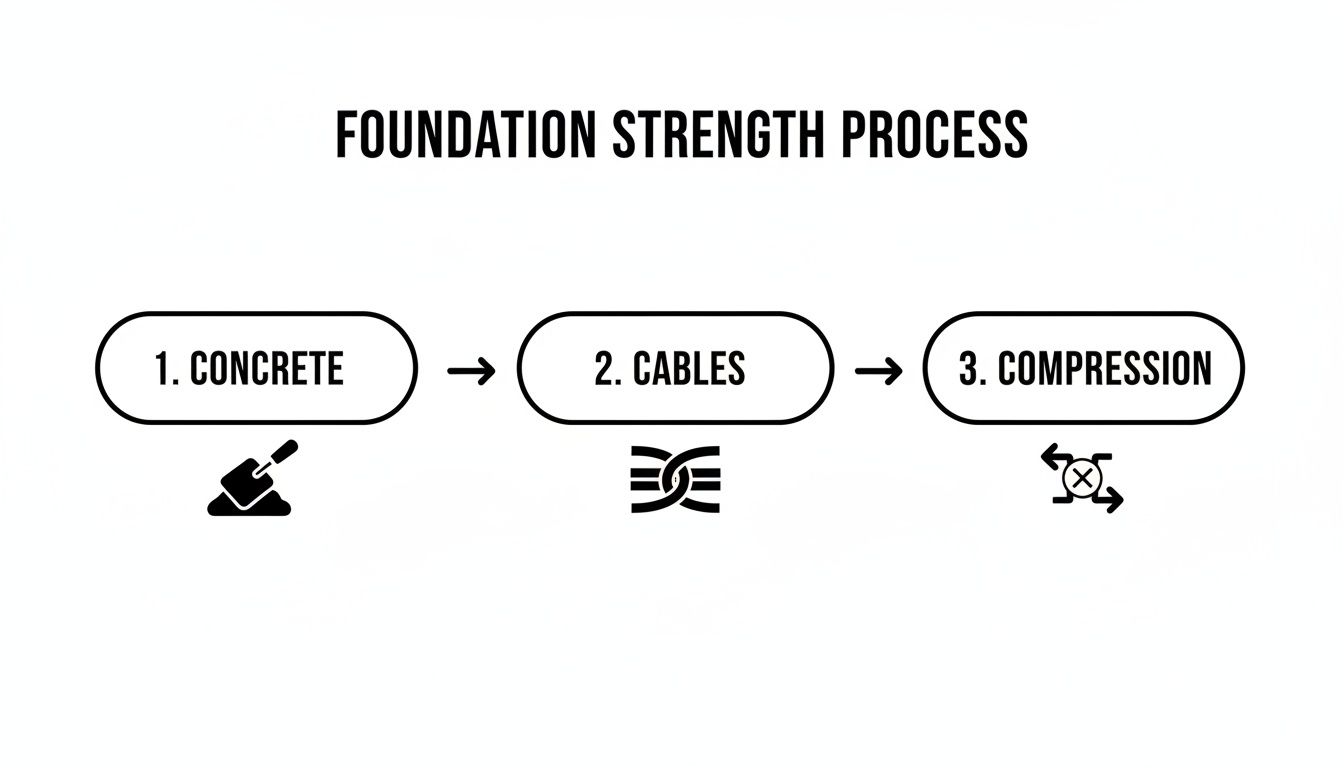

It’s a great visual for understanding how concrete, high-strength cables, and active compression all work in concert to give you a stronger, more resilient foundation. Once all the tensioning is done, the ends of the tendons are trimmed off, and the anchor pockets are filled with grout to protect the entire system for decades to come.
Key Advantages for Building in Southwest Florida

When you decide to build a custom home in Southwest Florida, you’re not just building on land—you’re building on ground that’s alive. Our region is famous for its expansive clay soils, which swell up like a sponge during our rainy season and then shrink dramatically when things get dry. This constant push and pull puts tremendous stress on a standard foundation, often leading to serious cracks and structural headaches down the road.
A post-tension foundation is the smart answer to this problem because it actively fights back against these natural forces. By locking an immense amount of compressive force into the concrete slab, it becomes incredibly resistant to the pulling and stretching that tries to tear it apart. The result? Fewer cracks, less worry, and a much more stable home for years to come.
Unmatched Resistance to Soil Movement
The biggest win for a post-tension foundation in areas like Cape Coral and Fort Myers is its incredible ability to handle what we call "differential settlement." This is what happens when one part of your foundation sinks or shifts more than another—a very common issue here, thanks to our fluctuating water tables and notoriously shifty soil.
A post-tension slab acts like a single, rigid raft floating on the soil. It distributes the weight of your home evenly and refuses to bend or flex, protecting your home’s structural integrity from the ground up.
This isn’t just a small improvement; it's a completely different level of performance. Across the U.S. and especially in Florida, post-tensioned foundations have become the gold standard for building on tricky soils. While a conventional slab might see cracking rates as high as 20-30% within just five years, post-tensioning drops that risk to less than 1%.
For Florida homes battling high water tables, these advanced foundations can cut differential settlement by an incredible 70-80% compared to foundations that only use rebar.
Superior Hurricane and Storm Performance
Beyond solving soil problems, a post-tension foundation gives you a crucial edge in hurricane resilience. During a major storm, a home is hammered by incredible forces, from powerful winds to the destructive power of storm surge and flooding. This is something every Florida homeowner has to take seriously, especially if you’re building in a higher-risk area. It’s always a good idea to check our guide on the Fort Myers flood zone map to understand your property’s elevation requirements.
Because a post-tension slab is compressed and unified, it helps the entire house act as one solid structure. This stability gives it much greater resistance to heavy wind loads and dramatically lowers the risk of damage from waterlogged soil. In a climate where being storm-ready isn't just a suggestion, it's a necessity, a post-tension foundation is a core component of a stronger, safer home that can protect everything from your impact windows to your whole-home generator.
Common Concerns and Potential Disadvantages
While a post-tension foundation is hands-down a superior choice for strength and longevity, it's not a system for the inexperienced. Its high-performance nature demands a high level of expertise from start to finish. This is probably the single most important thing to understand—this isn't a job for amateurs. You absolutely need a builder who has proven, hands-on experience with this technology.
One of the biggest concerns homeowners have revolves around future renovations. What happens if you want to add a new bathroom or move a kitchen island years from now? You can't just take a concrete saw to the floor. Those steel tendons are under thousands of pounds of tension. Accidentally cutting one is incredibly dangerous and can immediately compromise the structural integrity of your entire home. For this reason alone, any work that involves cutting or drilling into the slab is not a DIY project and requires professional oversight.
Specialized Knowledge is Non-Negotiable
This need for deep expertise starts on day one of construction, not just years down the road. When done right, problems are exceedingly rare. But if corners are cut, the issues can be significant.
- Corrosion Risk: Each tendon is housed inside a protective plastic sheath. If that sheath gets nicked or damaged during the concrete pour and moisture finds its way in, it can cause the steel to corrode over time. This weakens the whole system from the inside out, completely hidden from view.
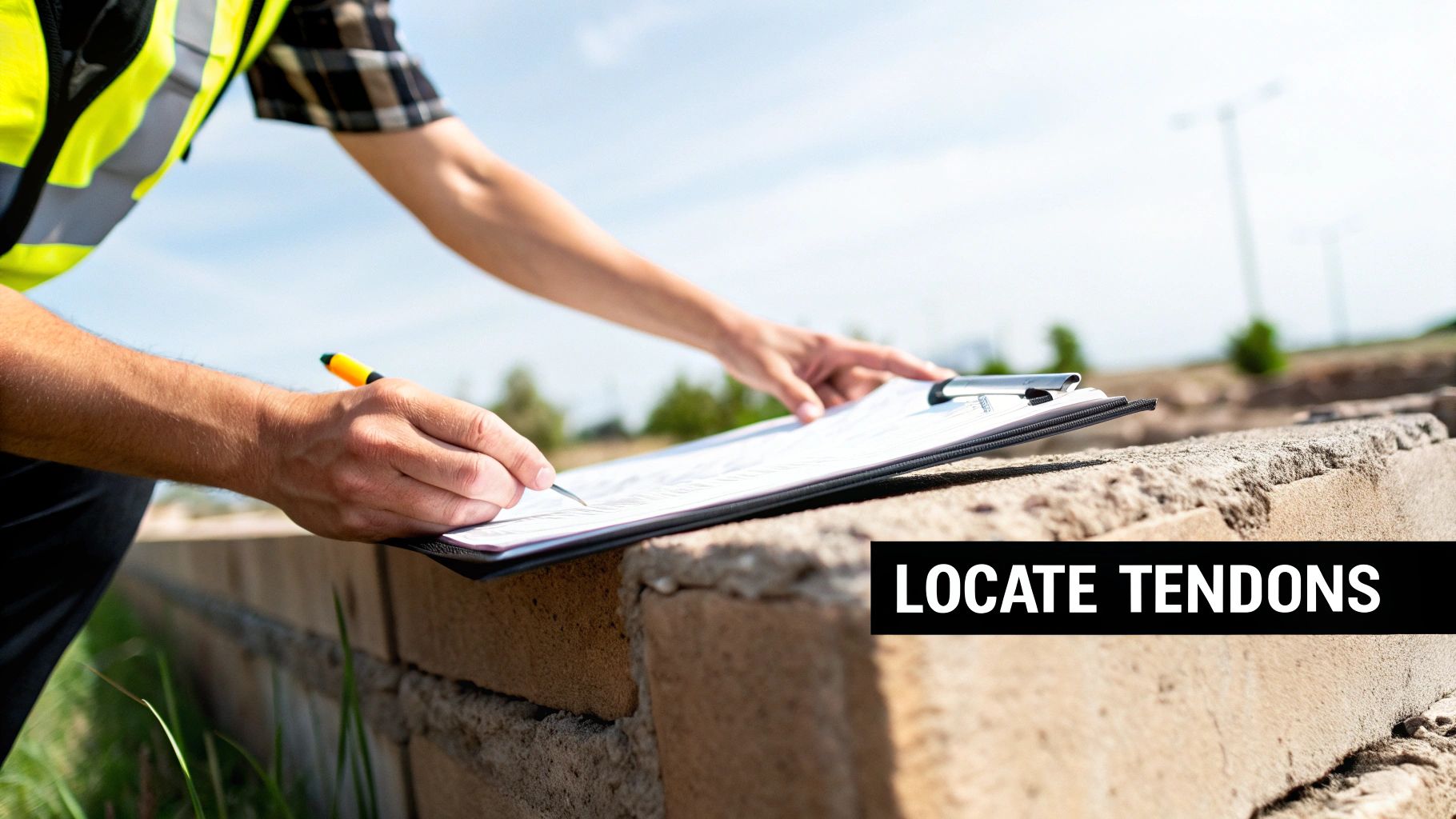
- Documentation is Crucial: A professional, trustworthy builder will give you a stamped engineering plan that shows the exact location of every single tendon in your foundation. Think of it as a roadmap for your slab. This document is non-negotiable and absolutely essential for any future work.
- Renovation Challenges: Without that "roadmap," any plumber or contractor would be flying blind. They'd have to bring in specialized ground-penetrating radar (GPR) to locate the cables before they could even think about drilling. That adds a lot of time, hassle, and expense to what should be a simple project.
At the end of the day, these potential issues all point to one critical truth: the quality of your post-tension foundation is a direct reflection of your builder's expertise and commitment. Choosing a builder who is on-site, who understands this technology inside and out, and who personally supervises the work is the most important decision you'll make. It’s what guarantees a flawless, permanent foundation for your Florida home.
The Proven Legacy of Post Tension Technology
You might think post tensioning is just another modern building trend, but its roots run deep. This is a seriously established technology with a century of engineering success behind it. We're not talking about an experiment here; we're talking about the result of decades of refinement that have made it the gold standard for durable construction, especially in challenging environments like ours in Southwest Florida.
The whole story starts big—not with homes, but with massive public works. The core concept first took shape in the early 20th century, where engineers in Europe were looking for ways to build stronger, more resilient bridges. It worked so well that by the 1950s, it was being used for critical U.S. infrastructure projects, proving its reliability on a grand scale and setting the stage for its jump into the residential world.
From Bridges to Backyards
The real breakthrough for homeowners happened when forward-thinking builders saw its potential for residential foundations. While the history books credit French engineer Eugene Freyssinet back in 1933, its momentum in America really took off after the landmark Walnut Lane Bridge was built in Pennsylvania in 1949.
Since the late 1950s, post-tensioning has become the definitive solution for foundations built on tricky, expansive soils. This is especially true in states like Texas and Florida, where soil pressure can climb as high as 10,000 psf. Think about that. Today, residential foundations consume over 50% of all post-tensioning tendons sold annually in the country. You can dive deeper into the market insights on post-tensioning systems to see just how widespread this technology has become.
This long and proven legacy is exactly why builders who care about quality rely on it. Choosing a post tension foundation for your new home in Cape Coral or Fort Myers isn’t about chasing the latest fad.
It means you are investing in a time-tested, engineered solution that has evolved from building iconic bridges to protecting the single most important structure—your home.
This history of performance gives you real peace of mind. It ensures the structural integrity of your home is built on a foundation of proven strength, giving you a direct answer to the unique geological and weather demands of building here in our beautiful coastal region.
Key Questions to Ask Your Custom Home Builder
Picking a builder for your Florida dream home is a huge decision. But when a post-tension foundation is part of the plan, the stakes are even higher. This isn't just another box to check—it's a highly engineered system that requires genuine, proven expertise. The long-term integrity of your foundation rests squarely on your builder's knowledge and their hands-on supervision.
Asking the right questions will quickly separate the true pros from those who just talk a good game. A builder who really knows post-tension technology will have confident, detailed answers ready to go. Think of this conversation as your most important tool for gauging their commitment to quality and making sure your home is built on a solid, permanent base.
Vetting Your Builder's Post Tension Expertise
When you sit down with a potential builder, have these questions ready. The way they answer will tell you everything you need to know about their process, their quality control, and their real-world experience with what a post tension foundation demands here in Southwest Florida.
Who designs your post-tension systems?
A quality builder will name a licensed structural engineering firm that specializes in post-tension design specifically for our unique local soil conditions. If you get a vague answer or they mention a generic, "one-size-fits-all" plan, that's a massive red flag.What is your quality assurance process during the stressing phase?
An expert will walk you through a detailed, multi-step process. This should absolutely include verifying the concrete's strength with cylinder break tests before any tensioning happens. They should also confirm the engineer of record (or their representative) will be on-site to witness and certify the stressing process and that they meticulously check tendon elongations against the original design specs.How do you document tendon locations for future renovations?
There's only one right answer here: they provide you with a copy of the stamped, as-built engineering plans that show the exact layout of every single tendon. This is a critical document that should stay with your home’s records forever.
A builder’s job isn’t just to build a house; it’s to provide you with the essential information to safely maintain it for a lifetime. Detailed foundation plans are a non-negotiable part of this commitment, ensuring any future work can be done without compromising the home's structural integrity.
Experience That Matters in Southwest Florida
Beyond the technical side, you need a builder who gets the unique challenges of our region. The sandy, expansive soils and high water table in places like Cape Coral and Fort Myers demand a lot more than just textbook knowledge.
Ask them point-blank: "What is your specific experience building with post-tension foundations here in Southwest Florida?"
They should be able to talk about past projects, explain how they adjust their approach based on different soil reports, and describe their methods for protecting the tendon sheathing from damage during the build. This is also a great time to bring up permitting. A builder with deep local roots will navigate local requirements seamlessly, which is key for keeping your project on track. If you want to get a head start, you can learn more about the specifics of the Cape Coral building permits process yourself.
Answering Your Questions About Post Tension Foundations
Building a custom home in Florida naturally brings up a lot of questions, especially about something as important as the foundation. We get it. Here are some straightforward answers to the questions we hear most often about post-tension technology, specifically for homeowners in Southwest Florida.
Can You Cut or Drill into a Post Tension Slab?
The short answer is yes, but this is a job that absolutely must be left to the professionals. Those steel tendons running through the slab are under thousands of pounds of tension. If someone accidentally cuts one, it's not just dangerous—it can seriously compromise the entire foundation.
So, how is it done safely? Specialists use tools like Ground Penetrating Radar (GPR) to map out exactly where every tendon is located before a single hole is drilled. This is why any reputable builder, including us, provides a detailed schematic showing the tendon layout. It’s a crucial safety and maintenance document for your home.
How Does a Post Tension Foundation Handle Hurricanes?
It performs exceptionally well during a storm, which is a non-negotiable feature for any new home in Florida. The foundation is a monolithic slab, actively compressed and held together, which helps the entire house act as one solid, rigid structure.
This design adds incredible stability against hurricane-force winds. It also makes the home far more resistant to the ground shifting that can happen when soil gets saturated from flooding or storm surge. This solid base provides critical support for other hurricane-impact features and ensures that essential systems, like your whole-home generator, remain on a stable platform even during the most severe weather events.
Investing in a post tension foundation is one of the smartest moves you can make to build a home that can stand up to Florida’s hurricane season. It’s a core component of a truly storm-ready design.
Are Post Tension Foundations More Expensive?
Upfront, the cost is often very similar to a conventional foundation, and sometimes just a little more. However, this design is more efficient, often requiring less concrete and steel, which can help offset some of the specialized labor costs.
The real financial win comes in the long run. By drastically reducing the risk of common Florida foundation issues like major cracking and settlement, a post-tension slab saves homeowners from potentially devastating repair bills down the road. It’s simply a smarter, more durable investment for your future.
What Are Signs of a Problem with a Post Tension Foundation?
When installed correctly by an experienced team, problems are very rare. Still, it’s good to know what to look for. The biggest red flags are large structural cracks, especially if one side of the crack is higher than the other (what we call differential settlement).
Another thing to watch for is rust stains bleeding out from the anchor points along the edge of your slab, which could mean a tendon is corroding. While tiny hairline cracks are normal as any concrete cures, these more serious issues warrant an immediate call to a structural engineer.
Building a home with a foundation engineered specifically for Florida’s demanding environment isn’t just a good idea—it’s a necessity. At Sinclair Custom Homes Inc, Matthew Sinclair’s hands-on approach ensures every single post-tension foundation is built with the integrity and quality your family deserves. Start your custom home journey with a builder you can trust.