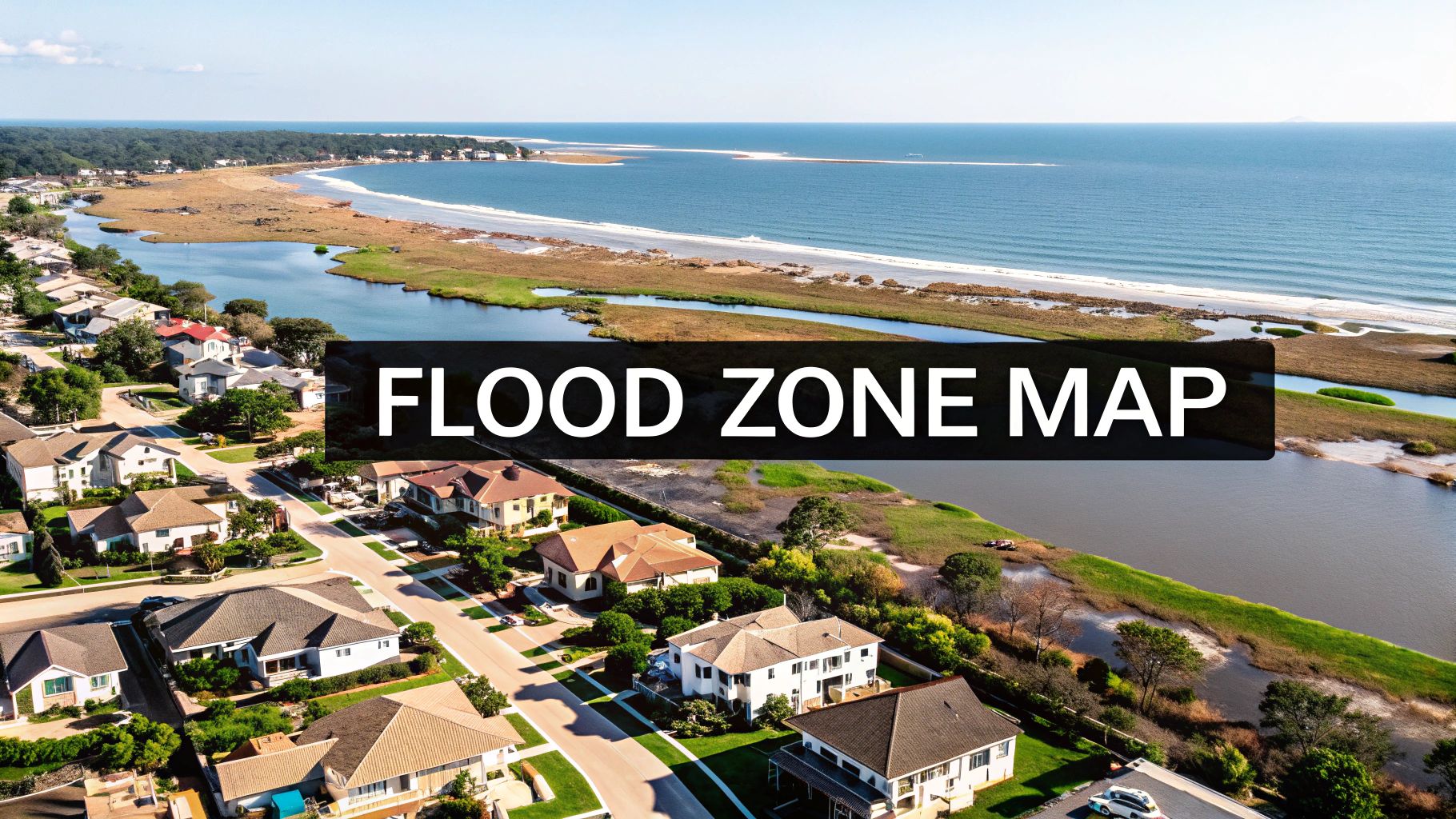
Long before you start dreaming about floor plans and finishes, you need to understand one thing: the Fort Myers flood zone map lays down the law for your entire custom home project. This isn't just about paperwork. It's the absolute foundation for building a safe, insurable, and resilient home in Southwest Florida. Getting this right from the start is the most important first step you can take.
Why Flood Zones Dictate Your Custom Home Build
When you build a custom home in Lee County, the flood zone designation for your specific lot is the true starting point. It directly impacts everything from how high your foundation needs to be (and what it will cost) to the kinds of building materials you're allowed to use, like hurricane-impact windows and reinforced roofing. Overlooking this detail can lead to expensive redesigns, huge insurance headaches, or worse—a home that simply can't stand up to Florida's weather.
The main tool we all rely on is FEMA's Flood Insurance Rate Map, or FIRM. These maps highlight areas that have at least a 1 percent annual chance of flooding. They show which properties are inside a Special Flood Hazard Area, break down the specific risk zones, and establish the Base Flood Elevation (BFE)—the minimum height required for any new construction.
The Real-World Impact on Your Build
For an experienced home builder, a flood zone isn't just a letter on a map. It’s a set of strict, non-negotiable instructions for how we have to build your home.
- Foundation and Elevation: A property in a VE zone (the highest-risk coastal area) demands a robust, and more expensive, deep-pile foundation that elevates the home on stilts. An AE zone, on the other hand, might just require a standard stem wall foundation built up on compacted fill dirt.
- Design and Materials: Your property's BFE determines the absolute lowest point for your finished floor. This decision cascades through your entire design, affecting the look of your home, the design of your entry staircase, and even where critical equipment like your AC unit and whole-home generator can be installed.
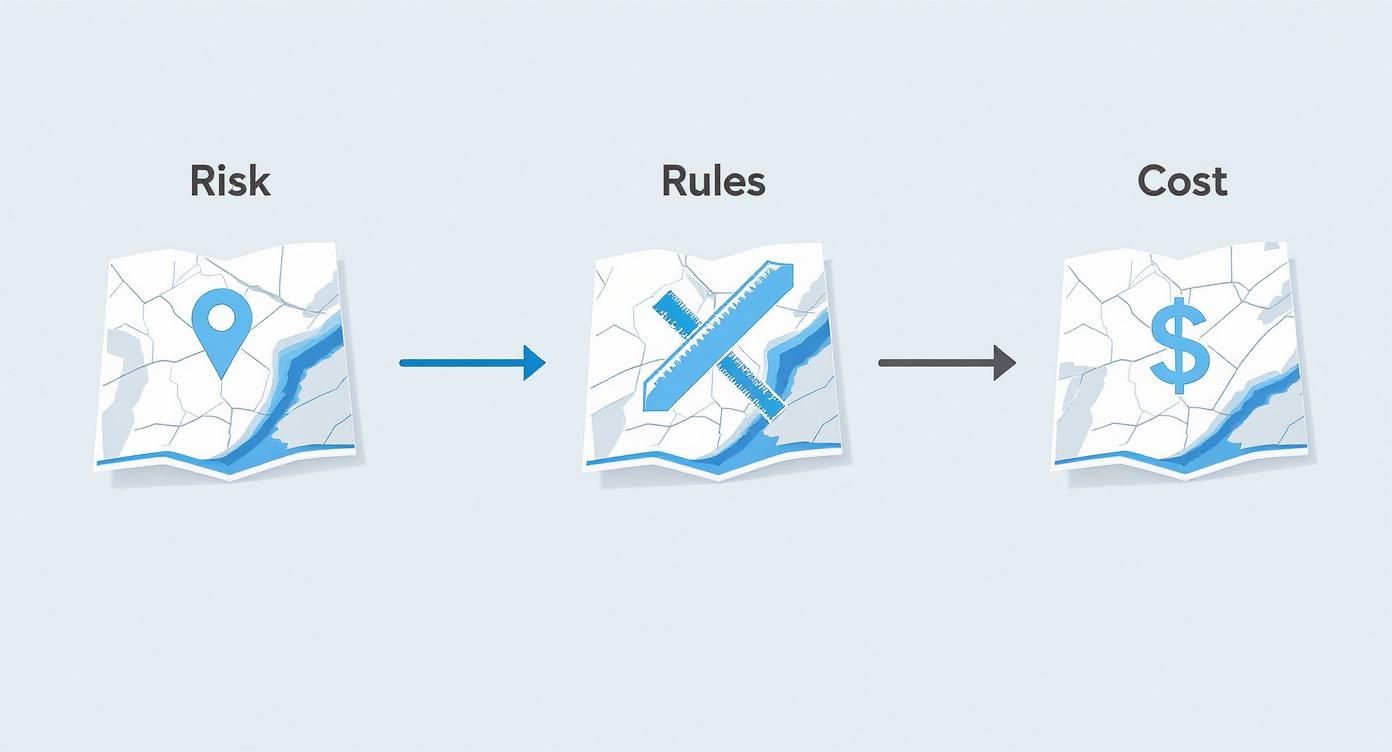
- Cost and Insurance: Yes, building higher usually means more upfront cost for the foundation and site work. But it almost always translates into major long-term savings on flood insurance premiums.
We're seeing a big trend with clients who understand the risks and rewards of building here. They choose to build with "freeboard," which means we intentionally build their home higher than the minimum BFE requires. It adds a critical buffer of safety and can seriously slash insurance costs—a truly smart move in a coastal area.
The Fort Myers flood zone map shapes the entire scope of your project. That's why working with experienced Lee County home builders who live and breathe coastal construction is so critical. We're the ones who translate all that technical data into a practical building plan, making sure your dream home can become a reality in this beautiful—but demanding—environment.
Finding and Reading Your Property's Flood Map Data
Finding your property's official flood designation is one of the first, most important steps in the building process, but it doesn't have to be a headache. For any custom home builder in Southwest Florida, there are two go-to resources: the FEMA Flood Map Service Center and Lee County's own Geographic Information System (GIS) tools. These are the exact online portals we use to pull the data for your piece of land.
Checking a potential property against the official Fort Myers flood zone map is just part of our standard due diligence. Long before we even think about design, we're verifying the zone and that all-important Base Flood Elevation (BFE). That number dictates so much of the build.
Using the Official Map Tools
The FEMA Map Service Center is the national gold standard and the best place to start. You just punch in an address, and it brings up the official Flood Insurance Rate Map (FIRM) for that specific spot.
This screenshot shows you the main search page where you'll kick off your lookup. Lee County also has a more localized GIS tool that often gives us extra property-specific details, which we always cross-reference to make sure we have the full picture.
The accuracy of these maps has come a long way, thanks in large part to technologies like drones and GIS. This tech allows for incredibly precise topographical surveys, which helps inform map updates and our site-specific building plans.
A classic real-world scenario we see all the time is a lot that straddles two different flood zones. When that happens, the building codes are crystal clear: the more restrictive zone's requirements apply to the entire structure. This is a non-negotiable rule that can seriously impact the foundation design and, of course, the budget.
Once we’ve confirmed all this data, we can help you get an official FIRM letter from the county, which is a document lenders almost always require. Whether you're just starting to look at land for sale in Lee County or you've already found the perfect lot, getting this information locked down is absolutely essential.
How Recent Map Updates Reshaped Fort Myers Building Codes
If you think the Fort Myers flood zone map is a set-it-and-forget-it document, think again. It’s a living tool that changes as we get better at understanding storm dynamics. For anyone in the custom home building industry, keeping up with these shifts is everything—they dictate design, materials, and a home's ability to weather a storm.
This became crystal clear on November 17, 2022. On that day, FEMA finally released the results of its massive, multi-year Coastal Risk MAP project. This wasn't just a minor tweak; it was the first major coastal remap for Lee County since 2008, closing a 14-year gap where flood assessment technology had leaped forward.
Armed with advanced storm surge and wave analysis models, FEMA completely redrew the flood lines for our coastal communities and properties lining the Caloosatchee River. The ripple effects for builders and homeowners were immediate and significant. You can get a sense of the project's scale by reviewing the FEMA map changes on Lee County’s website.
New Zones and Stricter Building Standards
The biggest takeaway from the 2022 update was the introduction of new risk categories that expanded into new areas. These reclassifications meant that a property once considered relatively safe might suddenly be facing much tougher building codes. That's a game-changer when you're in the middle of the custom home building process.
Two new designations, in particular, grabbed everyone's attention:
- Coastal A Zone: Think of this as a hybrid zone. While it's officially an AE zone, it's flagged as having the potential for 3-foot or greater breaking waves during a major storm. This means we have to build more like we would in a high-velocity VE zone, often requiring elevated pile foundations instead of just adding fill dirt.
- Limit of Moderate Wave Action (LiMWA): This isn't a flood zone itself but an informational line drawn right on the map. It marks the inland reach of 1.5-foot waves, basically serving as a warning sign of increased risk and pushing us toward stronger building practices, even within a standard AE zone.
For a custom home builder, these new lines on the Fort Myers flood zone map are our new rulebook. We now have to engineer foundations and select materials that can withstand not just rising water, but the destructive force of wave action in areas previously not designated for it.
These map changes are about so much more than insurance premiums. They signal a fundamental shift in how we have to approach coastal construction. By giving us a more accurate picture of the real risks, they empower builders like us to design and construct homes that are genuinely ready for whatever a Southwest Florida hurricane season throws at them. This means elevating generators higher, installing robust hurricane impact windows and doors, and choosing foundation designs that provide superior protection based on the very latest data.
Key Flood Zone Designations in Fort Myers
| Flood Zone | Risk Level | Typical Building Requirement | Flood Insurance Status |
|---|---|---|---|
| Zone VE | High (Coastal) | Elevated on piles or columns; no ground enclosures | Mandatory |
| Coastal A Zone | High (Coastal) | Elevated, often on piles; similar to VE construction | Mandatory |
| Zone AE | High | Elevated on fill or foundation walls; flood openings required | Mandatory |
| Zone X (Shaded) | Moderate | Standard foundation; no specific elevation needed | Optional, but Recommended |
| Zone X (Unshaded) | Low | Standard foundation; no specific elevation needed | Optional |
Understanding these zones is the first step, but applying them correctly to a specific property is where true expertise comes in. It's about building a home that's not just compliant, but genuinely resilient.
Designing a Storm-Ready Custom Home in High-Risk Zones
Building a custom home in a high-risk Fort Myers flood zone, like an AE or VE zone, isn't a setback. Far from it. This is your chance to build a home that's not just beautiful but smarter, stronger, and far more resilient than anything built just a decade ago. It’s where modern, hurricane-impact features stop being luxuries and become essential parts of a superior home.
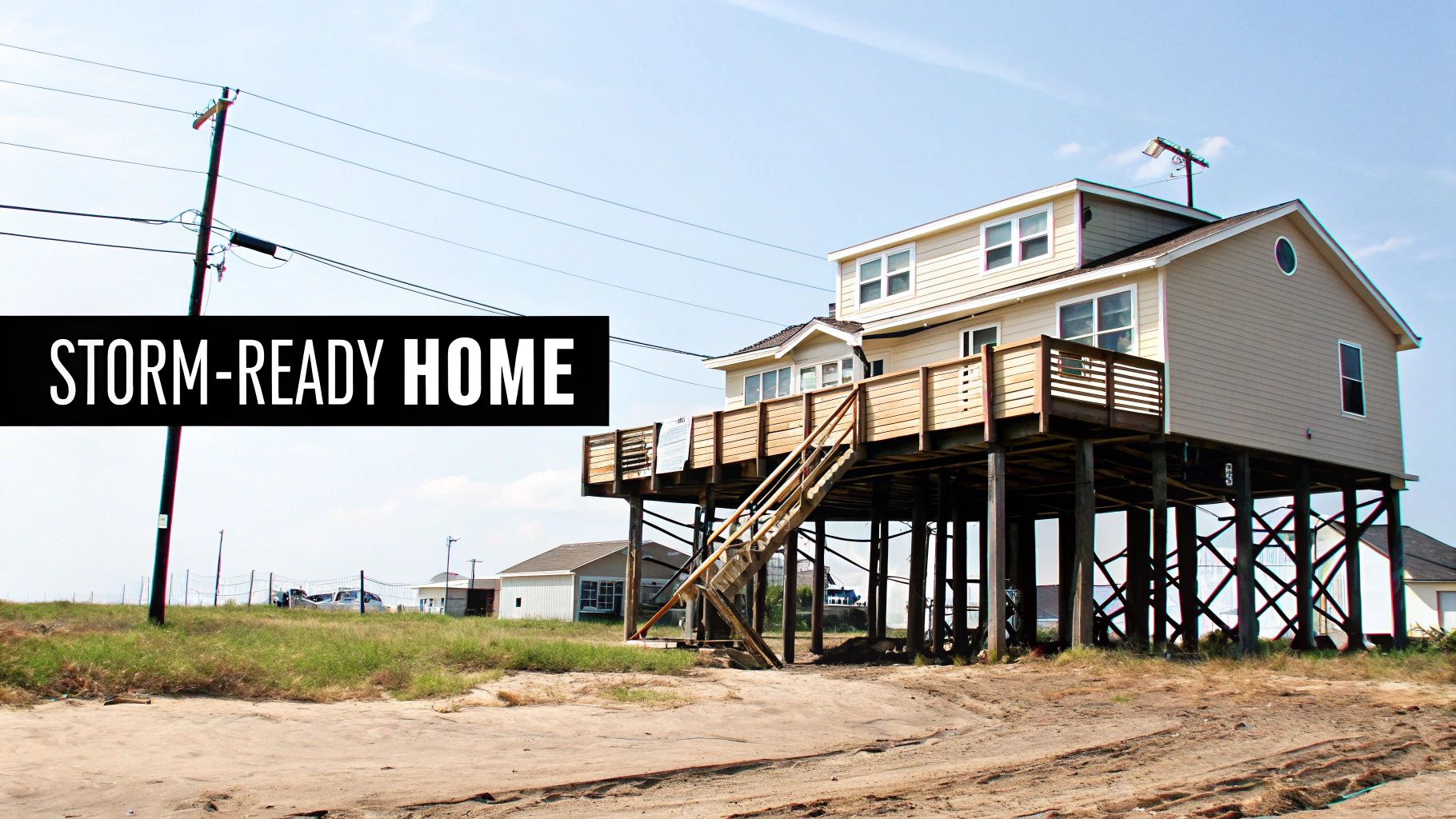
One of the most important concepts we work with is freeboard. Simply put, this means elevating your home’s finished floor above the minimum Base Flood Elevation (BFE) required by the code. Adding even just one or two feet of freeboard gives you a crucial buffer against unexpected storm surge and can slash your flood insurance premiums for years to come.
Choosing the Right Foundation for the Zone
Your home’s foundation is its first line of defense, and the flood zone you're in dictates the entire design. For example, in the high-velocity coastal VE zones, we use deep-driven pile foundations. Think of them as stilts that lift the entire living area safely above any potential wave action. In AE zones, we might use a monolithic slab on compacted fill or a stem wall foundation to get the elevation just right.
But it’s not just about lifting the house—we have to elevate its critical systems, too. This means:
- Placing all HVAC equipment on raised platforms.
- Installing the main electrical panel and outlets well above the BFE.
- Strategically designing the layout so all mechanical systems are shielded from floodwaters.
A critical trend we're seeing—and implementing—is the integration of whole-home generators on their own elevated, storm-rated platforms. After a hurricane, an extended power outage is more than an inconvenience. Having reliable power keeps your family safe and your home running. It’s a forward-thinking feature that’s quickly becoming a must-have in new Southwest Florida builds.
Integrating Hurricane-Ready Features
A modern custom home is a complete system designed to resist storm damage. Every single component has to work together. Impact-rated windows and doors are non-negotiable; they protect against both flying debris and water intrusion. Beyond just the foundation, we can also integrate systems like sump pumps to actively manage any water that gets in. Understanding the advantages of installing a sump pump is key to creating a truly comprehensive defense.
By combining smart elevation with robust, modern building features, you get a custom home that’s not just beautiful, but genuinely ready for whatever Southwest Florida’s weather throws at it.
Your Blueprint for Building a Resilient Florida Home
Once you’ve got a handle on the Fort Myers flood zone maps, you’ve taken the most important first step toward building your dream home the right way. The real key here is to stop seeing this data as a hurdle and start seeing it as your strategic guide to building a home that lasts.
When you know your property’s specific flood zone using the most current FEMA maps, you can design a home that is safe, insurable, and built to withstand whatever Mother Nature throws at it. Of course, turning that map data into smart design choices is where a builder who specializes in coastal construction becomes your most valuable partner.
Smart Investments in Safety and Value
Today’s resilient design features aren't just about meeting code; they're savvy investments in your family's safety and the long-term value of your property.
- Elevated Living Areas: Building above the minimum required elevation isn't just a suggestion—it's a critical safety buffer that can make all the difference.
- Hurricane-Impact Glass: This is non-negotiable in Florida. It’s your first line of defense to protect your home’s envelope from wind-driven rain and debris.
- Robust Backup Power: Integrating whole-home generators, especially on elevated platforms, provides stability and peace of mind during those inevitable extended power outages.
This forward-thinking approach, all rooted in solid flood data from the Fort Myers flood zone map, has become the new benchmark for luxury home building. It’s what ensures a secure and successful building journey in Southwest Florida, protecting your investment for decades.
Your Top Questions About Fort Myers Flood Zones Answered
When you're trying to make sense of the Fort Myers flood zone map, a few key questions always seem to pop up, especially for clients planning a new custom home. Let's clear up some of the most common ones we hear every day.
What Is the Difference Between AE and VE Flood Zones?
Both AE and VE zones are labeled as Special Flood Hazard Areas, meaning they're high-risk, but they are not the same beast. A VE zone, or Velocity Hazard zone, is the big one—it means your property could get hit with storm-driven wave action, not just rising water. You'll find these right on the coast.
Because of that wave threat, building codes are way stricter. We're talking deep-pile foundations to lift the entire home and often breakaway walls on any lower levels.
An AE zone covers areas of inland flooding. You still have to elevate the home above the Base Flood Elevation, but the engineering is different. And if a property happens to sit in both zones? We always have to build the entire home to the tougher VE zone standards. No exceptions.
The most important takeaway is that VE zones require engineering for lateral wave force, not just rising water. This fundamentally changes the foundation design and is a major cost factor in a custom coastal build.
How Does BFE Affect My Custom Home Design?
Think of the Base Flood Elevation (BFE) as the magic number that shapes your entire home design from the ground up. It's the minimum height your lowest finished floor has to sit at.
This single number dictates everything: how high your foundation needs to be, whether your main living space is on the ground floor or elevated, and how we design things like your grand entryway staircase or garage access. It's the starting point for the entire vertical plan of the house.
A smart move we always recommend is building with "freeboard." This just means we intentionally build your home's foundation a foot or more above the required BFE. It's not just for peace of mind against a future storm surge; it can also earn you some serious discounts on your flood insurance premiums.
Can I Build in a Recently Remapped High-Risk Zone?
You absolutely can. Just know that you'll have to follow the newer, more stringent building codes and elevation requirements for that reclassified zone.
The 2022 Fort Myers flood zone map updates pushed a lot of properties into higher-risk categories, which now demand more resilient construction. Any experienced local builder worth their salt is already designing to these higher standards. We're talking about things like elevated generator pads and hurricane-impact windows to make sure your new home is not just compliant, but truly ready for whatever comes its way.
Building a resilient, beautiful home in Southwest Florida begins with understanding the land it's built on. At Sinclair Custom Homes Inc, we translate the technical data of the Fort Myers flood zone map into a blueprint for a safe, strong, and enduring custom home. Start your building journey with an expert who puts quality and integrity first.