

When you’re building a custom home here in Southwest Florida, the discussion about interior walls almost always boils down to a choice between modern efficiency and old-world craft. For the vast majority of our new construction projects, high-performance drywall is the clear winner. It strikes the perfect balance of speed, cost-effectiveness, and the kind of resilience you need for the Florida lifestyle.
Plaster is undeniably beautiful, but it's become a niche choice in new construction. We typically only see it used in specific historical restorations or for one-of-a-kind artisanal feature walls where the budget and timeline aren't the primary concerns.
Choosing Walls for Your Florida Custom Home
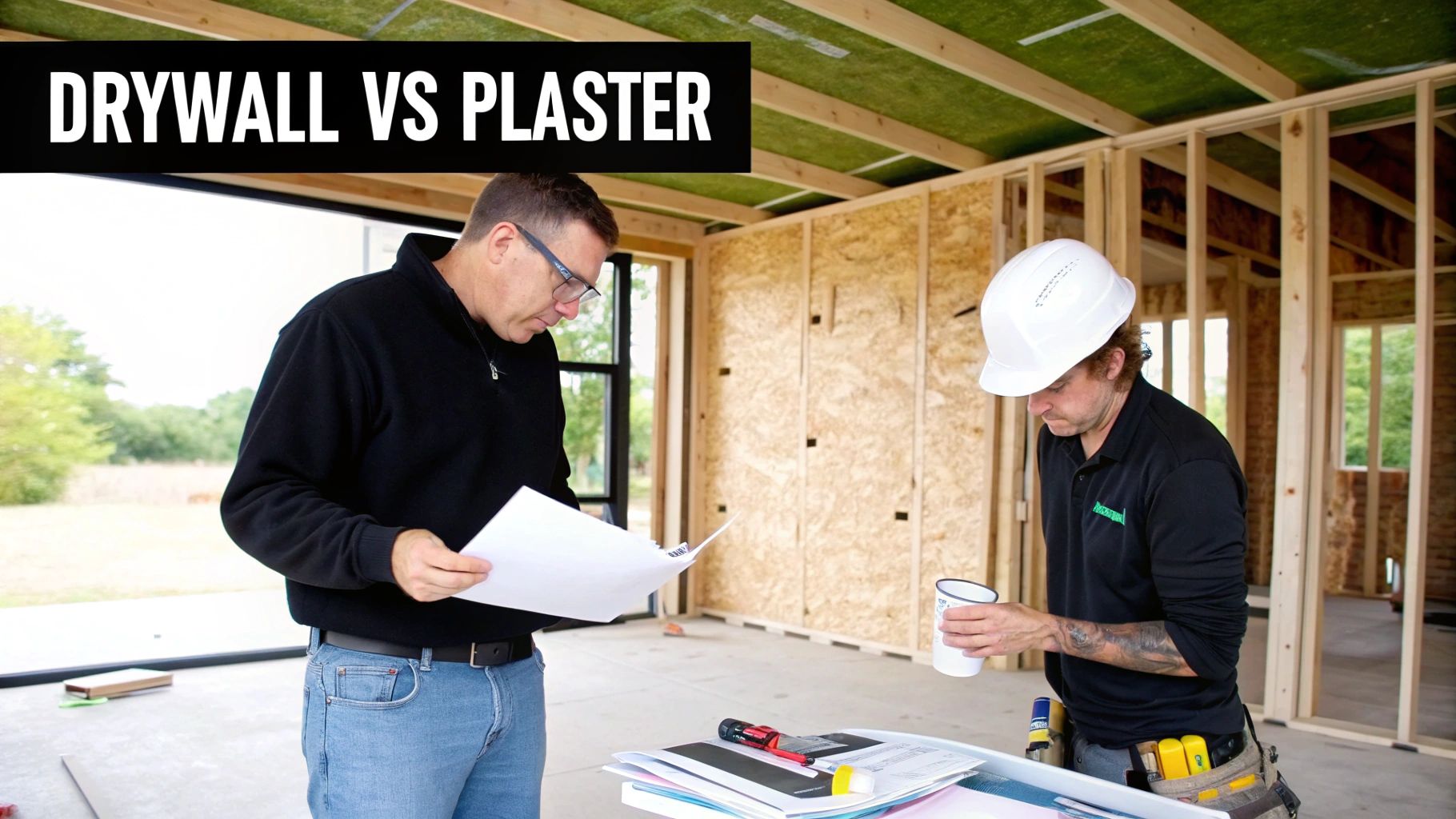
Deciding on your interior wall finish is a bigger deal than most people think. It's a foundational step in the custom home building process that directly impacts your budget, the construction schedule, and how well your home stands up to Florida’s unique challenges—from intense humidity to the threat of hurricanes. While both drywall and plaster can give you a stunning interior, they get there in fundamentally different ways.
Drywall, which you might hear called gypsum board, is the modern standard for good reason. It’s made in a factory as large panels that our crews can install quickly and efficiently. This keeps the project moving and makes labor costs predictable—two huge pluses in any custom home build. Drywall’s popularity completely changed interior construction, replacing the slow, messy, and labor-intensive process of applying wet plaster over lath strips.
Plastering, on the other hand, is a true craft. It requires skilled artisans to apply a wet mixture in several layers, with each layer needing time to cure properly. The process is far more time-consuming and expensive, making it a tough fit for the scale and pace of most new custom homes being built in Southwest Florida today.
Quick Look at Drywall vs Plaster for Florida Homes
To help you see the practical differences for your new home, we've put together a quick comparison. It highlights the key factors that matter most to our clients building in Southwest Florida.
| Factor | Drywall (Modern Standard) | Plaster (Luxury & Niche) |
|---|---|---|
| Installation Speed | Fast; panels are installed quickly | Slow; requires multiple coats and curing time |
| Cost | More affordable due to lower labor costs | Significantly more expensive |
| Hurricane Resilience | Excellent; impact-resistant versions available | Good; very hard but can be brittle |
| Moisture Management | Superior; mold/moisture-resistant boards | Good; naturally breathable but less specialized |
| Repairs | Simple and easy for homeowners or handymen | Complex; requires a skilled artisan to match |
| Best Use Case | New custom homes, modern designs | Historic restorations, artisanal feature walls |
This table makes it easy to see why drywall has become the go-to material. It simply delivers better on the key metrics that are critical for building a strong, reliable, and cost-effective home in our climate.
Getting to Know the Materials
Before we can really get into the weeds of the drywall versus plaster debate, it's important to understand what we're actually talking about. These two aren't just interchangeable wall coverings; their fundamental differences in makeup and installation are what drive everything else—from cost and timeline to how they perform in your Southwest Florida home.
Think of drywall as a manufactured sandwich: a core of gypsum mineral pressed neatly between two thick sheets of paper. This design is all about efficiency. We install large panels directly onto the wall studs, tape the seams where they meet, and then apply a joint compound to smooth it all out. It's a predictable, streamlined process, which is exactly why it has become the gold standard in modern home construction.
Drywall Isn't Just Drywall—Especially in Florida
Now, when we're building in places like Cape Coral or Fort Myers, standard drywall is rarely enough. The unique climate and building codes demand something more robust, which is why we almost always specify upgraded versions for our clients.
- Moisture-Resistant Drywall: You’ll hear this called "green board" or the more modern "purple board." It comes with a special coating designed to block moisture absorption. For bathrooms, laundry rooms, and kitchens in our humid environment, this isn't a luxury—it's a necessity to prevent mold.
- Impact-Resistant Drywall: This is a crucial part of building a hurricane-resilient home. It has a fiberglass mesh integrated into its core, adding serious strength. That reinforcement makes it much harder for flying debris to punch through the wall during a major storm, a critical feature for any new build in a high-velocity hurricane zone.
A high-quality wall finish is more than just the board itself. Proper preparation is key, and that includes choosing the best primer for drywall projects to ensure the final paint job is durable and looks flawless.
The Old-World Craft of Plaster
Plaster is a different beast entirely. It isn’t a pre-made panel we hang up; it's a custom-mixed paste made right on the job site. The recipe is simple—gypsum or cement, sand, and water—but the application is pure craft. A skilled plasterer applies this wet mixture over a backing called a lath, which used to be wood strips but is now typically a metal or gypsum mesh.
A true plaster wall is a solid, monolithic surface built up in several layers. An artisan applies a scratch coat, a brown coat, and a final finish coat, letting each one cure properly. The result is a dense, hard, and completely seamless surface unlike anything else.
This multi-layered, hands-on process is what makes plaster a premium, artisanal choice. It demands a high level of skill and a significantly longer timeline than drywall. Because of that, its use today is often reserved for specific high-end applications or historic restorations, rather than being the go-to for entire custom homes.
Performance in Florida's Climate and Storms
When you're building a custom home here in Southwest Florida, the walls have to do more than just divide rooms. They have to perform. They are a critical line of defense against our unique mix of intense humidity, relentless sun, and the constant threat of hurricanes. So, the question of drywall versus plaster really comes down to how each one holds up to these demanding, day-in-and-day-out conditions.
This comparison gets to the heart of the matter: the engineered, layered system of drywall versus the dense, monolithic nature of plaster.
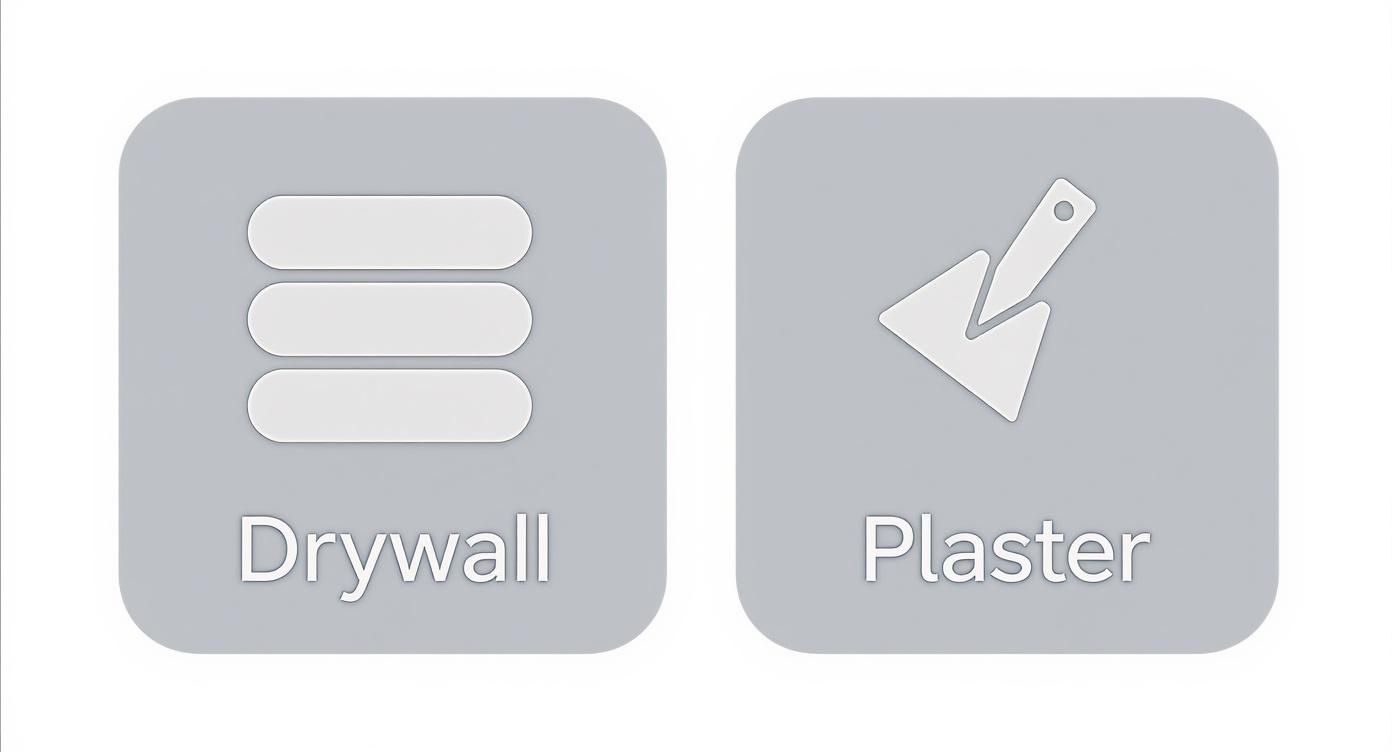
This simple visual shows it all. Drywall is an engineered system, while plaster is a solid, hand-applied material. That single difference is what drives their respective strengths and weaknesses in our climate.
Durability and Hurricane Resilience
In a region defined by hurricane season, impact resistance isn't a luxury; it's a necessity. Traditional plaster is incredibly hard and dense, which is great for resisting everyday bumps and scrapes. But when faced with the extreme force of storm-driven debris, that hardness becomes a liability. The material can become brittle, leading to catastrophic cracking or shattering on impact.
Modern building science, thankfully, has given us a far better tool for this job: impact-resistant drywall. This isn't your standard sheetrock. It's an engineered panel with a fiberglass mesh and a denser core, specifically designed to absorb and distribute the force of an impact without failing. It’s a vital part of a fortified home, providing a tested and reliable defense that plaster's old-school hardness just can't match.
For a new custom home in a high-velocity hurricane zone (HVHZ) like ours, specifying impact-resistant drywall is a modern necessity. It provides an active, engineered solution to storm resilience.
Managing Moisture and Mold
Southwest Florida’s notorious humidity creates the perfect breeding ground for mold. The old-school thinking was that plaster’s natural "breathability" made it better at handling moisture. That’s an outdated view. In a modern, tightly sealed, and air-conditioned home, what you really need is active moisture prevention, not passive breathability. Plaster can absorb airborne moisture, and if that isn't managed perfectly, it can lead to serious problems inside your wall cavity.
Here again, engineered drywall provides the smarter solution. In all high-humidity areas of our homes—bathrooms, laundry rooms, kitchens—we use moisture- and mold-resistant drywall, often called "purple board." This product has a special non-paper facing and a core treated with mold-inhibiting agents. It doesn't just resist moisture; it actively prevents it from penetrating the wall and stops mold growth before it can even start. It’s a targeted, dependable approach designed for exactly the climate we build in.
Acoustic Performance and Soundproofing
There's no denying that the solid, dense nature of a plaster wall gives it fantastic sound-dampening qualities. Its monolithic structure is naturally good at blocking airborne noise from traveling between rooms, which creates a noticeably quieter home. If you're prioritizing acoustic separation for a home office, a nursery, or a home theater, this is a major point in plaster's favor.
However, a popular new builder trend is to use drywall technology to achieve superior soundproofing. By creating specific wall assemblies—using things like double-layered drywall, resilient channels, or purpose-built sound-dampening gypsum boards—we can achieve an exceptionally high Sound Transmission Class (STC) rating. These systems are not only effective but also integrate perfectly with other needs, like fire resistance.
Of course, the insulation inside the wall is a huge part of the equation. You can learn more about how that works in our guide to understanding R-value in insulation. This modern approach allows us to deliver customized acoustic control precisely where you need it most.
Let's break down how these materials stack up head-to-head in our specific environment.
Florida Performance Showdown Drywall vs Plaster
| Performance Metric | Drywall | Plaster |
|---|---|---|
| Hurricane Resilience | Excellent (with impact-resistant panels). Engineered to absorb and distribute force without shattering. The modern standard for HVHZ zones. | Poor. Its hardness becomes brittle under extreme impact, leading to cracking and failure. Not ideal for storm-prone areas. |
| Moisture & Mold | Excellent (with moisture-resistant boards). Actively prevents moisture absorption and inhibits mold growth. Targeted for humid climates. | Fair. Can absorb ambient moisture ("breathes"), which can become a liability in a sealed, air-conditioned Florida home. |
| Acoustic Dampening | Good to Excellent. Standard drywall is decent; specialized systems (double layers, resilient channels) offer superior, customizable soundproofing. | Very Good. Naturally dense and monolithic, providing excellent baseline sound-blocking without special techniques. |
| Durability (Daily Wear) | Good. Standard drywall can dent, but repairs are simple. Impact-resistant versions offer much higher durability. | Excellent. Exceptionally hard and resistant to scrapes, dents, and everyday impacts. Very tough surface. |
As you can see, when it comes to the specific challenges of building in Southwest Florida—namely hurricanes and humidity—engineered drywall solutions consistently outperform traditional plaster.
Analyzing Project Cost and Timelines
When you're building a custom home here in Southwest Florida, every decision comes back to two things: how much it will cost and how long it will take. The drywall vs. plaster debate is a perfect case study. Both can give you a beautiful finish, but the road to get there couldn't be more different in terms of your budget and your move-in date.
Drywall is hands-down the champion of modern construction for one simple reason: efficiency. The material itself is affordable, but the real savings are in the labor. Hanging drywall is a fast, systemized process handled by skilled tradesmen who are readily available. That predictability is a massive advantage for keeping a complex home build on schedule.
Plaster, on the other hand, is a true artisan craft. It requires highly skilled plasterers—a trade that's becoming less common and, as a result, more expensive. The work is slow and deliberate, built up in multiple layers that each need time to properly cure. This drawn-out timeline not only racks up labor costs but can create a logjam for other trades like painters and trim carpenters, risking delays across the entire project.
Cost Breakdown for a 3,000 sq. ft. Custom Home
Let's put some real-world numbers to this. For a typical 3,000-square-foot custom home in the Cape Coral area, the cost gap isn't just noticeable—it's huge.
- Drywall Installation: A professional drywall job, including all materials and a high-level smooth finish, is a predictable and manageable part of your total budget. The entire process is usually wrapped up in a matter of weeks, which keeps labor costs in check.
- Plaster Installation: To finish that same home in traditional three-coat plaster, you could easily be looking at a cost three to five times higher than drywall. Almost all of that increase comes from the specialized, intensive labor and a timeline that can stretch out for months.
This is a serious difference in cost that opens up other opportunities. The money saved by choosing drywall can be put toward other high-impact features that matter in Florida—things like upgraded hurricane impact windows, a whole-home generator for storm security, or luxury design features in the kitchen. Our entire approach to home construction project management is built around finding this kind of value for our clients.
The Market Tells the Story
The construction industry’s move to drywall isn't just a local preference; it’s the global standard, driven by simple economics. The global drywall market was recently valued at around USD 46 billion and continues to grow. This isn't surprising, as demand for time- and cost-effective building materials keeps rising.
For a new custom home in Southwest Florida, the efficiency of drywall translates directly into a faster move-in date and a more manageable budget. This allows you to allocate resources to other critical features without compromising on a luxury finish.
At the end of the day, while plaster has an undeniable old-world character, its high cost and long installation time make it an impractical choice for an entire new build. Drywall gives you that flawless, high-end look while respecting the very real budget and schedule of a modern construction project.
Long-Term Maintenance and Repair Realities
Building a custom home here in Florida is a long-term play. Its real test isn't just the first year, but how it stands up to decades of family life and our unique coastal weather. When you're weighing drywall or plaster, what it takes to keep the walls looking good over the years becomes a huge factor in your real cost of ownership and, frankly, your peace of mind.
This is where drywall really shines. Life happens. A doorknob gets slammed into a wall, a piece of furniture scrapes the corner during a move, or you decide to rearrange the pictures. With drywall, these are minor bumps in the road, not massive projects. Most homeowners can handle patching small dings with a bit of spackle and some touch-up paint. That accessibility is a game-changer for keeping upkeep costs down and your walls looking fresh.
Plaster is a whole different story. Its hard, solid surface is great at shrugging off minor dents, but when a serious crack or hole appears, it’s not a DIY job. Repairing plaster is a true craft.
The Challenge of Plaster Repairs
Fixing plaster is more art than science. A pro has to meticulously match the color, texture, and the specific sheen of the original finish to make the repair disappear. It’s a slow process and costs significantly more than a drywall patch. On top of that, finding a plasterer with that level of skill in Southwest Florida can be tough, which can lead to frustrating delays and even higher bills.
For a modern family home that's going to be lived in—really lived in—the sheer simplicity of drywall repair is a massive practical advantage. It lets you handle the small stuff yourself, saving a lot of money over the long haul.
Total Cost of Ownership
Plaster's initial toughness is definitely appealing, but the potential for expensive, specialized repairs really changes the long-term value conversation. A single, major plaster repair could easily cost more than years of patching up minor dings in drywall.
When you look at the total cost of owning the home, drywall’s blend of solid durability and simple, accessible maintenance makes it the more sensible and budget-friendly choice for today's custom homes. It gives you a worry-free ownership experience, letting you enjoy your home without dreading a complex and expensive wall repair down the line.
The Sinclair Verdict: Our Recommendation for Your Custom Florida Home
After looking at this from every angle—from cost and construction timelines to what holds up best in a hurricane—our recommendation is clear. For new custom homes here in Southwest Florida, high-performance drywall is overwhelmingly the better choice. This isn't about following trends; it's about making a practical, forward-thinking investment in your home.
There's a reason drywall has become the modern standard. It hits that perfect sweet spot of cost-effectiveness, speedy installation, and design freedom. But more importantly, the specialized drywall products available today are engineered to solve the exact problems we face living in Florida.
Why Modern Drywall is Built for Our Climate
Today's engineered drywall isn't just one-size-fits-all. We can specify different types for different areas of your home, giving you targeted protection where you need it most.
- Impact-Resistant Boards: In a hurricane zone, this is non-negotiable. These boards provide a tested, hardened defense against wind-borne debris.
- Moisture and Mold-Resistant Panels: We insist on these for high-humidity areas like kitchens, bathrooms, and laundry rooms. They’re your first line of defense against the dampness that’s a constant in our climate.
This ability to tailor the wall system room by room is what makes drywall the intelligent choice for a resilient, durable, and beautiful Florida home.
We still love plaster. It has a beautiful, artisanal quality that's hard to replicate. But in today's building environment, we see its role shifting. It's now a premium, niche material—perfect for creating a stunning feature wall or for an authentic historical renovation where its unique character justifies the extra time and cost.
Ultimately, choosing drywall gives us a confident path forward for your project. It allows us to deliver the flawless, high-end finish you expect without compromising on the performance your home needs or blowing the budget.
Frequently Asked Questions About Wall Finishes
Choosing between drywall and plaster usually sparks a few important questions. When our clients are building their custom homes here in Southwest Florida, these are the answers we give to help them land on the right decision with confidence.
Can I Get a Perfectly Smooth Luxury Finish with Drywall
Absolutely. We hear this one a lot, and the answer is a resounding yes. A Level 5 drywall finish is the gold standard in the custom home industry for a reason—it creates a flawless, glass-smooth surface that’s impossible to tell apart from traditional smooth plaster.
This is our go-to for luxury homes, especially in rooms with big windows where the light hits just right or when clients want to use high-gloss paints. This is a popular new design feature that gives you that seamless, high-end look without the extra time and expense of old-school plastering.
Which Material Is Better During a Hurricane
While your home’s main structure is its first line of defense, the interior walls do matter. Plaster is dense, but modern building science has given us something far better for our climate: impact-resistant drywall.
This isn't your standard sheetrock; it's an engineered board made specifically to resist being punctured by debris. For any new home in a hurricane-prone area like ours, impact-resistant drywall is the superior, tested choice for a truly resilient building. This is a critical hurricane impact feature for any new build.
Is Plaster Better for Preventing Mold in Florida's Humidity
That's a common myth, and it comes from older ways of building. While old plaster could "breathe," today's materials and construction methods give us a much more reliable way to handle Florida's humidity. We exclusively use specialized moisture- and mold-resistant drywall (you'll often see it called purple or green board) in every high-humidity spot—bathrooms, kitchens, laundry rooms, you name it.
This engineered drywall doesn't just sit there; it actively repels moisture instead of absorbing it. When you pair that with a properly sealed and air-conditioned home, you get superior, predictable protection against mold growth, which is non-negotiable in our climate.
Of course, the wall itself is just the beginning. The final covering you choose also makes a big difference in the look and maintenance of your home. Understanding the nuances between paint versus wallpaper for interior walls can help you pull your entire design vision together.
At Sinclair Custom Homes Inc, we build homes engineered for the Florida lifestyle, combining luxury finishes with resilient construction. Contact us today to start planning your custom home.