If you're exploring the custom home industry in Florida, you've probably seen a wide range of prices for modular construction. On average, the cost for the modular home itself can run anywhere from $100,000 to over $400,000, and that really depends on how custom you want to get.
But that's just the starting line. The price tag on the factory floor is a long way from the final number you'll write on a check, especially when building in the demanding environment of Southwest Florida.
The Real Price of a Florida Modular Home Today
As the cost of traditional, "stick-built" construction keeps creeping up, a lot of folks here in Southwest Florida are giving modular homes a serious look. The idea of a predictable budget and timeline is incredibly appealing, especially with recent news about labor shortages and volatile material costs affecting the custom home industry.
The thing is, you have to look past that initial sticker price to get the full picture. The true, all-in cost is shaped by everything from new design features and finishes you choose to the specific challenges of building a home that can stand up to Florida's unique climate and recent storm experiences.
Key Cost Drivers for Florida Modular Homes
Several big-ticket items will have a major impact on your final budget. These aren't just optional upgrades; they are fundamental parts of building a safe, solid, and legal home in places like Cape Coral and Fort Myers, reflecting new builder trends towards resiliency.
- Customization and Finishes: A standard, off-the-shelf floor plan will keep you on the lower end of the price spectrum. But once you start customizing layouts, adding high-end finishes, and incorporating new design features like multi-panel sliding doors or outdoor kitchens, the price will climb accordingly.
- Your Lot and Site Prep: The piece of land you build on plays a huge role. Costs for clearing trees, grading the land for proper drainage, and pouring the right foundation can add up fast. This is especially true if you're in a flood zone that requires building on an elevated foundation—a critical factor in Southwest Florida.
- Hurricane Impact Features: Building in Florida means building for hurricanes. In high-velocity hurricane zones (HVHZ), features like impact-resistant windows and specially reinforced structures aren't just a good idea—they're required by code, and they come at a premium. News from recent storms has only intensified the focus on building beyond the minimum code.
- Utilities and Permits: Getting hooked up to the local water, sewer, and electrical grids costs money. So does pulling all the right permits from the city or county. These expenses are significant and can vary quite a bit depending on where you're building.
One of the biggest misconceptions we see is that the factory price is the final price. The reality is that once you factor in site work, your foundation, transportation, and hurricane-resistant features, you can easily add 30-50% or more to the base cost of the home itself.
Understanding the Price Tiers
Florida's housing market has a massive inventory of manufactured homes—around 824,400 units in total. The pricing generally breaks down into a few different tiers.
A simple, no-frills modular home might run from $100,000 to $300,000. A more complete, "turnkey" prefab package often lands between $200,000 and $275,000. For a fully custom modular design with premium features, you could be looking at $275,000 to $400,000 or even higher. You can dig into these pricing trends for Florida homebuyers to get a better sense of the market.
To give you a quick snapshot, here’s a general breakdown of what to expect for just the home itself.
Florida Modular Home Cost at a Glance
This table offers a quick look at the typical price ranges for the modular unit based on its size and level of customization.
| Home Type / Size | Prefab / Base Model Price Range | Custom Model Price Range | Average Cost Per Square Foot |
|---|---|---|---|
| Small (Under 1,500 sq ft) | $100,000 – $180,000 | $180,000 – $250,000+ | $90 – $170 |
| Medium (1,500 – 2,500 sq ft) | $180,000 – $250,000 | $250,000 – $350,000+ | $110 – $190 |
| Large (Over 2,500 sq ft) | $250,000 – $300,000+ | $350,000 – $400,000+ | $120 – $210+ |
Just remember, these numbers are for the structure itself. They don't include the cost of your land or any of the other "soft costs" and site work we’ll break down in the next section.
Decoding Your Modular Home Invoice
That initial quote for a modular home? It’s a lot like seeing the price tag on a high-performance engine. It's an impressive and crucial part, sure, but it’s a long way from the full cost of actually getting a car on the road. To really wrap your head around the cost of modular homes in Florida, you have to look past the sticker price from the factory and break down the entire invoice. A real-world budget covers everything from the factory floor to the final coat of paint on your brand-new home in Southwest Florida.
It helps to think of your total investment in two main buckets: the costs to build the house, and the costs to place the house. The first part is pretty simple—it’s what you pay the manufacturer for the physical structure. The second bucket is where budgets can get tricky, because it includes everything needed to prep your land and legally install the home.
The diagram below lays out the typical pricing tiers for the modular unit itself, giving you a solid starting point for your budget.
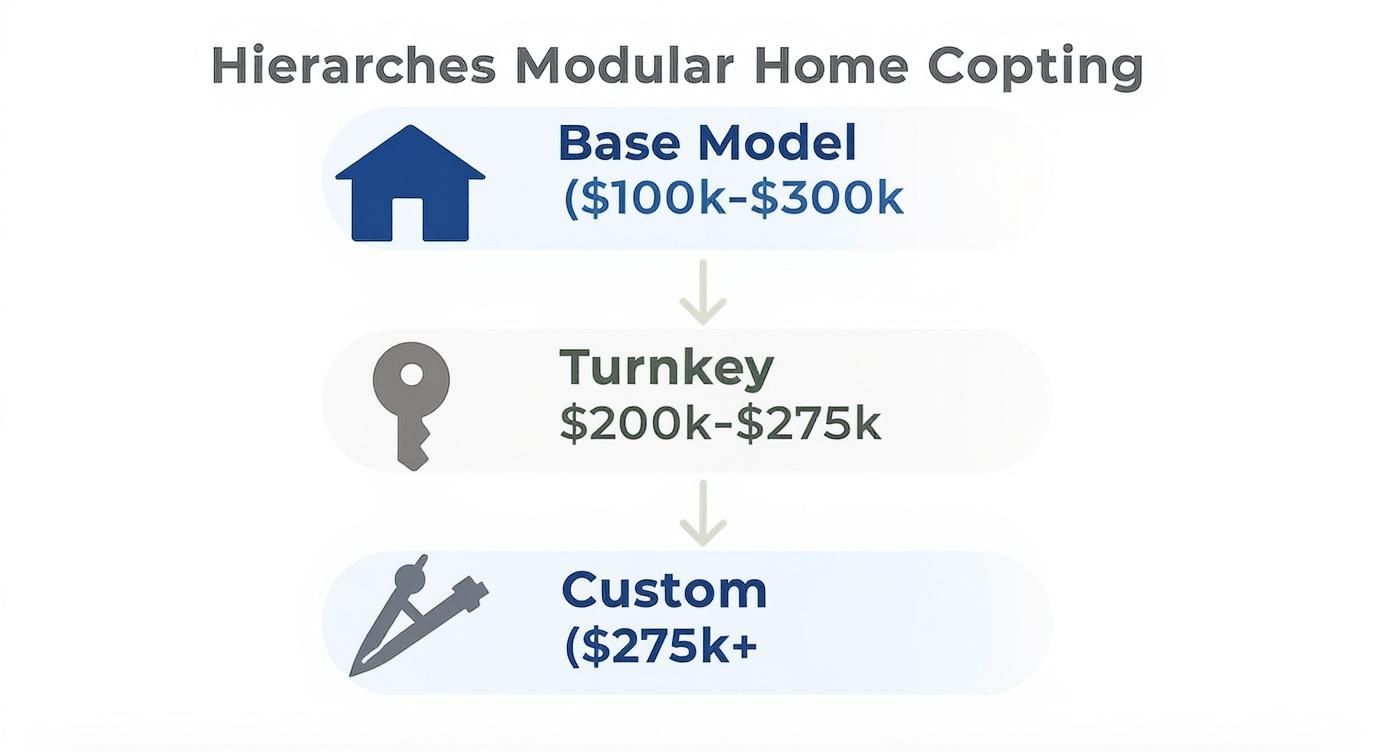
As you can see, the level of customization you choose has a direct line to the initial factory price, and that's before a single shovel hits the dirt on your property.
From Factory to Foundation: The Core Costs
The first big number on your invoice is the base price of the home itself. This covers the actual construction of your modules in a controlled factory setting, which includes all the standard materials, labor, and basic finishes. Keep in mind, what's considered "base" is always changing, reflecting new builder trends. Features that used to be pricey upgrades—like open-concept floor plans, energy-efficient appliances, and smart home tech—are becoming more and more standard in the custom home industry.
Next up is one of the most significant expenses unique to this building method: transportation. Your home's modules are massive, heavy, and need specialized trucks to get them from the factory to your lot in Cape Coral or Fort Myers. Depending on the distance and how many modules you have, this fee can run from a few thousand to well over $10,000.
Once the modules arrive, they need a permanent home. That brings us to site preparation and foundation costs, which typically include:
- Land Clearing and Grading: This means getting rid of trees, leveling the ground, and making sure water drains away from your home properly.
- Foundation Construction: This could be pouring a concrete slab or building a crawl space. For many homes in Florida's flood zones, an elevated foundation is a must.
- Crane and Crew for "The Set": A massive crane is brought in to lift each module off the transport truck and place it perfectly onto the foundation. This critical day is known in the industry as "the set."
The "Soft Costs": Finishing Your Project
With the house now sitting on its foundation, a whole new set of expenses comes into play. These are often called "soft costs"—everything required to turn those assembled modules into a livable, legal, and finished home. This is also the stage where unexpected issues can pop up and throw a wrench in the budget. Knowing how to handle these variables is crucial, and understanding the basics of construction change order management can stop small hiccups from turning into major budget-busters.
Utility hookups are one of the biggest soft costs. This is the process of connecting your home to all the local services:
- Water and Sewer: Tapping into the city lines or, in more rural spots, installing a well and septic system.
- Electricity: Running power from the utility pole to your home's main electrical panel.
- Gas Lines: If you're using natural gas, this involves connecting to the main gas line.
Permits and inspection fees are another line item you can't avoid. Local building authorities have to inspect and sign off on every major phase of the build, from the foundation pour to the final electrical wiring. These fees are your assurance that the home is built to the tough Florida Building Code—especially important for withstanding hurricanes.
Finally, you have all the finishing touches. This is where new design features come to life! It includes building out your decks, porches, and garage; pouring driveways and walkways; and getting your landscaping just right. These are the elements that really tie your home to its Southwest Florida surroundings, transforming a structure built in a factory into a truly finished, personalized residence.
Navigating Southwest Florida Building Costs
Building a new custom home in Southwest Florida is a completely different ballgame than building anywhere else in the country. If you're looking at cities like Cape Coral, Fort Myers, or Naples, you'll quickly find that the standard budget rules just don't apply here. Our beautiful coastal setting and recent news about storm impacts have created a unique set of non-negotiable building requirements that directly shape the final cost of any new home, including modular ones.
The biggest factor driving your budget is the Florida Building Code (FBC), specifically the parts covering High-Velocity Hurricane Zones (HVHZ). This isn't a list of suggestions; it's a set of strict mandates designed to make sure a home is still standing after a major storm. For your wallet, this means required—and often costly—upgrades are simply the price of admission for living in paradise.
Building for the Storm: Hurricane Impact Features
After devastating storms like Hurricane Ian, the conversation within the custom home industry has shifted dramatically. The focus on resilient building is more intense than ever. New builder trends show that clients aren't just meeting the minimum code anymore; they're actively looking for ways to build stronger, safer homes that can weather the next big storm. This has a direct impact on your project's bottom line.
Here are a few key hurricane impact features that will add to the cost:
- Impact-Resistant Windows and Doors: These are engineered to handle high-velocity winds and debris. They're mandatory in HVHZ areas and can easily add $15,000 to $30,000 or more to a project.
- Reinforced Roofing: This means stronger connections, secondary water barriers, and high-wind-rated materials to ensure your roof stays put when it matters most.
- Strengthened Structural Connections: Builders have to use specific straps, clips, and anchoring systems that tie the roof, walls, and foundation together into one solid, tough unit.
These aren't just line items on an invoice. Think of them as critical investments in your family's safety and your home's longevity. Keeping these complex requirements on track without blowing the budget is exactly where excellent home construction project management proves its worth.
Elevation and Flood Zone Considerations
A huge portion of Southwest Florida sits in designated flood zones, which throws another major cost layer into the mix. Building in these spots, especially in coastal areas of Fort Myers Beach and Cape Coral, almost always means elevating the home on stilts, pilings, or an elevated stem wall foundation. This isn't a simple task; it's a complex engineering and construction challenge dictated by the latest news and FEMA map updates.
Building a home on an elevated foundation in a flood zone can easily add $40,000 to $100,000+ to the site prep and foundation costs alone. This all depends on the required height and soil conditions, making it one of the biggest regional cost variables a home buyer will face.
This requirement comes from FEMA regulations and local laws designed to protect homes from storm surge. Yes, it's a major expense. But it's also what makes it possible to get affordable flood insurance and, more importantly, protects your investment from catastrophic water damage. This makes your choice of lot absolutely critical, as its elevation and flood zone will dictate these huge foundational costs from day one.
The Rise of Generators and Energy Resilience
The last few storm seasons have highlighted another new builder trend that affects new build budgets: the demand for whole-home generators. Losing power for days or even weeks during storms is no longer a "what if" scenario; it's a recent memory for many of us. As a result, more buyers see a permanently installed generator not as a luxury, but as a flat-out necessity for living in Southwest Florida.
Putting in a whole-home generator system involves several pieces:
- The generator unit itself
- A concrete pad to sit on
- An automatic transfer switch
- Professional electrical and plumbing hookups (for natural gas or propane)
This push for energy independence adds a significant cost, often ranging from $10,000 to over $25,000. For many in Southwest Florida, though, the peace of mind knowing the A/C, refrigerator, and any medical devices will keep running during a long outage makes it a worthwhile investment. It's a perfect example of how homeowner priorities are shifting toward resilience and self-sufficiency in the face of our unpredictable weather.
Comparing Modular Homes and Custom Built Homes
When you start digging into the cost of modular homes in Florida, you’ll inevitably hit the big question: Are they really cheaper than building a traditional, on-site custom home? The answer isn't a simple yes or no. It’s more of a balancing act between upfront savings and long-term value, between getting in fast and getting exactly the new design features you want.
The biggest draw for modular construction is its efficiency. Think of it like an assembly line for a house. By building the sections in a climate-controlled factory, manufacturers sidestep weather delays, dramatically cut down on material waste, and use their labor force with incredible precision. This factory process is where the cost savings really come from.
Understanding the Cost Difference
The financial upside of a modular home can be pretty appealing at first glance. When you factor everything in—the home itself, the site work, the foundation—you can often see overall savings of 10-25% compared to a stick-built home. The base cost for the factory-built modules can start as low as $50-$100 per square foot, which looks great next to the $150-$250 per square foot that’s common for a conventional build. For a deeper dive, mesocore.com breaks down these modular home cost savings in more detail.
But here in Southwest Florida, that initial price gap can shrink fast. Once you start adding the must-haves for our area—hurricane impact features, elevation for flood zones, and generators for storm resilience—the final price tag starts to look a lot more like a site-built home's.
The Trade-Off Between Speed and Customization
One of the most powerful selling points for modular is the timeline. While your foundation is being poured and cured on your lot in Cape Coral, your home is literally being built at the same time in a factory hundreds of miles away. This parallel process can shave months off a typical construction schedule, which means you get your keys sooner.
The catch? You’re giving up a significant amount of design freedom. You can certainly pick your floor plan and choose your finishes, but you’re always working within a set of constraints. The design has to be something that can be built in boxes, loaded onto a truck, and pieced together with a crane on-site.
For homeowners with a truly unique vision—maybe a dramatic, complex roofline, a two-story great room with a wall of glass, or a design that flows perfectly with an oddly shaped waterfront lot—a custom home offers a level of freedom that modular simply can’t replicate. This is the core of the custom home industry's value.
Resiliency and Long-Term Value in Florida
Let's be clear: the old stigma around "factory-built" homes is outdated. Modern modular homes are built to meet the exact same stringent Florida Building Code as any other house. They are engineered to handle hurricane-force winds. The real difference often comes down to the quality of the on-site work—how the sections are joined, the finishing touches, and, most importantly, the foundation it all sits on.
This is where a hands-on custom home builder has the edge. Being on-site every day allows a builder to oversee every single detail, ensuring the structure is perfectly married to its specific piece of land. This is critical on challenging coastal lots that might need deep pilings or complex foundations to stand strong against storm surge. That kind of meticulous, site-specific construction doesn't just provide peace of mind; it often translates to higher long-term property value.
So, let's put it all side-by-side to make the differences clear.
Modular Home vs. Custom Stick-Built Home Comparison
When you're weighing your options, seeing a direct comparison can help clarify which path aligns best with your goals, budget, and vision for your Florida home.
| Factor | Modular Home | Custom Stick-Built Home |
|---|---|---|
| Initial Cost | Typically 10-25% lower overall cost. | Higher upfront investment due to on-site labor and materials. |
| Build Timeline | Faster; factory construction and site prep happen at the same time. | Longer; construction is sequential and subject to weather delays. |
| Customization | Good, but limited by transportation and factory capabilities. | Virtually unlimited; complete freedom to design and build any vision. |
| Quality Control | Consistent factory quality but can have issues at on-site seams. | Quality is builder-dependent; excellent with a hands-on builder. |
| Site Integration | Standardized designs may not fit unique lots perfectly. | Superior; designed specifically for the land's topography and views. |
| Resiliency | Built to Florida code; strong when properly assembled. | Can be over-engineered for maximum storm and flood resilience. |
| Long-Term Value | Appreciates like a site-built home but may have less perceived value. | Generally holds higher long-term value due to unique design. |
In the end, the choice between modular and custom really boils down to your priorities. If getting into a new home quickly on a predictable budget is your top concern, a modular home is a fantastic option to consider. But for those here in Southwest Florida who want a home that is a true reflection of their vision, built with uncompromising quality and perfectly suited to our coastal lifestyle, a custom-built home is still the gold standard of the custom home industry.
Financing and Insuring Your Florida Home
Let's be honest, figuring out the financial side of building a new home can feel like a project in itself. When you're looking at the cost of modular homes in Florida, locking down the right loan and insurance policy is just as vital as picking out your floor plan. And here in Southwest Florida, the process has its own unique twists, with lenders and insurers keeping a sharp eye on hurricane impact features, elevation, and storm readiness.

Here's some good news right off the bat: because modern modular homes are built to the exact same strict Florida Building Code as any site-built home and are permanently attached to a foundation, they generally qualify for traditional mortgage loans. This is a huge leg up over manufactured or mobile homes, which often get stuck with chattel loans that come with far less attractive terms.
Securing Your Construction Loan
For most new builds, including modular, you'll likely be looking at a construction-to-permanent loan. Think of it as an all-in-one financial tool. It covers all the costs while the house is being built and then, once you get the keys, it seamlessly converts into a standard mortgage. This approach is a lifesaver—one application, one closing, and one set of fees.
To get your modular home financed, it’s crucial to get a handle on the mortgage process, which absolutely includes understanding home appraisals. Lenders are going to want a close look at a few key things:
- Your Financial Health: This means your credit score, income, and debt-to-income ratio. The usual suspects.
- The Project Plan: They'll need to see the detailed blueprints, your contract with the modular manufacturer, and a complete budget for all the on-site work.
- The Final Appraised Value: Before they sign off, an appraiser will estimate what the home will be worth once it's finished. This number is critical for setting the loan amount.
Lenders in Florida are more tuned in to new construction trends than ever before. They see the quality and speed of modern modular building and view these homes as solid, secure investments—especially when they're designed with Florida’s climate in mind.
Insuring Your Home in a High-Risk State
Once you have your financing sorted, the next major hurdle is homeowners insurance. Here in Florida, this isn't a small line item; it's a major part of your monthly budget. Insurers are all about managing risk, and their premiums directly reflect how well a home can stand up to hurricanes and flooding.
The great news is that new homes, whether they're modular or custom-built like ours, have a serious advantage. They are constructed to meet the latest, toughest building codes, which means they come packed with features that insurers love to see—and reward with better rates.
A few key things will heavily influence your insurance premiums:
- Hurricane Mitigation Features: Things like impact-resistant windows, reinforced roofing, and strong structural connections are pretty much non-negotiable if you want affordable insurance.
- Flood Zone Designation: Your property’s specific flood zone and how high your home’s first living floor sits are massively important. A house properly elevated on pilings will cost significantly less to insure against floods.
- Foundation Type: A permanent, reinforced foundation signals to insurers that your home is a stable, durable structure built to last.
- Backup Power: While it might not always give you a direct discount, having a permanently installed whole-home generator can be a big plus. It shows you can prevent secondary damage, like mold from a lack of AC, after a major storm knocks out power.
Trying to get your arms around all the details of storm coverage can feel overwhelming, but it's essential for protecting your investment. For a deeper dive, our guide on how much hurricane insurance costs in Florida can walk you through it: https://www.sinclaircustomhome.com/how-much-is-hurricane-insurance-in-florida/
Properly planning for both financing and insurance from the start ensures your beautiful new Florida home is also a financially sound and well-protected one.
So, What's the Next Step for Your New Florida Home?
You’ve done the hard work of digging into the numbers. Now, it’s time to shift from researcher to decision-maker. Building a new home in Southwest Florida comes down to one thing: weighing what you truly value against what each building method brings to the table. This is where you align your dream with the right path forward in the custom home industry.
Let's quickly recap what drives the final price tag. Remember, the cost is always shaped by your specific piece of land, the level of hurricane protection you need, and the new design features you desire. These are constants, whether you go modular or choose a custom-built home. The real question is, which path gets you to your finish line?
What Are Your Top Priorities?
Is the speed and predictability of a factory-built home what you're after? If getting the keys quickly and having a firm budget are your biggest concerns, a modular home is definitely a strong contender. The process is designed to be efficient, moving you into your new place faster.
But what if your dream involves a one-of-a-kind design? Or maybe you have a tricky coastal lot that demands a home built to fit it perfectly, not the other way around. If you're seeking the lasting value of true, site-specific craftsmanship, then a different approach is calling your name. Complete creative freedom and a home built without a single compromise—that’s the heart of the custom-building experience.
The choice really boils down to what you value most. Is it the rapid assembly and controlled costs of a modular build, or the bespoke design and hands-on artistry of a true custom home?
For those who envision a home that’s a genuine reflection of their life, built to the highest standards of quality and resilience right here in Southwest Florida, the next step becomes clear. The unmatched flexibility and superior quality of a custom-built home are waiting for you.
If you’re ready to turn your unique vision into a beautiful reality, we invite you to connect with a builder who values craftsmanship as much as you do. Reach out to Sinclair Custom Homes to start the conversation about your dream home today.
Common Questions About Florida Modular Homes
When you're looking to build a new home in Florida, you're bound to have questions. Let's tackle some of the most common ones we hear about modular homes in Southwest Florida to give you the clarity you need to make the right decision.
Are Modular Homes Really a Good Investment in Florida?
Yes, a modern modular home is a solid investment, plain and simple. We're not talking about mobile homes here. Modular homes are built to the exact same stringent Florida Building Code as a site-built house and are set on a permanent foundation.
Because of this, they appraise and get financed just like any other piece of traditional real estate, which means they appreciate in value over time. Their built-in resilience to Florida's weather only boosts their long-term appeal and worth.
The numbers really tell the story. While the average new manufactured home sold for $167,000, the statewide average for all homes shot up to $759,500. On a per-square-foot basis, you're looking at around $87 per square foot for manufactured housing versus $166 per square foot for conventional construction—a difference that makes modular a very attractive option for many. Discover more insights about housing trends in 2025.
Can Modular Homes Withstand Florida Hurricanes?
Absolutely. This is a non-negotiable for any home in Southwest Florida, and modular homes are no exception. They must meet the same tough Florida Building Code (FBC) standards as custom stick-built homes, which includes all High-Velocity Hurricane Zone (HVHZ) requirements where they apply.
That means they are engineered from the start with critical storm-ready features:
- Reinforced structural connections
- Impact-resistant windows and doors
- Roofing systems rated for high winds
Once it’s properly assembled on-site and anchored to a solid, elevated foundation, a modular home is every bit as ready for a storm as any other new home.
What Are the Biggest Hidden Costs I Should Plan For?
The biggest surprise for most people comes from the land preparation. That factory price is just for the house itself. You have to budget for a whole separate list of major expenses that can swing wildly depending on your lot in Cape Coral or Fort Myers.
The top "hidden" costs almost always involve site work. This includes land clearing, grading for proper drainage, getting utilities hooked up (water, sewer, electric), and especially the foundation—which can be a massive expense if you're in a flood zone requiring an elevated design. Adding a generator for storm resilience is another significant cost many now consider essential.
Don't forget about permitting and inspection fees, either. They can add up quickly. It is absolutely crucial to get a detailed, itemized estimate that covers everything from the factory floor to the final landscaping to avoid any painful budget shocks down the road.
For those who value unlimited design freedom and a home built with uncompromising quality on their unique Southwest Florida lot, a custom-built home remains the ultimate choice. At Sinclair Custom Homes Inc, we believe in building homes that are a true reflection of our clients' vision, with an on-site focus that ensures superior craftsmanship. If you’re ready to explore a home built without limitations, contact us to start your custom home journey.