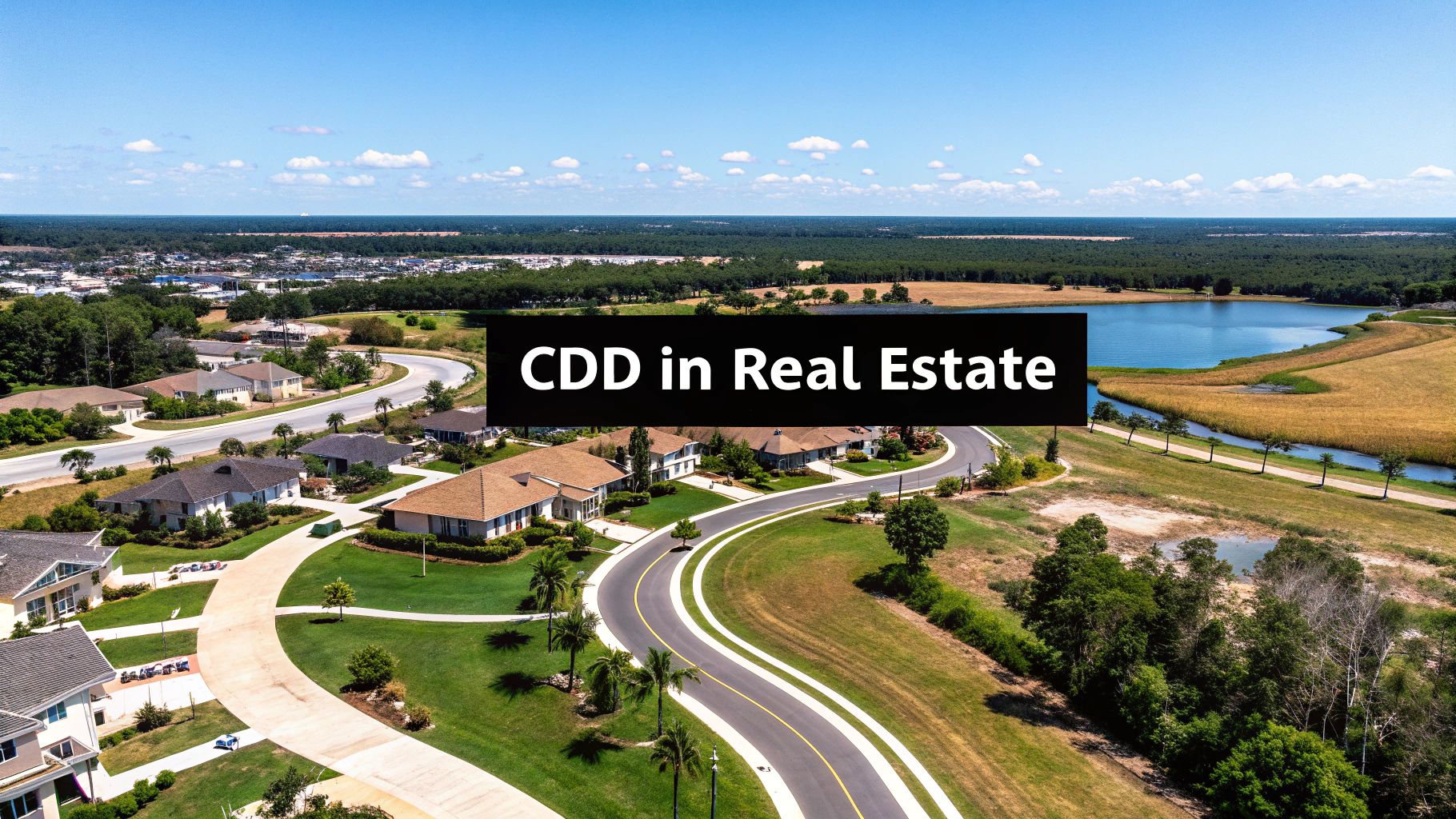
If you’ve ever looked at a property listing in Florida and seen the letters “CDD,” you’re not alone in wondering what they mean. The simplest way to think about a Community Development District (CDD) is as a startup fund for a brand-new neighborhood. It’s the financial tool used to build all the essential infrastructure and incredible amenities that make a new custom home community feel complete from day one.
Defining The CDD In Florida Real Estate
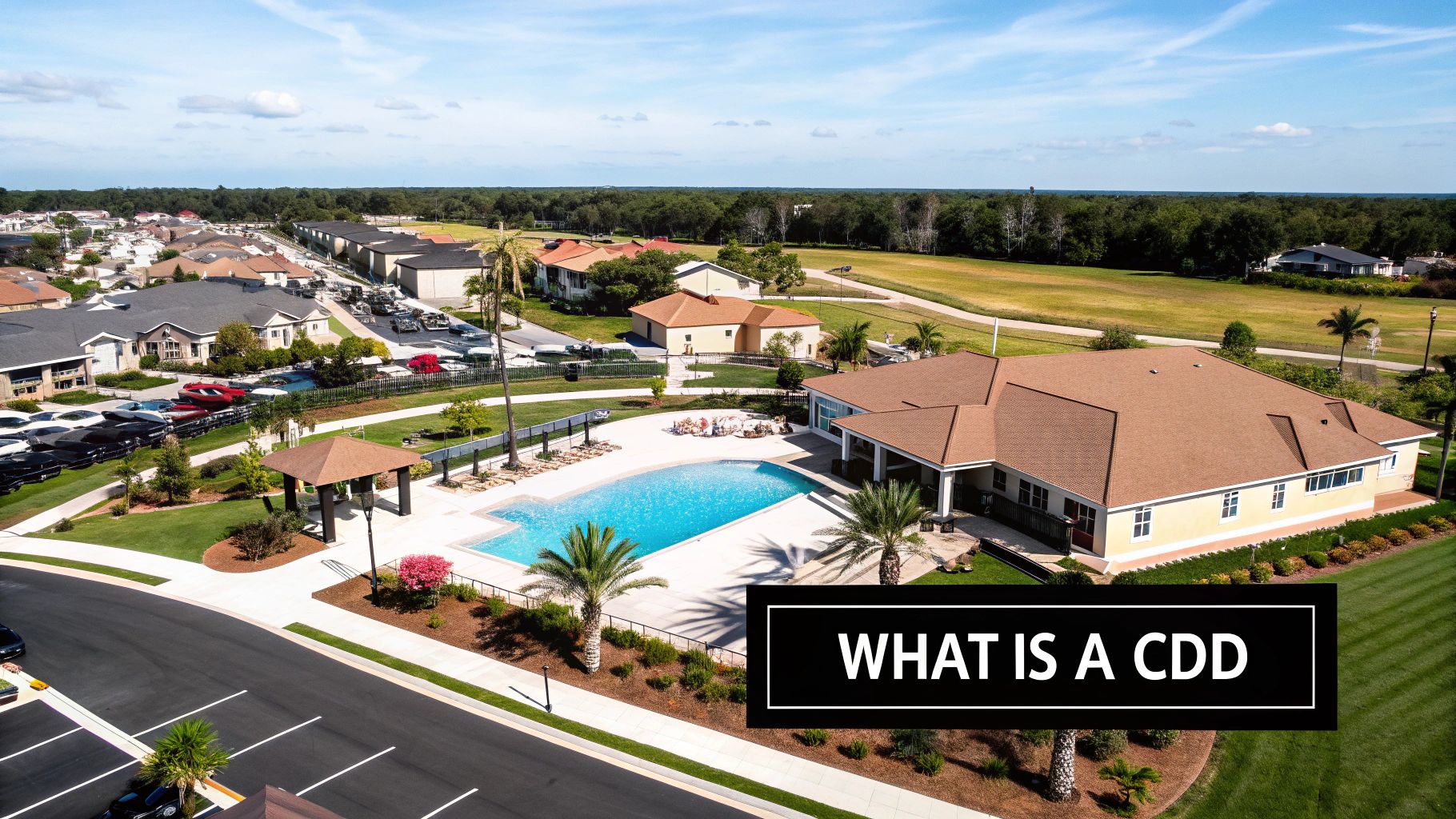
Picture a developer in Southwest Florida with a grand vision for a master-planned community. They’ve got the land, but it’s just that—raw, undeveloped land. Turning that expanse into the beautiful, functional neighborhoods you see across Cape Coral and Fort Myers requires a huge upfront investment. This is precisely where a CDD steps in.
A CDD is a special-purpose unit of local government created to finance, construct, and maintain the core components of a new community. Instead of the developer covering the entire multi-million dollar cost for roads, utilities, and clubhouses and then passing that massive expense onto the first homebuyers through inflated prices, a CDD provides a more structured and transparent way to pay for these projects over time.
The Engine Behind Modern Custom Home Communities
For custom home builders and their clients, a CDD is the financial engine that makes today’s amenity-rich lifestyle possible right from the start. It’s the mechanism that funds the very features that draw people to new construction homes in Florida in the first place, aligning with modern builder trends that emphasize community and lifestyle.
This funding model covers a huge range of elements, from the critical to the purely recreational:
- Essential Infrastructure: Roads, sidewalks, water and sewer lines, and the sophisticated stormwater management systems needed to handle Florida’s unique weather. This often includes building to higher elevations for storm resilience.
- Lifestyle Amenities: Resort-style pools, modern fitness centers, community clubhouses, pickleball courts, and playgrounds that reflect the latest in community design.
- Community Aesthetics: Professionally designed landscaping, irrigation for common areas, and the beautiful green spaces that give a neighborhood its character.
- Hurricane-Ready Features: Increasingly, CDDs fund community-wide resilience features like underground utilities to minimize power outages and robust infrastructure built to withstand hurricane-impact events.
To put it simply, a CDD is a financing tool that lets developers build high-quality, fully-equipped communities without front-loading the enormous initial costs onto the first buyers. This keeps home prices competitive while ensuring residents get to enjoy top-tier amenities from the moment they move in.
Here's a quick breakdown of what a CDD handles:
CDD At-a-Glance
| Component | Simple Explanation |
|---|---|
| Purpose | To finance and manage the infrastructure and amenities for a new community. |
| Funding Mechanism | Sells tax-free municipal bonds to raise money for initial development costs. |
| Governance | Run by a Board of Supervisors, initially appointed by the developer, then elected by residents. |
| Repayment | Homeowners pay back the bonds through an annual assessment on their property tax bill. |
| Maintenance | A separate Operations & Maintenance (O&M) fee covers ongoing upkeep of the community's assets. |
This structure ensures that the people who benefit from the amenities are the ones who pay for them over the long haul.
A Focus On Southwest Florida’s Needs
In coastal areas like Fort Myers and Cape Coral, the infrastructure funded by a CDD is especially important. Things like advanced water management and building to higher elevation standards are crucial for storm resilience in new developments. Features like underground utilities not only look better but also offer much better protection during hurricane season. Some forward-thinking communities are even exploring infrastructure to support whole-house generators during prolonged storm outages.
Ultimately, understanding what a CDD is—and what it does—is the first step to appreciating how today’s most desirable custom home communities are brought to life. It’s not just an extra fee; it’s an investment in the quality, stability, and long-term lifestyle of the entire neighborhood.
How CDDs Turn Dirt Into Premier Southwest Florida Communities
Ever look at a huge, empty stretch of land in Southwest Florida and wonder how it becomes a stunning, amenity-filled neighborhood? It takes a massive upfront investment to build more than just houses. This is where a Community Development District (CDD) comes in—it’s the financial engine behind the premier communities where Sinclair Custom Homes builds.
It all starts when a developer petitions the local government to establish a CDD. This creates a special, independent government body focused on one thing: financing and building the community's essential infrastructure. It’s a clever way to tackle one of the biggest challenges in new development.
Instead of the developer taking out millions in private loans and rolling that cost into the price of every home, the CDD issues tax-exempt municipal bonds. Think of it as the district itself taking out a loan to fund all the big projects right away.
From a Blank Canvas to Your Dream Community
That bond money is what brings a neighborhood to life from day one. It pays for the foundational elements that are non-negotiable in Florida, plus the luxury features that everyone wants.
For our clients at Sinclair Custom Homes, this is how the magic happens behind the scenes. It's the reason a community can offer these incredible features the moment you move in:
- Rock-Solid Infrastructure: This covers professionally engineered roads, storm-ready underground utilities, and sophisticated stormwater systems—all crucial for handling Florida's famous downpours and preventing flooding.
- Resort-Style Living: The bonds fund the beautiful amenities you see, from sparkling pools and modern fitness centers to elegant clubhouses, pickleball courts, and scenic walking trails, reflecting the latest new design features in community planning.
- Beautiful Surroundings: The funding also pays for lush landscaping, irrigation for all the common areas, and the preservation of natural wetlands and green spaces that make the community so beautiful.
Without this system, homebuyers would be looking at much higher home prices, or developers would have to add amenities piece by piece over many years. The CDD makes sure the complete vision for the community is a reality from the start. A perfect example of this in action can be seen by exploring a premier Naples gated community, which showcases the lifestyle made possible by CDD funding.
Who’s in Charge? A Voice for Homeowners
A key feature of a CDD is its governance. A five-member Board of Supervisors manages the district’s operations and budget, ensuring there's accountability and giving residents a real say in their community's future.
In the beginning, the developer appoints the board members to get the project moving and make sure the infrastructure is built to the right standards. But the system is designed to transition to homeowner control.
As more homes are sold, control of the Board of Supervisors gradually shifts from the developer to the residents. Eventually, homeowners elect the board members themselves, giving them a direct voice in how their community is managed and how their money is spent.
This resident-led governance is a huge advantage. It means the people who actually live there are the ones making decisions about maintaining amenities, managing the landscaping budget, and planning for the future. This democratic oversight keeps community standards high for the long haul, protecting property values and the quality of life for every homeowner. A CDD isn't just a financing tool; it’s a framework for building a lasting, resident-controlled community.
Breaking Down the Financial Impact of CDD Fees
For any homebuyer in Southwest Florida, the bottom line is everything. When you're looking at a property in a new community, getting the full financial picture means looking past the mortgage and standard property taxes. A Community Development District (CDD) adds a specific assessment to the mix, and you absolutely need to factor it into your budget to avoid any surprises down the road.
This is especially true if you're planning to build a custom home, where every single cost is mapped out. A CDD fee isn't just one mysterious charge; it's actually made up of two separate parts, each with its own purpose and lifespan.
The infographic below gives you a quick visual of how a developer kicks off a CDD to fund a new community's infrastructure using bonds.
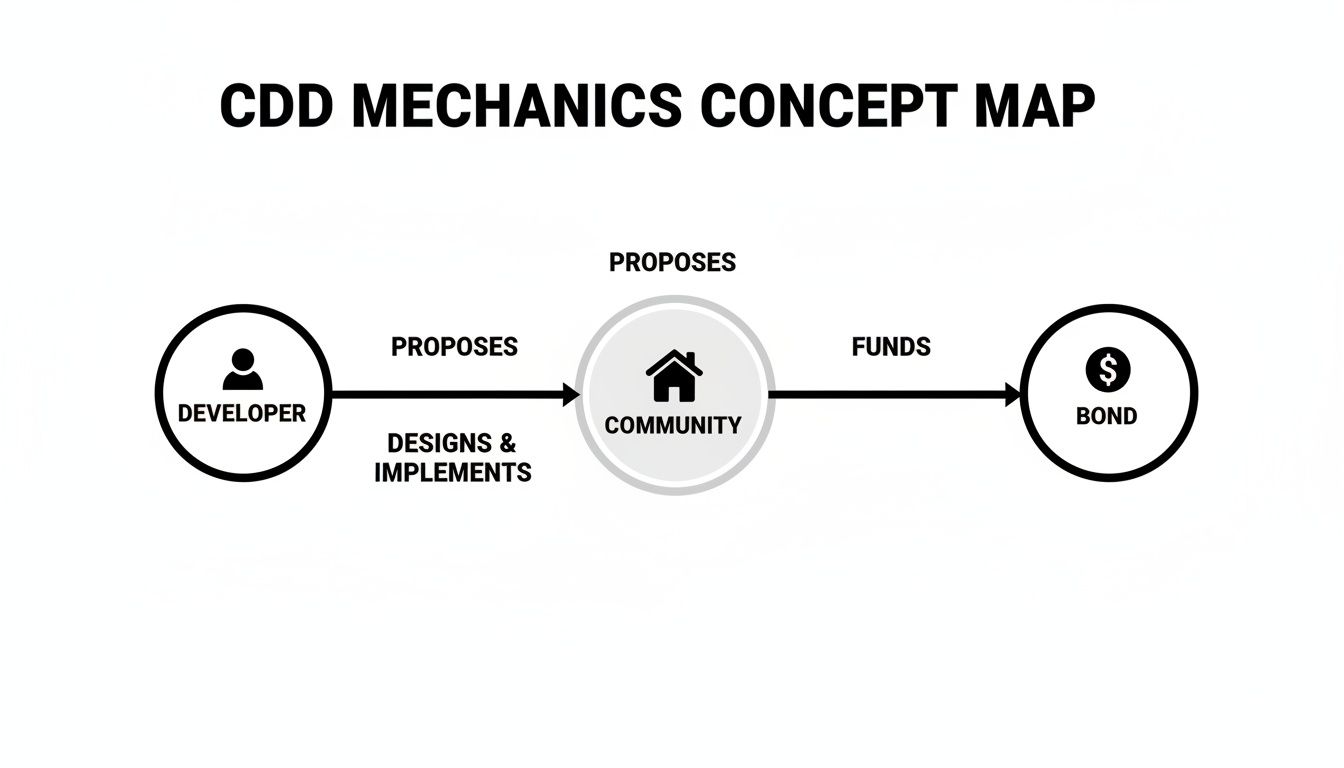
As you can see, the developer's vision gets turned into reality by using bonds to pay for the community's backbone—the roads, pipes, and amenities—which homeowners then pay back over time.
The Bond Portion: The Community Mortgage
The first and usually bigger part of your CDD fee is the bond portion. The easiest way to think of this is as the community’s mortgage. When the developer first established the district, the CDD issued municipal bonds—basically, a type of loan—to raise the millions of dollars needed to build everything from the roads and sewer lines to that beautiful resort-style pool and clubhouse.
Every property in the district is on the hook for paying back a slice of this bond debt. This payment is a fixed annual amount that's spread out over a set term, usually 20 to 30 years.
Here's the key takeaway for homebuyers: this bond portion has a definite end date. Once that bond is paid off, this part of the annual fee vanishes from your tax bill for good.
Many CDDs also give homeowners the choice to pay off their share of the bond debt in one lump sum. This can be a really attractive option if you want to lower your annual costs and own your property free and clear of this particular debt.
Operations and Maintenance: The Forever Fee
The second piece of the puzzle is the Operations & Maintenance (O&M) fee. If the bond is the community mortgage, the O&M fee is like the ongoing subscription service that keeps the neighborhood looking pristine and the amenities running like a well-oiled machine.
This part of the fee is perpetual; it does not have an end date. It covers all the recurring annual costs of managing and maintaining the infrastructure and amenities that the bond originally paid for.
These ongoing expenses cover a whole range of services that are essential for a top-notch community here in Southwest Florida:
- Amenity Upkeep: This keeps the community pool sparkling, the fitness center staffed, and the clubhouse running.
- Landscaping and Groundskeeping: It pays for mowing the common areas, maintaining irrigation systems, and taking care of all the landscaping that gives the neighborhood its curb appeal.
- Infrastructure Maintenance: This covers the upkeep of private roads, stormwater systems, and street lighting—all crucial for storm readiness and proper drainage.
- Administrative Costs: It pays the salaries for the district manager, legal counsel, and other pros who make sure the CDD runs smoothly.
The O&M fee can change a bit from year to year. It's based on the community's annual budget, which is set by the CDD Board of Supervisors in public meetings.
How CDD Fees Show Up on Your Tax Bill
A common point of confusion for buyers is how they actually pay this fee. You will not get a separate bill from the CDD every month or quarter. Instead, the total annual assessment (the bond part + the O&M part) is collected as a non-ad valorem assessment on your annual property tax bill.
This is a critical detail when you're planning your finances. When you're calculating your estimated monthly housing payment—what we often call PITI (Principal, Interest, Taxes, and Insurance)—the CDD fee is rolled into the "T" for taxes. Your mortgage lender will typically escrow these funds right along with your regular property taxes and homeowner's insurance, breaking down the total annual cost into manageable monthly chunks.
Understanding the total cost of ownership is vital. Factoring these fees into your budget from day one helps you accurately compare properties and understand what you're truly investing in. For a bigger picture on budgeting, our guide on the cost to build a house in Florida dives deeper into the overall expenses.
This method of collection is a hallmark of CDDs, which are especially common here. In fact, Florida has one of the largest concentrations of Community Development Districts in the country, making this knowledge absolutely essential for local buyers.
It's also smart to understand how other costs might pop up. Reviewing HOA special assessment rules can give you a good idea of similar financial responsibilities in other types of planned communities. By knowing exactly where to find these numbers and what they mean, you can plan your finances with confidence and make a smart decision on your new custom home.
Weighing the Pros and Cons of a CDD Community
Deciding where to build your custom home in Southwest Florida is a huge decision. It’s about so much more than just the plot of land; you're choosing the entire lifestyle that surrounds your home. When you come across a Community Development District (CDD), you're essentially looking at a trade-off: a higher annual cost in exchange for a potentially higher quality of life. Is it the right fit for your family?
The key is to really understand what you're getting and what you're paying for. CDD communities offer a pretty unique deal, especially if you're looking for that move-in-ready, resort-style vibe to go along with your brand-new custom home. By looking at both sides of the coin, you can make a choice that fits your budget and what you envision for your future.
The Upside: What You Gain with a CDD
For many families, the biggest draw of a CDD is getting instant access to incredible amenities. From the very first day you get the keys to your new Sinclair Custom Home, the whole neighborhood is your playground. You aren’t stuck waiting years for a community pool or fitness center to get built—it’s all there, ready to go, funded by the CDD bonds.
This upfront investment also creates a cohesive, beautifully kept environment that can seriously boost your property's value down the road.
- Resort-Quality Amenities: CDD fees are what pay for the construction and professional management of things like sparkling resort-style pools, modern fitness centers, pickleball courts, and beautiful clubhouses.
- Pristine Common Areas: Those annual fees also ensure that all the landscaping, parks, and grand entryways are kept in perfect condition. It creates a stunning first impression and fantastic curb appeal for the entire community.
- Superior Infrastructure: In Southwest Florida, this is a massive benefit. CDDs often provide advanced stormwater management systems, build lots at a higher elevation for better flood protection, and install underground utilities that are far less vulnerable during a hurricane. These are crucial hurricane-impact features that enhance safety and reduce post-storm headaches.
For our custom home clients, a CDD provides a high-end backdrop that truly elevates the home itself. The quality of your home is matched by the quality of your surroundings, creating a seamless luxury experience from your front door to the community gate.
Building in a CDD means you're not just investing in a house; you're investing in a complete lifestyle package. The amenities and well-kept environment provide an immediate sense of community and can make your custom home feel like a permanent vacation retreat.
The Downside: What to Consider
Of course, all these amazing benefits come at a price. The main drawback of living in a CDD is the extra financial obligation. This fee isn't optional; it's a legal assessment on your property that's collected every year right along with your property taxes, and it's a long-term commitment. You have to be comfortable with this added expense in your budget.
Another point to think about is the community governance. A Board of Supervisors runs the CDD, setting the budget and making the rules for all the common areas. While this is great for maintaining high standards, it can sometimes feel a bit restrictive if the board’s decisions don't quite line up with your personal preferences.
CDD vs Non-CDD Community Living
To make it clearer, here’s a straightforward comparison that breaks down the key differences between living in a community with a CDD and one without.
| Feature | CDD Community | Non-CDD Community |
|---|---|---|
| Amenities | High-end, resort-style amenities are available from day one. | Amenities are often more limited or non-existent unless added privately. |
| Annual Cost | Includes standard property tax, plus the CDD bond and O&M fees. | Typically just includes standard property taxes and maybe an HOA fee. |
| Infrastructure | Professionally managed infrastructure, often built to higher, more storm-resilient standards (e.g., higher elevation, underground utilities). | Infrastructure quality can vary and is maintained by the local municipality. |
| Governance | A CDD Board of Supervisors manages community assets and budgets. | Governance is limited to local city/county rules or a smaller-scale HOA. |
Looking at them side-by-side really helps clarify where your money goes and what kind of lifestyle you can expect in each scenario.
Ultimately, the choice comes down to what you value most. If your vision includes immediate access to incredible amenities, robust infrastructure designed for Florida’s climate, and professionally maintained surroundings, the benefits of a CDD can far outweigh the added cost. As your builder, we act as your knowledgeable partner, helping you transparently weigh these factors to find the perfect setting for your new custom home.
How to Find and Verify CDD Information in Florida
Knowledge is power, especially when you're about to make one of the biggest investments of your life. When you're looking at a home or lot in Southwest Florida, just knowing what a CDD is in real estate is only the first step. You also need to know exactly how to find and verify those fees.
Doing a little homework upfront gives you the complete financial picture before you even think about signing on the dotted line.
Thankfully, finding this information isn't complicated once you know where to look. It’s all public record, made to be transparent for buyers just like you. The trail starts with the property listing and leads to official county resources. This digging is critical—it confirms the annual assessment, shows how many years are left on the bond, and tells you what the ongoing O&M fee covers. Getting these numbers right is key to budgeting your true cost of homeownership.
Start with the MLS Listing
Your first clue will usually be in the Multiple Listing Service (MLS) listing. Real estate agents in Florida are required to disclose if a property is in a CDD. You’ll typically see a "yes/no" checkbox or a field spelling out the annual CDD fee.
Think of this as a great starting point, but always treat it as a preliminary number. You'll want to verify it with an official source. Sometimes, a detailed listing might even break down the fee into its two parts: the bond (debt) and the O&M. This gives you a clearer view of your obligation and which portion of it will eventually end.
Dig Into the County Property Appraiser Website
For the definitive, undeniable truth, your next stop is the website for the county property appraiser where the home is located. In our neck of the woods, that means the Lee County or Charlotte County Property Appraiser sites. These government websites are the gold standard for all things property tax.
Here’s the simple process:
- Search the Property: Find the property search tool on the site and type in the address or parcel ID.
- Find the Tax Bill: Once you pull up the property record, look for a link to the detailed tax bill or tax roll.
- Look for Non-Ad Valorem Assessments: On the tax bill, scroll down to the section labeled “Non-Ad Valorem Assessments.” This is exactly where the CDD fee will be listed, usually identified by the district's name.
This official document lays out the exact assessment for the current tax year. It's the most reliable way to confirm the numbers you saw on the MLS.
When you check the official tax bill, you’re no longer relying on marketing materials—you’re looking at the same government records your lender will use to qualify your loan. This one step removes all the guesswork.
The Sinclair Custom Homes Approach to Transparency
When you partner with Sinclair Custom Homes, you don't have to play detective. We believe building a custom home should be an exciting and transparent journey right from the start, and that begins with picking the perfect lot.
For any lot you're considering within a CDD, our team provides all the documentation and fee breakdowns upfront. We make sure you see the complete financial picture and understand how the CDD fits into the total investment in your new home.
This commitment to clarity is part of our promise to you—just as important as nailing down your project's timeline. You can learn more about the administrative side of building in our guide to navigating Cape Coral building permits. Our goal is to empower you to make a confident, informed decision that perfectly suits your family's budget and lifestyle, ensuring there are no surprises when we break ground on your dream home.
Building Your Custom Home with Florida CDDs in Mind
Deciding where to build your custom home in Southwest Florida goes way beyond the lot size. You're choosing a community, a financial setup, and ultimately, a lifestyle that needs to mesh perfectly with your family's vision. Seeing the choice between a Community Development District (CDD) and a private lot isn't a problem to be solved—it's a chance to intentionally design the life you want to live.
This is where a good builder becomes your most trusted advisor. Here at Sinclair Custom Homes, we make it our job to walk you through the real-world trade-offs. A CDD community can offer an incredible, turnkey lifestyle with resort-style amenities and pristine grounds, all neatly packaged into the CDD assessment. On the other hand, a private lot gives you total autonomy and no CDD fee, but you're on the hook for creating and maintaining your own slice of paradise.
Our entire process is about giving you complete clarity on these options. We want you to feel confident in a choice that truly fits your family’s daily life and financial comfort zone. The conversation always starts with what you value most.
Aligning Your Vision with the Right Location
To get this right, you have to think about what "home" really means to you. Is it having a beautiful community pool and a state-of-the-art gym just a short walk from your front door? Or is it the unmatched privacy and creative freedom that comes with a larger property that has no deed restrictions?
Let's break it down with a few key questions:
- What's Your Lifestyle? Are you looking for built-in social circles and ready-to-use recreational facilities, or would you rather design your own private oasis with a custom pool and unique landscaping?
- What's Your Financial Comfort Zone? Does the predictability of an annual CDD assessment for professional management and amazing amenities sound good? Or do you prefer a lower tax bill and handling any upkeep on your own terms?
- How Important is Storm Readiness? It's a real factor here. Many newer CDDs are engineered with modern infrastructure, like superior drainage systems, lots built to a higher elevation, and underground utilities that can make a huge difference during a storm. These are key hurricane-impact features that savvy buyers now look for.
The right choice is always a personal one. It’s all about creating that perfect harmony between the custom home you've designed and the community that surrounds it. That's how you ensure your dream home is built in a place you'll love for years to come.
Your Partner in Building a Lasting Legacy
At the end of the day, understanding what a CDD is in Florida real estate is about making a smart, informed investment in your family's future. Getting a handle on the specific rules and assessment costs is a non-negotiable part of the custom home journey here. If you're looking to dive deeper into the financial side, you can discover more insights about down payments on National Mortgage Professional.
At Sinclair Custom Homes, we’re more than just builders; we’re your partners through every single step, from picking the perfect lot to that final, exciting walkthrough. Our goal is simple: give you the straightforward expertise you need to build your masterpiece in a community that feels like it was made just for you. We help you look past the spreadsheets to see the lifestyle your new home will unlock.
Your Top CDD Questions Answered
When you're looking at building a custom home in Southwest Florida, the topic of Community Development Districts often brings up a few key questions. We hear them all the time from homebuyers, so let's clear the air on the most common ones.
Is a CDD Fee the Same as an HOA Fee?
That’s a great question, and the short answer is no, they're two different things—though you'll often find both in the same master-planned community.
Think of it like this: The CDD fee is like a government-level assessment. It’s what pays for the big-ticket infrastructure that makes a community possible in the first place—the main roads, the massive water management systems, and the major amenities like the community clubhouse, pools, and tennis courts.
On the other hand, the HOA fee is a private fee paid to your neighborhood's association. Its job is much more localized. It covers things like enforcing community rules (keeping lawns tidy, for example) and maintaining smaller assets that are specific to your little corner of the development.
Can I Pay Off My CDD Bond Early?
Yes, in most situations, you absolutely can. Homeowners usually have the choice to pay off the "bond" portion of their CDD—that's the debt part—in one lump sum. A lot of people do this to lower their yearly property tax bill.
Once it's paid off, that specific assessment is gone from your annual taxes for good. Just remember, you’ll still have to pay the Operations & Maintenance (O&M) part of the fee. That piece never goes away because it covers the ongoing costs of keeping the community amenities looking and working great.
Do All New Florida Communities Have CDDs?
Not at all. While CDDs are definitely a fixture in many of the large, amenity-loaded communities you see across Southwest Florida, they aren't a given. It all comes down to how the developer decided to finance the infrastructure.
You’ll find that many custom homes built on private, non-deeded lots or within smaller, more intimate developments don't have a CDD at all. This is a crucial detail to nail down when you're searching for that perfect piece of land for your new home.
Building your dream home is about understanding every piece of the puzzle, and that's where we come in. At Sinclair Custom Homes Inc, we pride ourselves on giving you the straightforward answers and expert guidance you need to feel confident in your choices. Explore our process and see the quality we bring to every build.