

One of the biggest perks of owning a saltwater pool is how much simpler the maintenance is compared to a traditional chlorine pool. Instead of constantly handling chemicals, a salt chlorine generator does the heavy lifting, creating a slow and steady supply of sanitizer. The result is a smoother, more comfortable swimming experience with far less hassle. For owners of custom homes, this automated system is a fantastic way to protect your investment, ensuring consistent water quality with minimal day-to-day effort, a trend we see gaining momentum in the Southwest Florida building industry.
The Sinclair Custom Homes Approach to Pool Care
Here in Southwest Florida, a saltwater pool isn't just an extra—it's become a cornerstone of the modern luxury lifestyle. Across Cape Coral and Fort Myers, these systems are now a standard feature in high-end custom homes, evolving from a trend into an expectation for new builds. It's easy to see why. The water feels noticeably softer and silkier on your skin, without the harshness and smell often associated with traditional chlorine.
This isn't just a local building preference; it reflects a major shift in the entire pool industry. Saltwater systems are one of the fastest-growing segments of pool care worldwide, changing how homeowners think about chemicals, labor, and long-term costs. In fact, the global pool cleaning market is projected to hit $45.5 billion by 2032, with industry analysts pointing directly to the "growing preference for saltwater pools" as a key driver. For anyone building a custom home in our area, this confirms that a saltwater system is a smart, mainstream upgrade backed by solid industry data.
Protecting Your High-End Investment
Keeping up with your saltwater pool is about much more than just having clear water; it's about protecting a significant asset integral to your custom home's design. Your pool is a central part of your home’s value and aesthetic. Letting the care slip can lead to expensive damage, especially with high-end finishes like PebbleTec, custom tile work, and premium coping that are popular design features in new Florida homes.
A well-maintained saltwater pool does more than provide a superior swimming experience—it preserves the craftsmanship and materials that define a Sinclair Custom Home. Consistent care is the simplest way to protect its long-term beauty and functionality.
Our philosophy centers on proactive, simplified routines that are specifically tailored for the demanding Southwest Florida climate. We believe managing your pool should be straightforward, letting you enjoy your personal oasis without it becoming a constant chore. This guide will walk you through the essential practices to keep your pool pristine year-round, from routine chemical checks to getting ready for hurricane season. Our hands-on experience in swimming pool construction in Cape Coral, FL, gives us direct insight into what these systems need to perform at their best.
Mastering Your Pool's Water Chemistry
The real magic of a saltwater pool isn't just the salt itself—it's the perfect harmony of all the chemical components working together. Your salt chlorine generator is a fantastic piece of tech that handles the heavy lifting of sanitation, but it doesn't manage the whole show. Getting a handle on your pool's overall water chemistry is absolutely crucial for protecting the beautiful finishes and high-end equipment in your custom Florida home.
Here in Southwest Florida, this balance is constantly under attack from intense sun, torrential downpours, and relentless humidity. If you let the other chemical levels slip, you're setting yourself up for cloudy water, frustrating algae blooms, and even permanent damage to your PebbleTec surfaces, tile, and plumbing—all key design features. It might seem like a delicate dance at first, but once you know the key players, it’s surprisingly simple to manage.
Beyond Salt: The Core Chemical Trio
While your chlorinator is busy making sanitizer, three other measurements create the foundation for stable, crystal-clear water. Think of them as the support crew that lets your salt system do its job effectively. Nail these, and you'll sidestep most common pool problems before they even start.
-
Total Alkalinity (TA): This is your pH's bodyguard. In Florida, a sudden afternoon thunderstorm can send your pH on a rollercoaster ride. Proper alkalinity, kept between 80-120 ppm, acts as a buffer, absorbing these jolts and stopping the water from becoming too acidic or basic. This is what protects your pool surfaces and expensive equipment from getting eaten away by corrosion or caked in scale.
-
pH Level: This is simply a measure of how acidic or basic your water is. You're aiming for a very specific sweet spot: 7.4 to 7.6. If the pH creeps too high, your chlorine loses its punch, and you’ll likely see cloudy water or ugly calcium scaling. If it drops too low, the water turns acidic, which stings swimmers' eyes and skin and starts corroding metal parts like your handrails and heater.
-
Calcium Hardness (CH): This is non-negotiable for anyone with a concrete, gunite, or plaster pool. Calcium hardness is what keeps your pool's finish intact. If the water is too "soft" (below 200 ppm), it becomes hungry for calcium and will start leeching it from wherever it can—namely, your pool's plaster or tile grout. Keeping the level between 200-400 ppm ensures the water is satisfied and won't try to eat your pool.
Florida's Secret Ingredient: Cyanuric Acid
The sun in Southwest Florida is no joke. Without some backup, those powerful UV rays can vaporize up to 90% of your free chlorine in just a couple of hours. This is where Cyanuric Acid (CYA)—often called "stabilizer" or "sunscreen" for your chlorine—becomes your best friend.
CYA essentially latches onto chlorine molecules, shielding them from the sun without getting in the way of their sanitizing job. For a saltwater pool in our climate, a CYA level between 50-80 ppm is perfect. It lets your salt cell work smarter, not harder, which extends its lifespan and keeps your chlorine level steady even on the brightest Cape Coral days.
It's no surprise that homeowners are embracing these smarter, more automated systems—a major trend in new custom home construction. The global market for salt water chlorinators is expected to grow at about a 5.0% CAGR from 2023 to 2030, driven by people who want that silky smooth water without all the hassle. You can discover more insights about these market trends on Cognitive Market Research.
Saltwater Pool Chemistry Targets for Southwest Florida
To help you keep everything in check, here’s a quick-reference chart with the ideal ranges for our unique climate.
| Chemical Parameter | Ideal Range | Notes for Florida Pools |
|---|---|---|
| Free Chlorine | 1-3 ppm | Test regularly; your salt cell output may need adjusting during rainy or hot seasons. |
| pH | 7.4 – 7.6 | Tends to rise in salt pools. Use muriatic acid or a pH reducer as needed. |
| Total Alkalinity (TA) | 80 – 120 ppm | Your first line of defense against pH swings from heavy rainfall. |
| Calcium Hardness (CH) | 200 – 400 ppm | Essential for protecting plaster and gunite finishes from etching and pitting. |
| Cyanuric Acid (CYA) | 50 – 80 ppm | Crucial "sunscreen" to prevent the Florida sun from burning off your chlorine. |
| Salt Level | 2700 – 3400 ppm | Check your salt cell's manual for its specific optimal range. |
| Phosphates | Below 125 ppb | Algae food. Heavy rains and plant debris can cause spikes. |
| Total Dissolved Solids (TDS) | Below 6000 ppm | Includes salt. High levels can interfere with chemistry and equipment. |
Keeping a printout of this table in your pool equipment area is a great way to make your weekly testing routine quick and easy.
Proper Testing and Chemical Addition
To stay on top of these levels, you'll need a good test kit. While strips are fine for a quick glance, a quality liquid reagent kit gives you the accurate readings you need to make precise adjustments.
Always test your water before adding any chemicals. Guessing is the fastest route to creating an even bigger headache. Adjust in this specific order: first Alkalinity, then pH, and finally Calcium Hardness. Following this sequence stops one chemical change from throwing another one completely out of whack.
Remember, the goal isn't just to dump salt in the pool. It's about creating a perfectly balanced environment where your system can run efficiently, giving you that incredible saltwater feel. If you're still weighing the options, check out our deep dive into salt pools vs. chlorine. Understanding this chemistry is the key to protecting your investment and enjoying that silky-smooth water all year long.
A Realistic Maintenance Schedule for Florida Pools
Consistency is the line between a sparkling backyard oasis and a frustrating, green headache. Keeping a saltwater pool pristine isn't about marathon cleaning sessions; it's about getting into a simple, repeatable rhythm. For homes here in Southwest Florida, that rhythm has to account for our intense sun, sudden downpours, and the fact that we use our pools pretty much year-round.
We've laid out a straightforward maintenance schedule broken down by daily, weekly, monthly, and seasonal tasks. This isn’t a rigid, one-size-fits-all checklist. Think of it as a practical blueprint for proactive care, designed to protect the significant investment of a custom-built pool and lanai.
The Daily Glance
This takes less than a minute. Seriously. You can do it while you’re walking out to the lanai with your morning coffee. Making a quick visual inspection a daily habit is the best way to catch small issues before they become expensive problems.
- Skimmer Baskets: Take a quick look for leaves, palm fronds, or other debris. A full skimmer basket restricts water flow, which makes your pump work way harder and can mess with your salt cell's chlorine production.
- Water Level: Make sure the water is at the midpoint of the pool skimmer opening. If it drops too low, the pump can run dry—a costly mistake that can lead to a burnout and hundreds in repair bills.
- Visual Clarity: Just look at the water. Is it clear? Can you hear the equipment running normally? A quick daily glance trains your eye to spot changes right away.
The Weekly Water Checkup
Set aside about 20-30 minutes each week for the important stuff. This is your main chance to get hands-on, making sure your water chemistry is balanced and your equipment is running smoothly.
First, test your water with a reliable liquid reagent kit. You're focusing on the big three we talked about earlier: Free Chlorine, pH, and Total Alkalinity. Based on what you find, make small, precise adjustments. The goal is always balance, not wild chemical swings.
Next, give the pool surfaces a quick brush. This simple step prevents microscopic algae spores from getting a foothold on your walls and steps, especially in tight corners or along grout lines. It's one of the most effective ways to stop algae blooms before they start. Lastly, don't forget to empty the pump strainer basket to keep circulation strong.
Monthly Deep Dive
Once a month, it's time to inspect your system a bit more thoroughly. This is when you'll test for the other critical chemical levels like Calcium Hardness and Cyanuric Acid (CYA). These don't fluctuate as quickly as chlorine or pH, so a monthly check is plenty.
One of the most critical monthly tasks for any Florida saltwater pool is cleaning the filter. Whether you have a cartridge, sand, or D.E. filter, keeping it clean is essential for pulling fine particles out of the water and keeping it sparkling. A dirty filter puts a massive strain on your entire system.
You'll also want to take a close look at your salt cell. Check for any white, flaky buildup (that's calcium scale) on the metal plates inside. If you see scaling, it’s time for a cleaning—we’ll get into how to do that in a later section.
This diagram really breaks down the right order for chemical adjustments to get stable water.
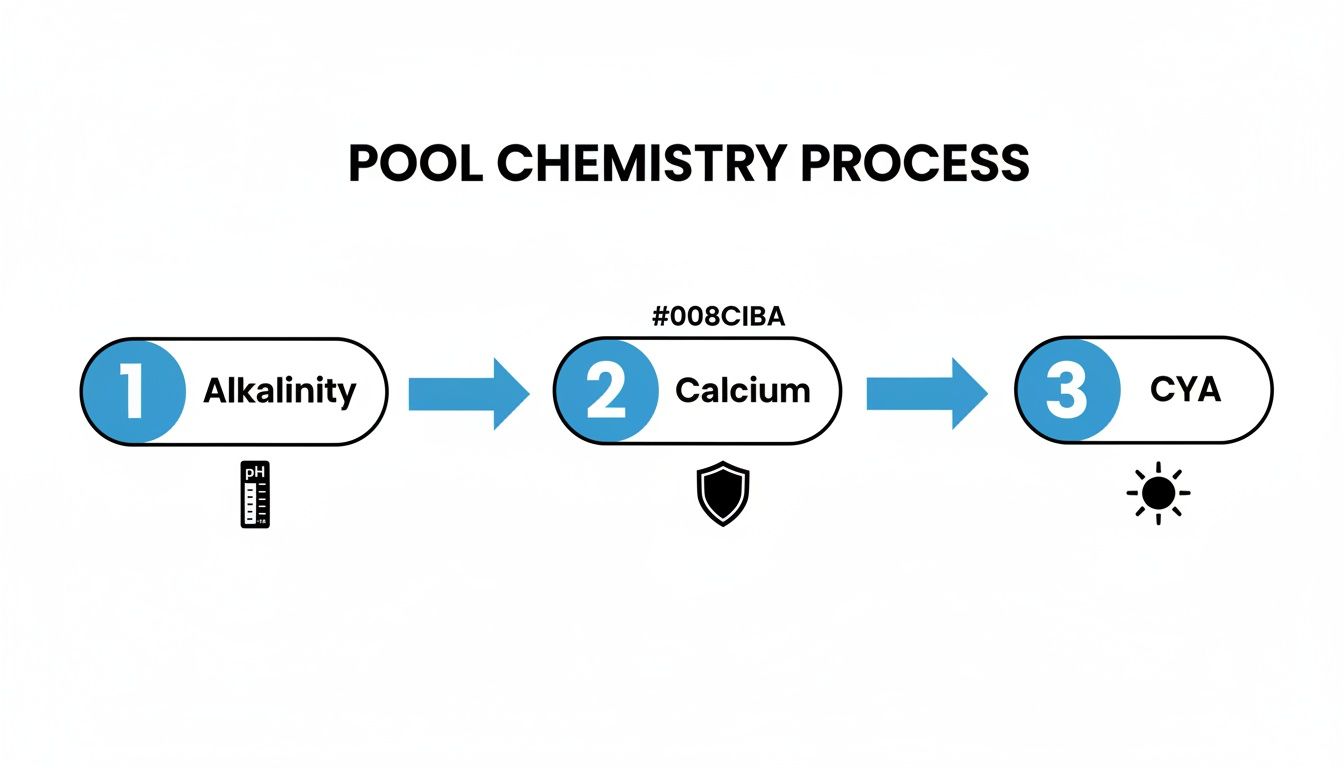
It shows how Alkalinity is the foundation for stabilizing pH, followed by Calcium to protect your pool surfaces and CYA to shield your chlorine from our relentless Florida sun.
Seasonal Adjustments for the Florida Climate
Living in Cape Coral or Fort Myers means your pool faces some unique seasonal challenges that directly affect new home design and maintenance. Your maintenance schedule has to be flexible enough to adapt.
- Summer Rainy Season (June-September): Daily torrential downpours are just a part of life here. All that fresh water dilutes your salt levels and washes away your CYA. After a big storm, always test your salt and CYA and adjust them. You’ll probably need to bump up your salt cell's chlorine output, too, to handle all the extra gunk that gets washed in.
- Intense Heat & Sun (May-October): The combination of high temps and non-stop UV rays torches chlorine. During these months, you will almost certainly need to run your pump longer and set your chlorine generator to a higher percentage just to keep up.
- Winter "Dry" Season (November-April): With less rain and cooler water, you can usually back off your pump run time and lower the generator's output. This is a great way to save on electricity and reduce wear on your equipment. It's also the perfect time to schedule any major servicing or repairs.
Caring for Your Saltwater System Equipment
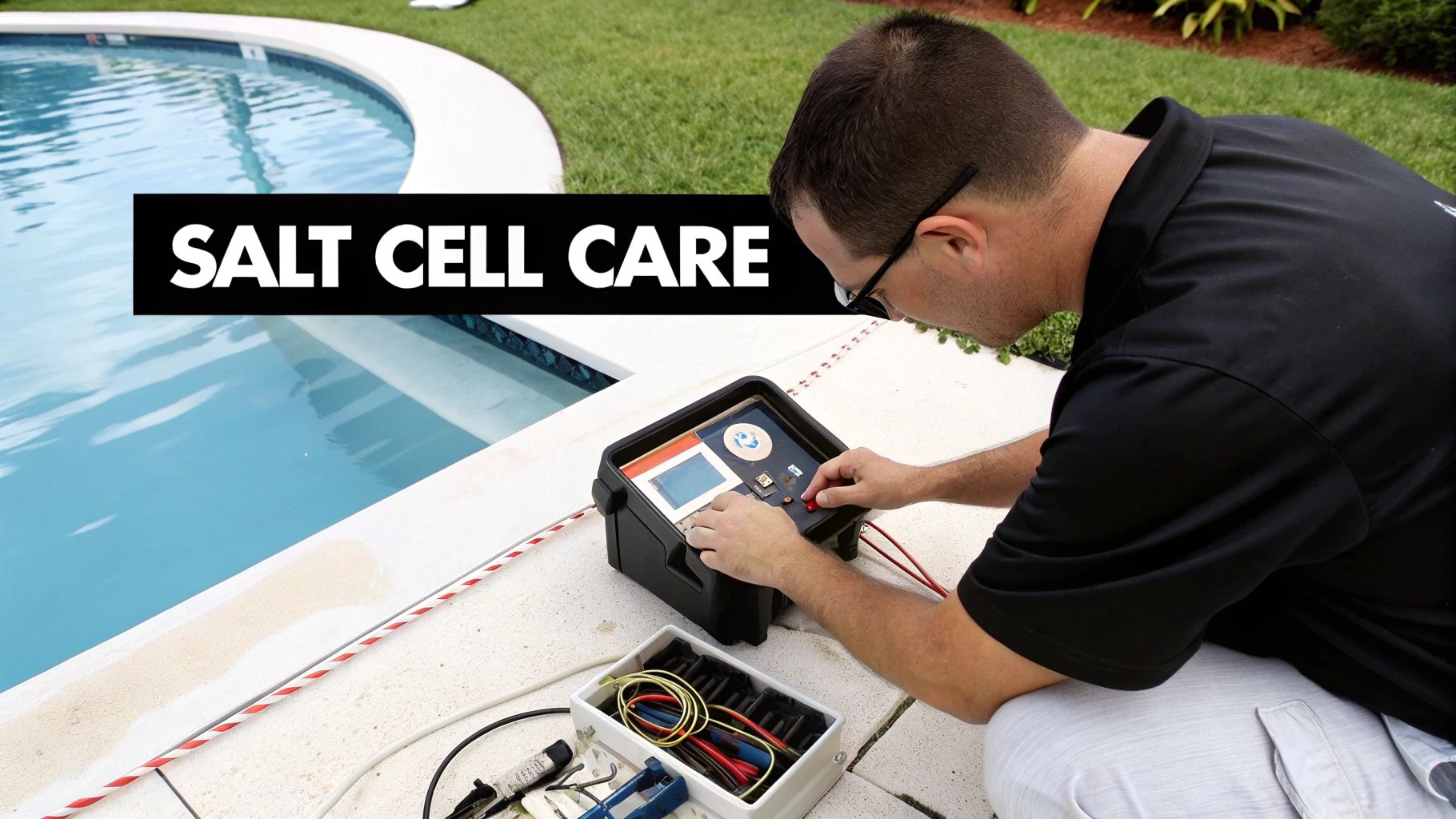
Perfectly balanced water is just one half of the equation. The real heart of your saltwater pool is the hardware doing all the heavy lifting: your saltwater chlorinator. This system, which includes a control unit and a salt cell, is a sophisticated piece of tech that needs the right care to keep your pool sparkling. For owners of custom homes, this system is a key part of your property’s automated infrastructure, and looking after it protects your investment for years of hassle-free swimming.
Keeping this equipment in top shape is what makes saltwater pool maintenance so simple and effective. Unlike traditional pools, saltwater systems front-load their expenses into the equipment to slash those year-over-year chemical bills. It's a trend that's catching on fast—the global saltwater pool system market is projected to grow from USD 1.035 billion in 2025 to USD 1.541 billion by 2033. This shows a clear shift toward smart, hardware-driven solutions that cut down on manual labor, a key trend in modern home building.
Keeping Your Salt Cell Clean and Efficient
The salt cell is where the magic happens. Water flows over a series of metallic plates, and a process called electrolysis converts simple salt into pure, sanitizing chlorine. But over time, those plates can get coated with white, flaky calcium deposits, especially with the hard water we have here in Southwest Florida. This buildup acts like armor, choking the cell's ability to produce chlorine and forcing your entire system to work harder than it should.
A quick visual inspection once a month is all it takes. Just peek through the cell's clear housing (if it has one) or unplug and unscrew the unit to look inside. If you see that chalky buildup, it’s time for a cleaning.
- Kill the Power: Before you touch a thing, shut off all power to your pool equipment at the circuit breaker. Safety first, always.
- Remove the Cell: Carefully unscrew the unions holding the cell in place and lift it out of the plumbing line.
- Mix the Right Solution: In a bucket, mix a solution of one part muriatic acid to four parts water. A critical safety tip: always add the acid to the water, never the other way around.
- Let it Soak: Submerge the scaled end of the cell into the solution. You’ll see it fizz immediately as the acid works to dissolve the calcium. This process usually takes just 5-15 minutes.
- Hands Off the Plates: Never use a screwdriver, wire brush, or any sharp tool to scrape the plates. They have a delicate, expensive coating that is easily damaged, which means you'll be buying a new cell. Once the fizzing stops, rinse the cell thoroughly with a garden hose and reinstall it.
When you remember the cost to install a salt water pool, you realize how valuable this single component is. Protecting it is the key to getting the most out of that initial investment.
Understanding Your Control Panel Codes
The control unit is the brain of your saltwater system, and it talks to you through indicator lights and error codes. A blinking light might look alarming, but most of the time, it's just a simple notification you can handle in minutes.
Don't panic when you see an error code. These are designed to be diagnostic tools, not signs of a catastrophe. They typically point to a simple maintenance need, like adding salt or cleaning a filter, which helps you keep the system running optimally.
Here are a few of the most common alerts you’ll run into on control panels in Cape Coral and Fort Myers homes:
| Common Alert Code | What It Really Means | How to Fix It |
|---|---|---|
| Low Salt or Add Salt | The salt level has dipped below the ideal range (usually under 2700 ppm). The cell stops making chlorine to protect itself from damage. | First, test your salt level with a separate kit to confirm. Then, add pool-grade salt directly to the pool according to the manufacturer’s chart for your pool size. |
| No Flow or Flow Error | There isn't enough water moving through the salt cell for it to run safely. The system shuts down chlorine production to prevent overheating. | This is almost always a circulation problem. Check and clean your skimmer baskets, the pump basket, and your main pool filter. |
| Inspect Cell or Clean Cell | This is usually just a timed reminder from the system (like every 500 hours of run time) telling you to check the cell for calcium buildup. | Give the cell a visual check and clean it if you see any scaling. If the plates are clean, you can typically just press a button to reset the light. |
Preparing Your Pool for Hurricanes and Summer Heat
Here in Southwest Florida, taking care of a saltwater pool is about more than just chemistry and cleaning. It’s about being ready for our unique—and often intense—weather. You’ve got the sweltering summer heat that pushes your system to its limits and the constant threat of hurricanes. A proactive strategy that incorporates modern building resilience is the only way to protect the most valuable outdoor feature of your custom home.
When you’re prepared, you can handle any storm without facing expensive damage or long periods of downtime. A pool that’s been properly prepped will recover much faster, so you can get back to enjoying your personal oasis as soon as the sun comes out again.
Your Pre-Hurricane Battle Plan
When a storm starts tracking toward Cape Coral or Fort Myers, having a clear, actionable checklist is your best friend. The entire goal is to secure your pool and patio area to minimize the damage high winds and torrential rain can cause.
Whatever you do, don't make the common mistake of draining your pool. It sounds logical, but it's the worst thing you can do. The weight of that water is actually what holds the pool shell in the ground, protecting it from "popping" out due to hydrostatic pressure from a rising water table—a critical consideration for homes built at lower elevations. At most, you only need to lower the water level by about a foot to handle the excess rain.
Your hurricane prep is as much about protecting your home and property as it is about the pool itself. Every loose item on your lanai—from furniture to planters—can become a dangerous projectile, which is why integrated hurricane impact features are a key trend in new home design.
As a storm gets closer, follow these practical steps:
- Secure Everything: Bring every loose item inside. This means patio furniture, umbrellas, pool toys, cleaning equipment, and potted plants. If it’s too big to bring in, tie it down securely or, as a last resort, carefully place it in the pool.
- Add Extra Chlorine: Give your pool a good shock with liquid chlorine. Hurricanes dump a massive amount of debris, rain, and other contaminants into the water. Bumping up your chlorine level beforehand gives you a head start in the fight against bacteria and algae blooms.
- Turn Off the Power: This is the last thing you should do before the storm hits. Go to your circuit breaker and shut off all power to your pool equipment. This single step can save your pump and salt system from destructive power surges. It's also why many new custom homes now include whole-home generators, ensuring a quick and safe power-up for essential systems post-storm.
Post-Storm Recovery and Cleanup
Once the storm has passed and it's safe to venture outside, the recovery begins. The first priority is always safety—be on high alert for downed power lines and any dangerous debris scattered around your property.
After you've secured the area, you can start the cleanup. Grab a leaf rake and get all the large debris out of the pool first, then empty the skimmer and pump baskets. You’ll probably have to do this a few times. Once the big stuff is gone, you can restore power, get the pump running, and begin the tedious process of brushing and vacuuming. Since hurricanes often bring flooding, knowing how to file a flood insurance claim is crucial knowledge for any Florida homeowner.
Expect the water to be a mess. You'll need to rebalance everything, paying close attention to your salt and CYA levels, as the heavy rain will have diluted them significantly. It might take a few days of constant filtering and careful chemical adjustments to get your water back to being crystal clear.
Managing Florida's Summer Heat and Rain
Even when a hurricane isn't looming, our summer weather demands changes to your normal saltwater pool routine. The combination of intense heat, punishing UV rays, and daily downpours creates a seriously challenging environment for your water balance.
The sun is your chlorine's worst enemy. During the hottest summer months, you'll absolutely need to run your pump longer—often 10-12 hours a day. You'll also need to turn up your salt chlorinator's output percentage to make up for how quickly the sun burns off the chlorine.
Those daily afternoon thunderstorms are another major factor. A single heavy downpour can dilute your salt and stabilizer levels in less than an hour. It’s a good habit to test your water after any significant rain. Keeping your salt, alkalinity, and CYA within their ideal ranges is your best defense against the chemical chaos Florida summers can dish out.
Answering Your Saltwater Pool Questions
Even the most well-maintained pool will throw you a curveball now and then. As custom home builders in Southwest Florida, we’ve fielded just about every question imaginable from new homeowners about their saltwater pools. Let's clear up some of the most common ones we hear.
Think of this as your go-to FAQ, built on years of hands-on experience designing, building, and servicing pools right here in Cape Coral and Fort Myers. These aren't just textbook answers; they're practical insights to help you understand the why behind what your pool is doing.
Do Saltwater Pools Still Use Chemicals?
Yes, they absolutely do—this is probably the biggest myth out there. A saltwater pool isn't a "chemical-free" pool; it's a chlorine pool. The magic is in how that chlorine gets into the water.
Instead of you lugging around heavy buckets of tablets or jugs of liquid chlorine, your salt chlorine generator handles the job automatically. Through a process called electrolysis, it converts the salt into a pure, steady stream of chlorine. This automation is a key design trend in the custom home industry, simplifying life for homeowners.
You'll still need to keep an eye on your overall water balance and add other chemicals from time to time, such as:
- pH adjusters (like muriatic acid) to lower pH when it creeps up.
- Alkalinity increasers to create a stable buffer for your pH.
- Calcium hardness increasers to protect your plaster and equipment.
- Cyanuric acid (stabilizer) to keep the Florida sun from burning off your chlorine.
The real win is that you’re handling far fewer harsh chemicals regularly. It just makes the whole maintenance routine simpler and more pleasant.
Can You Open Your Eyes in a Saltwater Pool?
For almost everyone, the answer is a definite yes. This is one of the main reasons people fall in love with their saltwater pools—the comfort is just on another level. The water feels noticeably softer and is so much gentler on your skin and eyes.
Because the salt chlorinator produces a consistent, low level of chlorine, you avoid those high concentrations that cause red, stinging eyes in traditional chlorine pools. The salt level itself is also incredibly mild, only about 1/10th the salinity of the ocean, so it doesn't sting. While everyone's sensitivity is a little different, the vast majority of people find they can open their eyes underwater without any irritation at all.
Why Does My Salt System Say No Flow?
That "No Flow" light is probably the most common—and thankfully, easiest—issue to fix. When you see it, don't panic; your salt system isn't broken. It's actually a built-in safety feature doing its job.
The salt cell requires a steady flow of water to generate chlorine safely and avoid overheating. If its sensor detects that water movement has dropped too low, it shuts down chlorine production and flashes that "No Flow" alert.
A "No Flow" alert is almost always a circulation problem, not a system failure. Before you even think about calling for service, check the simple stuff first. 9 times out of 10, a quick cleaning is all you need.
Run through this quick checklist:
- Check your skimmer baskets: Are they packed with leaves and debris?
- Check the pump basket: Is the strainer basket clogged?
- Check your main filter: This is the most common culprit. When was the last time you cleaned it?
Once you clear the blockage, water flow will be restored, and that error light should switch off on its own.
Is Salt Corrosive to My Pool Deck and Equipment?
This is a great question. Salt is naturally corrosive, so it’s smart to be thinking about it. However, when we design and build a new custom home in Florida, we plan for this from day one by selecting the right materials—a key component of forward-thinking builder trends.
While the salt concentration in your pool is very low, it can still take a toll on the wrong materials over many years. That's why we exclusively use corrosion-resistant finishes for everything around the pool.
- Pavers and Travertine: We recommend natural stone and high-quality pavers for pool decks. These premium design features stand up beautifully to salt exposure and the intense Florida sun.
- Powder-Coated Aluminum: This finish is our standard for screen enclosures, railings, and even outdoor furniture because it creates a tough barrier against corrosion, an essential hurricane impact feature.
- Sacrificial Anodes: This is a pro tip. We install a simple zinc anode directly into the pool’s plumbing. This small, inexpensive part is designed to corrode first, "sacrificing" itself to protect the expensive metal components in your system, like the heat exchanger in your pool heater.
By making smart material choices from the start, the corrosive nature of salt becomes a non-issue. You get all the benefits without worrying about your beautiful lanai and expensive equipment. It's all part of building a home that's meant to last in our unique coastal environment.
At Sinclair Custom Homes Inc, we believe a home should be a masterpiece of quality and craftsmanship, engineered for enjoyment, not constant work. If you’re ready to build a custom home in Southwest Florida with unmatched integrity and attention to detail, visit us at https://sinclaircustomhome.com to start your journey.