


When you're building a custom home in Florida, the pool is more than just an add-on; it’s the centerpiece of your lifestyle. The decision between a pool heat pump and a gas heater is a big one, often boiling down to a classic trade-off: long-term value versus immediate power.
For the majority of homeowners we work with in Southwest Florida, a pool heat pump is the smarter long-term investment. It just makes sense with our climate and the growing focus on energy efficiency in new custom builds. That said, gas heaters absolutely still have their place, especially for those who need lightning-fast heat for a spa or want a system that can run on a generator after a storm.
Choosing the Right Pool Heater for Your Florida Home
Picking the right pool heater has a lasting impact on your wallet, your daily routine, and even your home's hurricane preparedness. This isn't just about getting warm water. It's about integrating a major appliance into your home's overall energy strategy and design. As builders, we're seeing a huge shift toward sustainable, smarter homes, so understanding how these two technologies fit into that picture is key.
The debate really comes down to cost and efficiency.
- Pool Heat Pumps: Think of these as a reverse air conditioner. They don't create heat; they pull it from the abundant warm, humid Florida air and transfer it to your pool water. This process is incredibly efficient and aligns with modern design trends focused on lower monthly bills.
- Gas Pool Heaters: These are pure power. They burn natural gas or propane to heat the water directly. It’s fast and effective but uses a lot more energy, which means higher operating costs over time.
Key Performance and Cost Metrics
A quick glance at the numbers shows the fundamental trade-offs. Gas heaters are the undisputed champions of speed, but heat pumps dominate in efficiency and have a much lighter environmental touch—two factors that are becoming deal-breakers in modern custom home design.
This chart really drives home the differences in efficiency, running costs, and emissions.
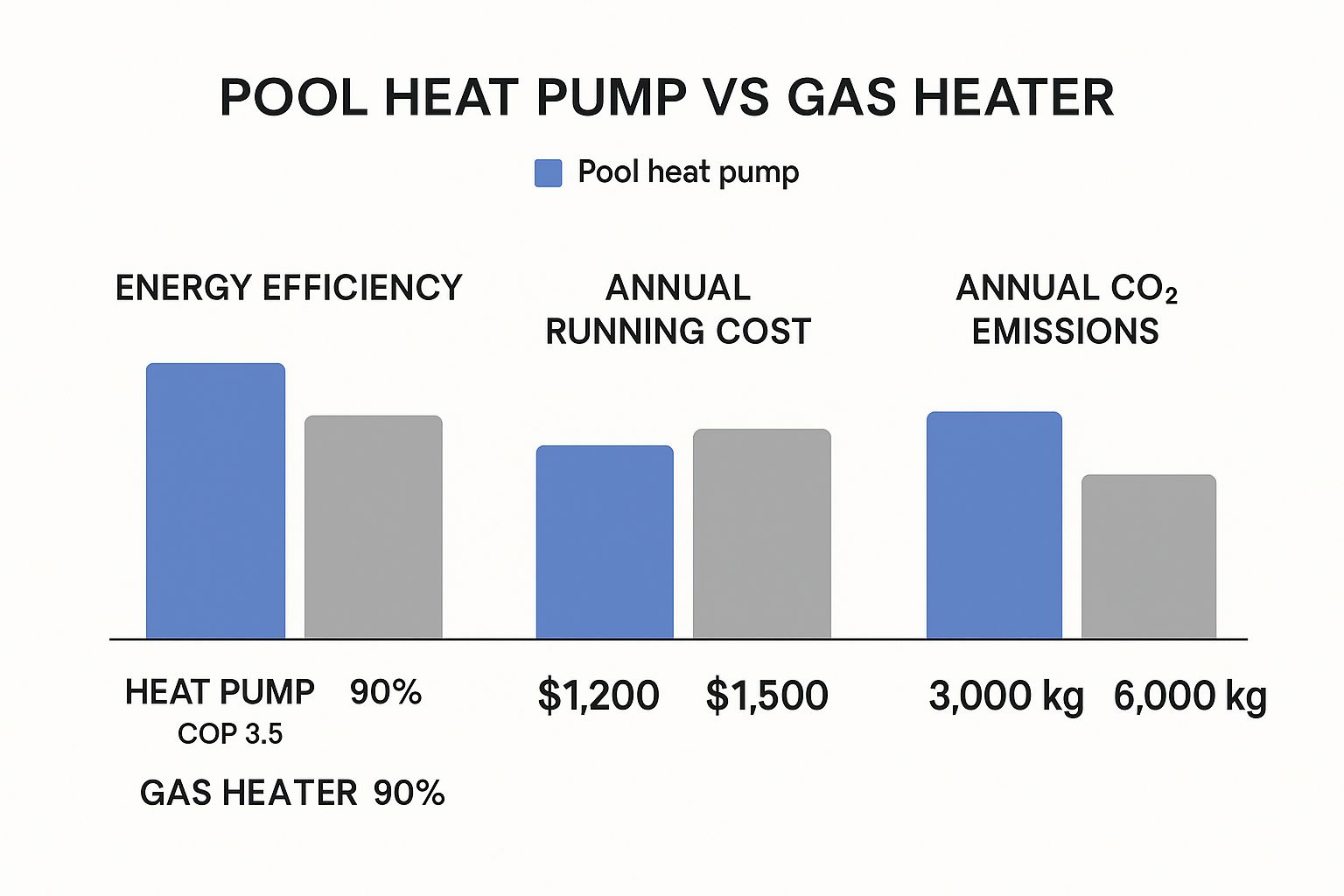

The data is clear: a heat pump's incredible efficiency translates directly into lower annual costs and a significantly smaller carbon footprint.
In Florida, a heat pump works with our environment, not against it. It leverages the state's natural warmth, making it a perfect match for year-round efficiency. This synergy is a huge reason why they're so popular in new custom builds.
To help you see how these features stack up for Florida living, here’s a quick-glance table comparing the two systems.
Quick Comparison: Pool Heat Pump vs. Gas Heater for Florida
| Feature | Pool Heat Pump | Gas Pool Heater |
|---|---|---|
| Best For | Consistent, low-cost heating | Rapid, on-demand heating & spas |
| Energy Efficiency | Very High (up to 600% efficient) | Low (around 80-95% efficient) |
| Heating Speed | Slow (raises temp 1-2°F per hour) | Fast (raises temp 3-5°F+ per hour) |
| Storm Resilience | Requires grid power to operate | Can run on a generator with propane |
Ultimately, this comparison helps frame the decision around your specific priorities—whether that's daily, affordable comfort or the power to heat up a spa in a hurry, even after a hurricane.
Understanding How Each Heater Operates

When you're deciding between a pool heat pump and a gas heater for your new custom home in Southwest Florida, you need to understand that they're built on completely different technologies. One is a master of efficiency, the other a powerhouse of speed. This fundamental difference ripples through everything, from your monthly bills to how we design your home's infrastructure.
A pool heat pump works a lot like a reverse air conditioner. It doesn't actually create heat; it cleverly captures it. The unit pulls in our warm, humid Florida air, and a compressor then supercharges that latent heat. From there, the thermal energy is transferred directly into the pool water as it circulates through the unit. It’s a process of moving heat, not making it from scratch, and that’s the secret to its incredible energy efficiency.
A gas pool heater, on the other hand, works through direct combustion. It’s a much more straightforward and powerful method. Natural gas or propane is burned inside a combustion chamber, and as your pool water flows through an internal heat exchanger, it absorbs this intense heat. The result? The water warms up very quickly before it returns to your pool.
How Technology Dictates Design
For us as custom home builders, this operational difference has real-world implications for your new home's design and layout. The decision isn't just about the heater itself but how it integrates with the rest of the home's systems, including hurricane impact features.
-
Pool Heat Pump: This is mostly an electrical job. A heat pump needs a dedicated, heavy-duty circuit—usually a 50-amp breaker—run directly to the equipment pad. This is something we must plan for in the home's electrical schematics right from the beginning, especially in elevated homes.
-
Gas Pool Heater: This one requires more complex infrastructure. We have to plumb a dedicated gas line from the main source all the way to your pool equipment, which is a big consideration for site planning and landscaping. It also critically requires proper ventilation for its exhaust, which dictates its placement to ensure safety and meet building codes.
The growing demand for efficient systems is clear in market trends. The global market for pool heat pumps has ballooned, expanding from an estimated USD 4.9 billion in 2023 to a projected USD 6.9 billion by 2032. This surge is almost entirely due to their ability to turn electricity into heat far more efficiently than older methods. You can explore more about this market expansion and its drivers.
For a new build in Florida, this choice sets the tone for your home's entire energy profile. A heat pump aligns perfectly with new builder trends toward smarter, more efficient homes. A gas heater prioritizes on-demand performance, often for a secondary feature like a spa or as part of a storm-resilient design.
Performance in a Florida Context
Here in Southwest Florida, the warm ambient air gives a heat pump a consistent source of energy to draw from pretty much year-round. This natural synergy makes it the ideal primary heater for keeping your pool at a comfortable temperature for daily enjoyment.
A gas heater's performance, however, is completely independent of the weather. Whether it’s a balmy 90-degree afternoon or a rare, chilly evening, it delivers the same raw heating power. This makes it the undisputed champion for heating a spa from cold to hot in under an hour, or providing comfort after a major storm when the grid is down.
Looking at the Total Cost of Ownership
When you're building a custom home in Southwest Florida, every dollar counts. You’re not just thinking about today; you’re planning for the long haul. In the pool heat pump vs. gas heater debate, it’s easy to get fixated on the price tag you see upfront, but that's only part of the equation. The real story unfolds when you look at the total cost of ownership—what it costs to buy and run the unit day in and day out.
At first glance, gas heaters almost always look like the winner. They are simpler machines, which means their initial purchase and installation are generally more budget-friendly. But that initial savings can disappear surprisingly fast when you start paying the monthly utility bills, especially with how much propane and natural gas prices can swing.
A Breakdown of the Upfront Investment
That initial outlay for a pool heater is a real line item in your new home construction budget. As custom builders, it's something we account for early on because it impacts both the unit cost and the infrastructure needed to support it.
- Gas Pool Heater: A quality gas heater, including installation, typically lands somewhere between $4,000 and $6,000. The biggest costs outside the unit itself are running a dedicated gas line and making sure it's ventilated properly—a non-negotiable for safety and building codes.
- Pool Heat Pump: A heat pump requires a bigger upfront investment, usually from $6,000 to $8,000, sometimes more. That higher price tag comes from its more complex technology. Installation is an electrical job, needing a dedicated heavy-duty circuit, which we plan for right from the start in your home’s electrical design.
While the numbers seem to favor gas initially, this is where the real financial comparison just gets started. If you want a deeper look, check out our guide on the factors that influence pool heater pump cost.
Uncovering the True Operating Costs
This is where the financial script completely flips. You pay more for a heat pump upfront, but that's your ticket to years of incredible energy efficiency. For anyone building a custom home in Southwest Florida, where the pool is basically a year-round accessory, those operational savings add up to a significant amount over the life of your home.
Let's look at what you can realistically expect to spend per year to run each one in our area:
- Pool Heat Pump: Because it just moves existing heat from the air, a heat pump's annual electricity cost can be as low as $300 to $800 for the season. It sips electricity instead of chugging fuel.
- Gas Pool Heater: A gas heater's raw power comes at a price. Depending on how much you use it and the going rate for fuel, you could be looking at $500 to $1,500 a year, or even more. That cost is directly tied to how often you fire it up.
This move toward efficiency isn't just a local trend; it's happening everywhere. The heat pump swimming pool heater market has seen massive growth, with projections showing it will jump from USD 1.8 billion in 2023 to USD 4.4 billion by 2032. It's a clear sign of a global shift toward smarter, more sustainable heating that uses 60% to 80% less energy than gas heaters for the same result.
Pinpointing the Break-Even Point
The break-even point is that magic moment when the money you've saved on a heat pump’s lower running costs officially pays back its higher initial price. Here in Southwest Florida, that calculation works heavily in the heat pump's favor, thanks to our long swimming season and warm air—the exact conditions where a heat pump shines.
For a homeowner planning to live in their custom-built property for years, a heat pump isn’t just another expense—it's a smart investment in the home's financial health. The break-even point often shows up much faster than people think, usually within just 3 to 5 years.
After that, every dollar you're not spending on fuel is pure savings. This thinking aligns perfectly with modern builder trends, where we prioritize upfront quality and smart design features to achieve long-term cost-effectiveness and home value.
Performance in a Florida Context
When you're building a custom home in Southwest Florida, the pool heater isn't just another piece of equipment—it's a critical part of your lifestyle. The choice between a pool heat pump and a gas heater is a big one, and our unique weather plays a huge role in which one will work best for you. This is a conversation we have early in the design process because it directly impacts your enjoyment of your new home.
A pool heat pump's entire world revolves around the ambient air temperature. Its efficiency is measured by something called the Coefficient of Performance (COP), which is just a fancy way of saying how many units of heat it can squeeze out of the air for every unit of electricity it uses. Here in Florida, with our consistently warm and humid air, heat pumps are in their element, operating at peak performance for most of the year.
This natural advantage makes them a fantastic choice for homeowners who want to keep their pool at a perfect, comfortable temperature from spring all the way through fall. A heat pump is a master at maintaining heat, raising the water temperature slowly but surely by 1-2°F per hour while just sipping electricity.
The Role of Speed and On-Demand Heat
A gas heater, on the other hand, couldn't care less about the weather. It creates its own heat by burning fuel, giving you powerful, immediate results whether it's a blistering August afternoon or one of those rare, cool January evenings. This makes it the undisputed champion of on-demand heating.
If you're a custom home buyer who values spontaneity, a gas heater is the only real option for getting a spa hot in a hurry.
A gas heater can take a spa from chilly to a blissful 104°F in less than an hour. A heat pump simply can't compete with that kind of speed. This feature is a non-negotiable for homeowners who love to entertain or enjoy an unplanned soak after a long day.
This on-demand power becomes a major design consideration. We often see clients designing their dream outdoor kitchen and entertainment area who choose a gas heater specifically for the spa, guaranteeing it’s ready to go at a moment's notice.
Performance Comparison in the SWFL Climate
The decision really boils down to how you see yourself using your pool and spa. One system is built for endurance and steady efficiency, while the other is all about raw power and speed.
| Performance Scenario | Pool Heat Pump | Gas Pool Heater |
|---|---|---|
| Year-Round Pool Maintenance | Excellent. By far the most efficient and affordable way to keep a pool consistently warm for daily use. | Good, but Costly. It can do the job, but the operating costs will be significantly higher. |
| Heating a Spa from Cold | Poor. It can take many hours, which makes it totally impractical for spontaneous use. | Excellent. The fastest option around, heating a spa in just 30-60 minutes. |
| Effectiveness on Cool Days | Good. Efficiency dips when air temps fall below 50°F, but that's a rare occasion in Southwest Florida. | Excellent. Performance is completely unaffected by air temperature, delivering full power anytime. |
| Heating Speed | Slow. Designed for gradual, efficient heating over time. | Fast. Engineered for rapid temperature spikes, perfect for immediate use. |
This comparison shows exactly why so many new luxury builds in places like Cape Coral and Fort Myers are now designed with hybrid systems. You get the best of both worlds, using each technology for what it does best.
Resilience and Post-Storm Recovery
For any custom home we build in Southwest Florida, hurricane resilience is at the top of the priority list. This philosophy extends to every single system in the house, and that includes the pool equipment. After a storm passes, getting back to normal is what matters most, and your pool heater can play a surprisingly important part in that.
A gas heater has a clear edge in a post-storm situation. If your home is set up with a whole-home generator and a propane tank, your gas heater can be up and running as soon as it's safe, even if the power grid is down for days. Having the ability to heat your spa can be a huge comfort after a stressful event.
A heat pump, however, is completely reliant on a stable power grid. While we always design new homes with elevated equipment pads to protect against storm surge, a heat pump is useless without electricity. For any homeowner focused on total storm readiness, this is a critical point to consider. As new building trends lean toward self-sufficiency, a gas heater's ability to run off a generator is a very compelling feature.
Installation Longevity and Maintenance Demands
When you're building a new custom home in Southwest Florida, you’re thinking about the long game. The equipment you choose needs to perform well on day one, but its entire lifecycle—installation, upkeep, and lifespan—is just as critical. This is especially true when choosing between a pool heat pump and a gas heater, as the decision goes way beyond initial cost and gets into the nitty-gritty of your home's design and long-term value.
The installation process for each system is worlds apart, and it's something that needs to be baked into your home's architectural plans right from the start. Getting the installation right is everything for the heater's longevity. This includes thinking through practical details like finding stable swimming pool heat pump mounting solutions to create a solid foundation.
Installation and Architectural Integration
For us as custom builders, the heater choice directly impacts the infrastructure we need to plan for, affecting everything from the home's layout to its elevation plans. It’s a crucial conversation we have with every client during the design phase of the custom home building process.
A pool heat pump is mostly an electrical job. It needs its own dedicated, heavy-duty circuit run out to the equipment pad. While that sounds straightforward, we have to account for it in the home's total electrical load calculations, a key consideration for new custom homes with many modern electronic features.
A gas heater, on the other hand, is a much bigger architectural puzzle. It requires a dedicated gas line plumbed from the main source, which can impact site plans and landscaping designs. More importantly, it requires proper ventilation and an exhaust stack. We have to position that stack perfectly to meet building codes and keep residents safe, which absolutely influences the design of your outdoor living area.
Maintenance Needs and Lifespan Comparison
The ongoing care each unit requires plays a massive role in its total cost of ownership and your day-to-day convenience. One system is pretty much "set it and forget it," while the other needs a bit more professional hand-holding.
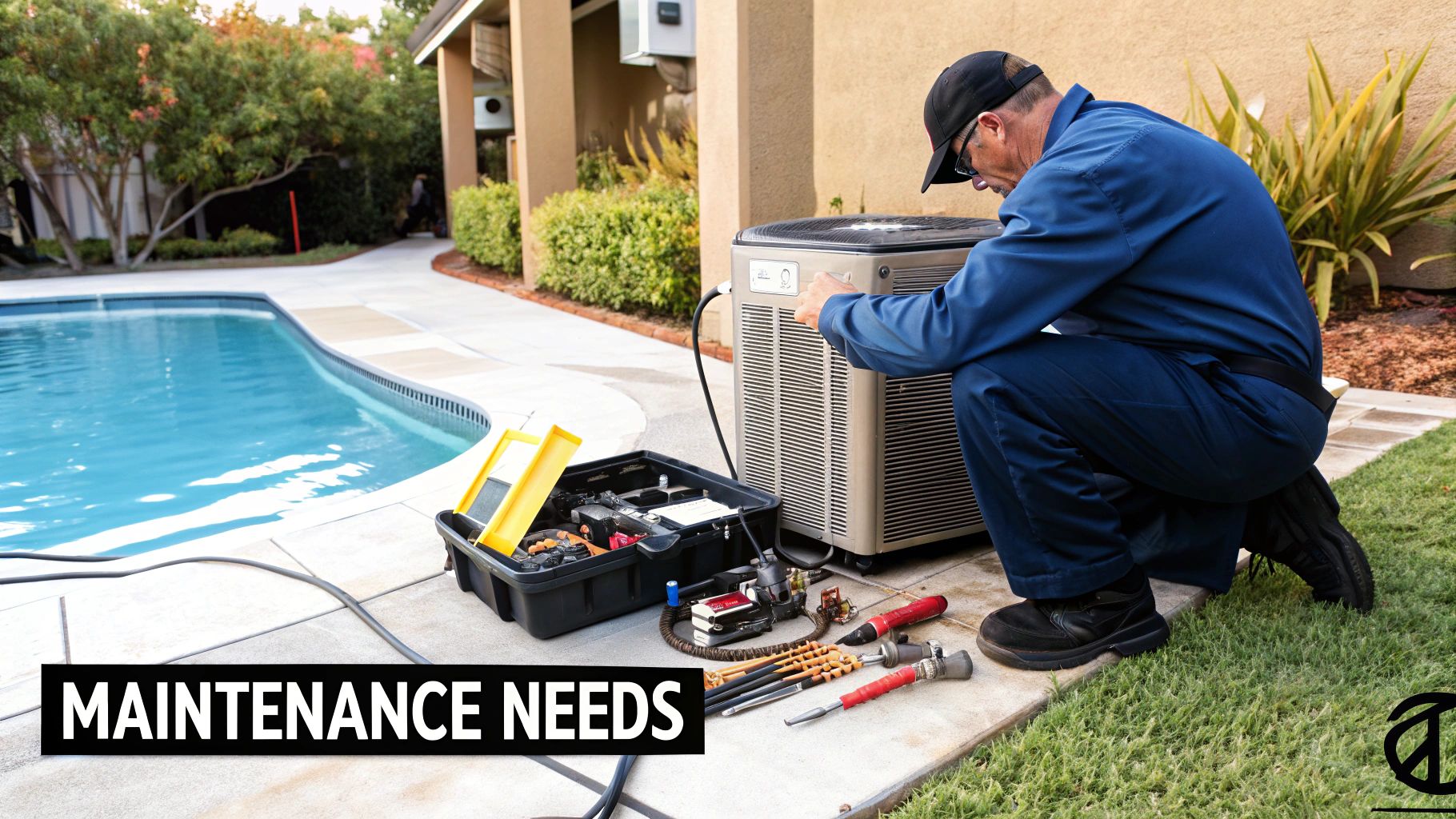
- Pool Heat Pump Maintenance: These units are refreshingly low-maintenance. The main tasks are simple: keep the coils free of leaves and debris for clear airflow and give the evaporator coil an occasional cleaning. With just this basic upkeep, they have a typical lifespan of 10 to 15 years, and we’ve seen plenty last even longer.
- Gas Heater Maintenance: Gas heaters need more serious annual servicing from a qualified pro. This isn't just for performance—it's for safety. A technician will check for gas leaks and clean internal parts like the burner trays, which can get clogged and kill efficiency. Because of the corrosive nature of combustion, gas heaters just don't last as long, usually around 7 to 10 years.
A heat pump's longevity is a key selling point in the custom home market. Its less corrosive internal process means it often outlasts its gas counterpart, providing a better long-term return on investment for the homeowner.
When you look at the whole picture, it’s easy to see why the market is slowly shifting. Gas heaters have long been the go-to for their raw speed, but with rising fuel costs and a bigger focus on efficiency, heat pumps are gaining serious ground. This aligns with a major trend in the custom home industry: building for efficiency and resilience from the ground up.
Making the Final Decision for Your Lifestyle
When it comes down to it, choosing between a pool heat pump and a gas heater is really about how you see yourself living in your new Florida custom home. This isn't just about the hardware; it’s about matching the technology to your daily routine, how you entertain, and your financial outlook. The best way to get a clear answer is to walk through a few real-world scenarios.
Let's put the technical specs aside for a moment and look at a couple of common Florida homeowner profiles. You'll likely see yourself in one of them, and that's when the right choice will click into place.
Matching the Heater to Your Florida Lifestyle
The decision becomes surprisingly simple when you line up a heater's strengths with what matters most to you. Are you in the pool every day and watching the budget, or are you the weekend host who needs serious heating power, and fast?
-
The Year-Round Swimmer: This person sees their pool as a core part of their home, used constantly for exercise, relaxation, and daily enjoyment. They need the water to be consistently warm and comfortable without getting a heart-stopping electric bill every month. For this lifestyle, the pool heat pump is the clear winner. Its incredible energy efficiency and low running costs are perfect for maintaining that ideal temperature all season long.
-
The Weekend Entertainer & Storm-Prepped Homeowner: This homeowner loves to host, with the pool and spa acting as the centerpiece of social events. They need to fire up the spa and have it perfectly hot in under an hour. Critically, they also prioritize post-hurricane comfort and want key amenities to run on their generator. In this case, the raw, on-demand power of a gas heater is non-negotiable.
The Ultimate Solution The Hybrid System
In the Southwest Florida custom home market, we're seeing a fantastic trend that gives luxury homeowners the best of both worlds: the hybrid heating system. It’s quickly becoming a go-to feature in high-end new construction because it solves the efficiency vs. power dilemma.
A hybrid system pairs a super-efficient heat pump for daily pool heating with a brawny gas heater just for the spa or for those times you need a rapid temperature boost. You get efficiency for the daily grind and power when you need it.
The hybrid model is the peak of pool heating strategy for a custom Florida home. You get the incredible cost savings of a heat pump for 95% of your needs, plus the instant-on power of gas for those moments when speed is everything. It removes all compromise.
This dual-fuel setup is a perfect match for the philosophy of top-tier custom builders, who focus on creating homes that are as smart as they are luxurious. If you’re looking for contractors who specialize in this kind of forward-thinking design, you can learn more about the best home builders in Florida and see how they approach modern home amenities.
At the end of the day, the choice is a personal one. While this guide covers the two most popular heating methods, it's good to know other options exist for unique backyard designs. For instance, exploring why a wood-fired hot tub might be a good fit for certain lifestyles can open up different ideas for creating that perfect warm-water oasis. The final decision comes down to which system truly fits into the life you plan to build in your new home.
Frequently Asked Questions
Choosing between a pool heat pump and a gas heater often boils down to a few key questions, especially when you're building a new custom home in Florida. Getting clear answers on how these systems perform through our distinct seasons and unpredictable weather is absolutely critical. We hear these questions all the time from our clients, so let's get right to them.
How Well Do Heat Pumps Work in a Florida Winter?
You'll be happy to know that pool heat pumps work exceptionally well during a typical Florida winter. Modern units are absolute workhorses, designed to efficiently pull heat from the air even when temperatures dip as low as 45-50°F.
Since our winters rarely stay below that range for long, a properly sized heat pump will have no trouble keeping your pool at that perfect, swim-ready temperature. It's really the ideal choice for enjoying your pool year-round here in Southwest Florida.
Which Pool Heater Is Better During a Hurricane?
This is a great question, and each system has its pros and cons when a storm is on the horizon. A gas heater has the clear advantage for immediate use after a hurricane, since it can run off a home generator and a propane tank if both the power grid and natural gas lines are down. A heat pump, on the other hand, is completely dependent on electricity from the grid.
In modern custom home construction, new building codes often require pool equipment to be installed on elevated platforms. This is a critical design feature that protects both types of heaters from storm surge, a major consideration in hurricane-prone areas.
Is a Hybrid Heating System Worth the Investment?
For many of the new luxury custom homes we build in Florida, a hybrid (or dual-fuel) system is absolutely worth the investment. It's the best of both worlds. You get the incredible day-to-day energy savings of an efficient heat pump, but you also have the raw, on-demand power of a gas heater for your spa or for those times you need to raise the pool temperature quickly. This setup gives you maximum flexibility and is a significant selling feature for any high-end property.
Does a Pool Cover Really Make a Difference in Florida?
Yes, without a doubt. A pool cover is the single most effective thing you can do to boost your heater's performance and slash your operating costs. By stopping heat from escaping through evaporation, a good cover can cut your heater's runtime by an incredible 95%. This is a crucial value-add that we recommend with every single new pool we build.
At Sinclair Custom Homes Inc, we believe your pool should be a source of relaxation, not a drain on your resources. We integrate the most efficient and resilient systems into our custom builds to match your Florida lifestyle. Contact us today to discuss the vision for your new home.