


When you're building a custom home here in Southwest Florida, the choice between lath and plaster versus drywall goes way beyond looks. This is a big decision that affects your home's durability, how it stands up to hurricanes, and even your project's timeline. While drywall is definitely the modern go-to for its speed and affordability, old-school plaster offers incredible durability and a unique, high-end finish that’s getting a second look in luxury custom builds.
Choosing Walls For Your Florida Custom Home

As you start the journey of building a new custom home in Cape Coral or Fort Myers, you quickly realize every single material matters for long-term performance and value. The walls are a foundational choice, influencing everything from sound insulation to how your home handles Florida’s unique climate. Getting a handle on the real differences between these two methods is the first step to making a smart choice that fits your vision and your budget.
This guide cuts through the generic advice to give you a straight-up comparison built for homeowners in SWFL. We’re going to look at each system through the lens of what matters most here:
- Hurricane Readiness: How does each material add to the structural strength of your home when the winds pick up?
- Moisture and Mold Resistance: In our humid climate, which one performs better and keeps mold at bay?
- Modern Design Trends: How well do these materials work with the latest new design features you want in a luxury home?
Lath and plaster might be something you associate with historic homes, but its rock-solid durability and beautiful finish are making it a niche option for new, high-end projects. That said, you have to weigh those perks against a serious impact on your budget and construction schedule.
If you’re looking at an existing home and aren't sure what you've got, you can learn more about how to tell the difference between drywall and plaster in our detailed guide.
Quick Comparison Lath & Plaster vs Drywall At A Glance
To kick things off, here’s a high-level summary of the key characteristics of each wall system. Think of it as a quick reference cheat sheet for new builder trends.
| Attribute | Lath and Plaster | Drywall |
|---|---|---|
| Installation Time | Weeks to Months | Days |
| Cost | Significantly Higher | Cost-Effective Standard |
| Moisture Resistance | Naturally Breathable | Requires Specialized Boards |
| Durability | High Impact Resistance | Easily Dented or Damaged |
| Repairs | Requires Skilled Labor | Simple DIY or Handyman Fix |
| Best For | Historic Authenticity, High-End Finishes | Modern Construction, Speed, and Budget |
This table gives you the basics, but as you’ll see, the best choice often comes down to the specifics of your project and what you value most in your custom home.
Understanding The Construction Process And Materials
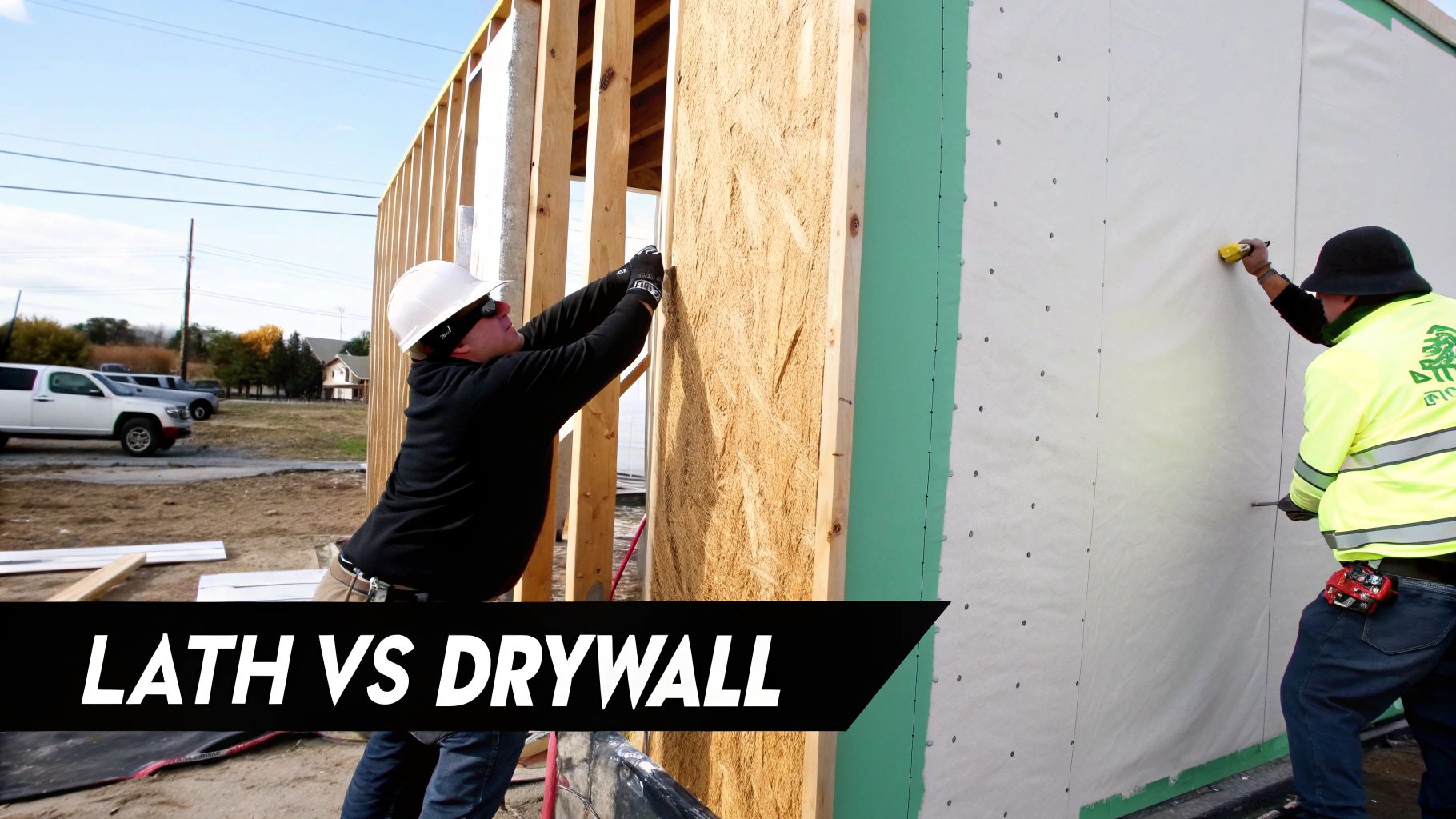
When you get down to the studs, the differences between lath and plaster and drywall are night and day. We're not just talking about two different wall surfaces; these are fundamentally different construction systems from the ground up.
Knowing how each one comes together is crucial. It helps you understand why one became a historical hallmark of craftsmanship and why the other is the undisputed king of modern efficiency, especially here in Southwest Florida’s custom home market. The choice impacts everything from your budget to your project schedule.
The Classic Lath and Plaster Method
Think of lath and plaster as a meticulous art form, built on-site, layer by painstaking layer. It's a throwback to traditional building techniques that require a ton of skill and patience from true artisans.
It all starts with the lath—a grid of thin wooden strips (or sometimes metal mesh) nailed horizontally across the wall studs. This framework is the skeleton of the wall. It’s also important to understand the role of load-bearing walls in this context, as the entire structure provides the foundation for the heavy plaster to come.
Then comes the plaster, which is applied in three distinct coats. Each has a job to do, and each needs serious time to dry.
- The Scratch Coat: This first, gritty layer is troweled directly onto the lath. The plaster is pushed through the gaps, where it oozes behind and hardens into "keys," mechanically locking the entire wall system to the studs.
- The Brown Coat: Once the scratch coat has cured, a second, smoother layer goes on to build up thickness and create a flat, even plane. This coat is where the wall gets its real strength.
- The Finish Coat: This is the final, paper-thin layer where the plasterer's skill is on full display. It’s troweled on to create that perfectly smooth or textured finish you see.
This multi-step process is what gives lath and plaster its incredible durability and solid, monolithic feel. But it's also its biggest weakness in today's building world. Each of those coats can take days—sometimes weeks—to fully cure, a process made even longer by Florida’s humid climate.
The Modern Drywall Installation Process
Drywall, on the other hand, is all about speed, precision, and consistency. The material itself—gypsum board—is manufactured in a factory and delivered to the job site in large, ready-to-go sheets, usually 4×8 feet or larger. This efficiency is precisely why drywall took over the custom home industry.
From the 1700s well into the mid-1900s, lath and plaster was the standard. But it was slow. A single room could take weeks as plasterers waited for each coat to dry, and work often ground to a halt in cold weather. Drywall changed everything, slashing installation time from weeks to just a few days and allowing for year-round construction.
The installation process is incredibly straightforward:
- Hanging the Sheets: Crews measure and cut the gypsum boards to fit the space, then fasten them directly to the wall studs with screws.
- Taping and Mudding: The seams where the boards meet are covered with special tape and coated with layers of joint compound, what we call "mud."
- Sanding and Finishing: After the mud dries, it’s sanded down to create a perfectly smooth, seamless surface that’s ready for primer and paint.
This assembly-line approach is a game-changer for project timelines. It dramatically cuts down the on-site labor and eliminates the long curing delays of plaster, which is a massive advantage in our custom home building process. While it may lack the old-world, handcrafted feel of plaster, its efficiency is what keeps a project moving forward on schedule.
Performance Under Pressure In The Florida Climate
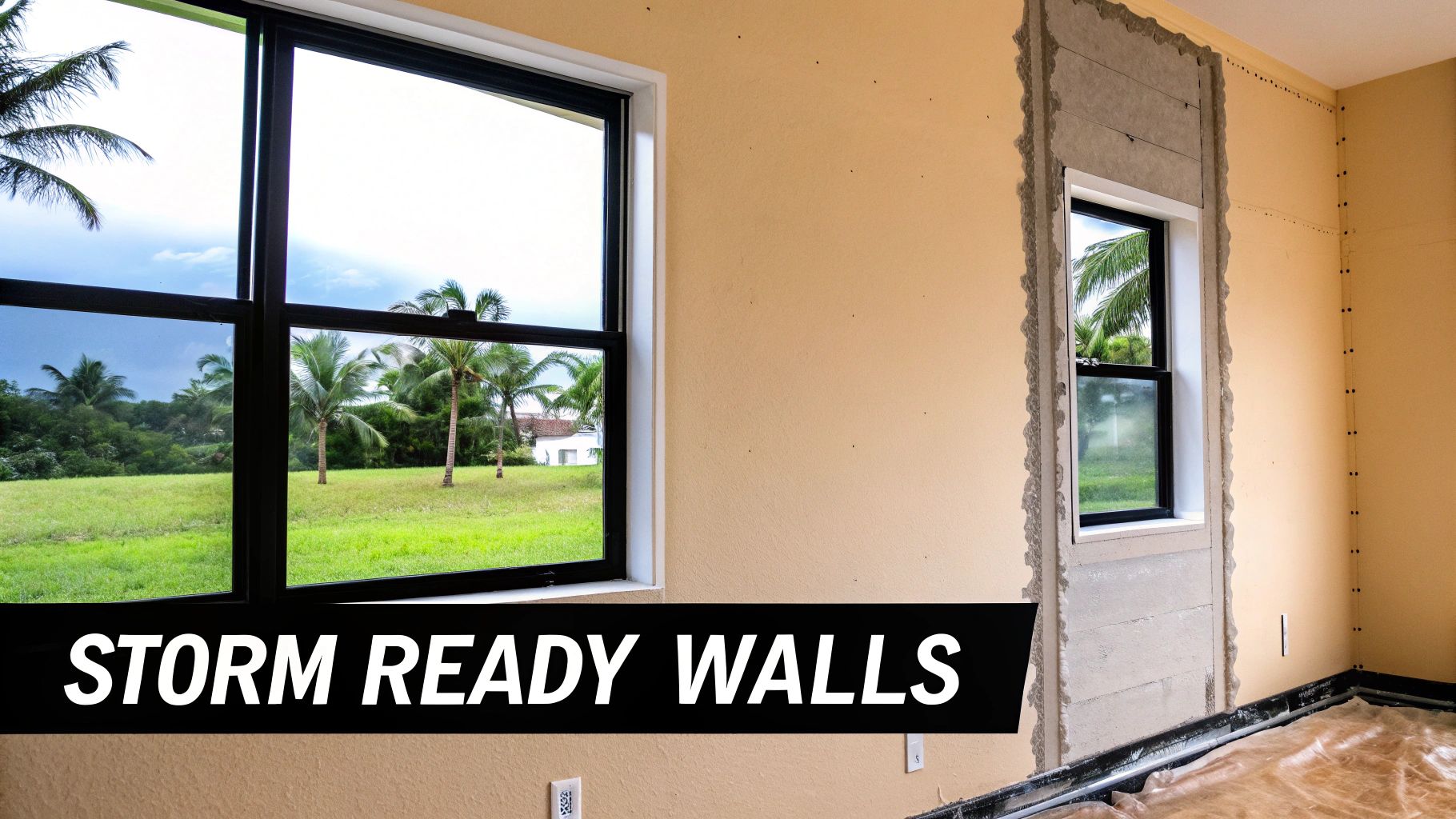
Here in Southwest Florida, walls aren't just for dividing rooms—they're a critical line of defense. Between the intense sun, suffocating humidity, and the constant threat of hurricanes, how a wall performs under pressure is every bit as important as how it looks. When we stack up lath and plaster against drywall, we have to look past the surface to see how each one handles these unique local stressors.
This really gets to the heart of building a resilient custom home in places like Cape Coral and Fort Myers, where Mother Nature amplifies daily wear and tear. The strength, moisture-handling capabilities, and structural behavior of your walls directly impact your home's longevity and your peace of mind.
Daily Durability and Impact Resistance
One of the first things you'd notice living with these two materials is their raw toughness. Lath and plaster cures into a solid, rock-hard slab, giving it incredible impact resistance. It’s a dense surface that laughs off the bumps and dings of everyday life, whether you're moving furniture or have kids playing a little too rough indoors.
Drywall, on the other hand, is a much softer material. Its gypsum core is sandwiched between paper, which makes it pretty easy to dent, ding, and scratch. Sure, the repairs are simple, but the constant need for touch-ups can be a real headache for homeowners who want a flawless finish.
In a high-end custom home, the substantial feel of plaster walls adds a tangible sense of quality and permanence. This superior hardness is a key reason why plaster is reconsidered for luxury builds where long-term durability is a primary goal.
Moisture Management and Mold Prevention
Humidity is the defining challenge of building in Florida, making moisture control a non-negotiable priority. This is where the two materials take fundamentally different approaches.
Traditional lime-based plaster is naturally hygroscopic, a fancy way of saying it can absorb and release moisture from the air. This "breathability" helps regulate indoor humidity and makes the wall inherently resistant to mold because moisture doesn't get trapped inside.
Standard drywall doesn't breathe. Its paper facing can become a buffet for mold when it gets wet and stays that way. To get around this, we have to use specialized products in high-moisture zones:
- Moisture-Resistant Drywall: Often called "green board," this is our go-to for kitchens, laundry rooms, and bathrooms.
- Glass Mat Gypsum Board: This is an even tougher option. It uses fiberglass facers instead of paper, making it highly resistant to mold.
With Florida's humidity, picking wall materials that fight moisture and prevent mold is paramount. For a deeper dive, it's worth reading about how to avoid mold in your home and damp buildings. The wall system is just one piece of a bigger strategy to keep your home dry and healthy.
Hurricane Performance and Structural Rigidity
During a hurricane, high-velocity winds put immense pressure on a home's structure, causing the whole frame to flex. While interior walls aren't the main structural defense, their rigidity can absolutely contribute to the overall strength of the building envelope. These hurricane impact features are a core component of new builder trends in Florida.
The dense, seamless nature of a lath and plaster wall adds significant rigidity. By locking onto the studs, it creates a stiff diaphragm that helps resist the racking and flexing forces from hurricane winds. That extra stiffness can mean fewer cosmetic problems like cracked window seals or doors that don't close right after a storm.
Drywall, being a system of separate panels screwed to studs, offers less of this built-in rigidity. The seams are the weak points, and under major stress, these joints can crack. While modern hurricane-rated construction ensures the home's core structure is sound, the monolithic strength of plaster provides a real advantage in keeping things looking good after extreme weather.
Of course, both wall types are just one part of a system that needs to work with proper insulation. You can learn more about how insulation strengthens your home by understanding R-Value in our guide.
Properly cared for, lath and plaster walls can last over 100 years—a testament to their durability—while drywall might show its age after 30-50 years. It's also worth noting that lath and lime plaster offer superior fire resistance. But moisture is still the enemy; about 65% of deterioration in older plaster walls is linked to moisture problems, often from modern repairs that trap dampness.
Analyzing The Cost And Project Timeline
When you're building a custom home here in Southwest Florida, every choice you make has a ripple effect. But few decisions hit your budget and your move-in date quite as hard as the one between lath and plaster versus drywall. The differences in cost and time aren't just small details; they're significant enough to reshape your entire project.
Getting a handle on these differences is crucial for smart planning. You have to weigh the upfront cost and the extra time on the construction schedule against the look and feel you want for your home's walls.
The Financial Breakdown
Let’s be direct: the price gap between these two wall systems is huge, and it all boils down to labor. Lath and plaster is a true craft, demanding skilled artisans who are, frankly, becoming harder and harder to find. In Southwest Florida, securing a crew with the deep experience needed for a perfect three-coat plaster finish is a real challenge, and their expertise comes at a premium.
Drywall, on the other hand, is the engine of modern building efficiency. The materials are everywhere, and there’s a large pool of experienced crews, which keeps labor costs competitive and easy to predict. The whole process is a well-oiled machine, from hanging the sheets to finishing the seams, making it simple to forecast costs accurately.
Here’s where the money goes:
- Labor Costs: This is the big one. Lath and plaster can easily cost three to five times more per square foot than drywall. That difference is almost entirely due to the specialized, time-intensive skill it requires.
- Material Costs: While the raw materials for plaster—gypsum, lime, sand—aren't wildly expensive on their own, you need a lot of them for those thick, multiple coats. Drywall sheets are mass-produced, which helps keep the material costs down.
- Project Delays: The longer timeline for a plaster job can sneak in other costs you might not think about, like extra months on a construction loan or extended rent for temporary housing. You have to factor those into the real total budget.
Impact On Your Construction Schedule
In any custom home build, time is one of your most valuable assets. These two wall systems operate on completely different clocks. The sheer speed of drywall is a major reason it became the go-to standard for builders in fast-growing places like Cape Coral and Fort Myers.
We can have a standard-sized custom home fully drywalled—hung, taped, mudded, and sanded—in just a few days. That fast turnaround means the painters, electricians, and cabinet installers can get in and start their work right away, keeping the whole project humming along without dead time.
For a custom home builder, maintaining momentum is essential. Drywall’s quick installation and predictable drying times create a reliable workflow, minimizing the costly downtime that can plague a construction site.
Lath and plaster, however, is a slow, methodical process that can tack on weeks, sometimes even a month or more, to your project. Each of the three coats—the scratch, brown, and finish coat—has to be applied and then cure properly before the next one can even start.
That curing time gets tricky with Florida's humidity, which can really slow things down. A single room might take a couple of weeks to finish properly, and a whole house can mean a major delay. This doesn't just push back your move-in date; it disrupts the entire sequence of the build, from installing baseboards to laying down your final flooring. This isn't just about picking a wall finish; it's about choosing a construction philosophy—old-world craftsmanship versus modern, streamlined efficiency.
Exploring Aesthetics And Custom Design Opportunities
When we're building a custom home here in Southwest Florida, the walls are so much more than just dividers. They set the tone for the entire house. Moving past the technical specs, your choice between lath and plaster versus drywall really shapes your home's character and what’s possible aesthetically. This is where your design vision starts to take shape, whether you’re dreaming of old-world charm or crisp, modern lines.
Plaster is the undisputed champion of high-end, artisanal finishes. Its most celebrated quality is the ability to create a completely seamless, solid surface, with none of the joints or seams you see with drywall. This opens the door to stunning architectural details that are frankly difficult, if not impossible, to pull off with drywall.
Just picture a grand entryway with a gracefully curved staircase, or an arched hallway that flows perfectly without a single sharp corner. For these kinds of organic, flowing shapes, plaster is the perfect medium. It gives a custom home a feeling of substance and handcrafted elegance that’s hard to beat.
The Artistry Of Plaster Finishes
The real magic of plaster, though, is its incredible versatility. In the hands of a skilled artisan, that final coat can be worked to create a huge range of textures, from a polish as smooth as glass to a rich, dimensional finish.
This is how you make a truly unique design statement:
- Venetian Plaster: A go-to choice in luxury homes, this finish is polished to a high sheen that creates a marble-like surface with incredible depth and movement.
- Tadelakt: This is a traditional Moroccan lime plaster technique that gives you a smooth, waterproof finish. It's perfect for creating unique, seamless showers or bathroom walls.
- Textured Finishes: From a light stippling to more pronounced, rustic textures, plaster can be tailored to fit any style, whether you're building a Mediterranean-inspired home or restoring a historic one.
These finishes create a look and feel that drywall just can't match. The subtle, natural variations in a hand-troweled wall add a layer of warmth and authenticity, making it the top choice for clients who want their home to feel truly one-of-a-kind.
The Versatility And Practicality Of Drywall
While plaster brings that artisanal charm, drywall delivers a crisp, clean canvas that has become the foundation of modern and minimalist design. Its biggest aesthetic plus is its ability to produce a perfectly flat, uniform surface, especially when you go for a Level 5 finish—the highest standard of smoothness available.
In contemporary homes where clean lines, sharp angles, and flawless surfaces are everything, drywall is often the better choice. It creates the perfect, quiet background that lets feature lighting, large artwork, and minimalist new design features really shine.
Beyond its clean appearance, drywall offers a practical flexibility that’s a huge deal for modern life in Florida. Our homes change as technology does. Need to add a new outlet, run wiring for a smart home system, or install a dedicated circuit for a whole-house generator in storms? It's a straightforward job with drywall.
The process is simple: cut a hole, run your wires, and patch it up seamlessly. Trying to do the same thing with a lath and plaster wall is a much bigger, dustier job that usually requires a skilled plasterer to come in and fix the damage. This adaptability makes drywall a more future-proof option, ensuring your home can easily grow with your needs.
The Final Verdict For Your Florida Home

After weighing the construction methods, climate performance, costs, and design potential, the choice between lath and plaster vs drywall for your Southwest Florida custom home becomes a whole lot clearer. Each material has its place in modern construction, but they line up with very different priorities for homeowners here in Cape Coral and Fort Myers. The final decision really comes down to balancing your design dreams with the hard realities of your project’s budget and timeline.
For the overwhelming majority of new custom homes we build today, modern drywall systems are the hands-down winner. There's a good reason it's the industry standard—it’s cost-effective, goes up fast, and fits perfectly with contemporary building schedules. When you pair it with moisture-resistant boards in kitchens and baths, drywall delivers excellent, reliable performance that’s built for Florida’s humidity.
When Drywall Is The Clear Winner
In most building scenarios, drywall is simply the most practical, high-performance solution. It gives you a clean, smooth canvas (especially with a Level 5 finish) that's perfect for the modern and transitional designs so many of our clients love. Its flexibility is another huge plus. Need to run new wiring for smart home features or add a generator connection for hurricane season? Modifying drywall is a simple, straightforward job, ensuring your home can grow with your needs.
For builders and homeowners in Southwest Florida, predictability is everything. Drywall’s consistent quality, stable pricing, and fast installation help keep custom home projects on schedule and on budget, minimizing delays from labor shortages or bad weather.
When To Consider Plaster As A Premium Option
Now, this doesn’t mean lath and plaster, or its modern cousin veneer plaster, is obsolete. Not at all. It’s better to think of it as a premium, niche application for specific, high-impact goals. You'll want to think about plaster when your project calls for something special:
- Authentic Historical Design: If you're creating a room with a specific historical feel, nothing beats the authentic look and texture of a true plaster wall.
- Unique Architectural Features: For those stunning curved walls, seamless arched entryways, or intricate ceiling details, plaster offers an artistry that drywall just can't replicate.
- Superior Acoustic Dampening: In a home theater, music room, or even a home office where quiet is key, the sheer density of a plaster wall provides incredible sound insulation.
This decision tree gives you a good visual for how your design goals will point you toward either a modern or a more historic wall finish.
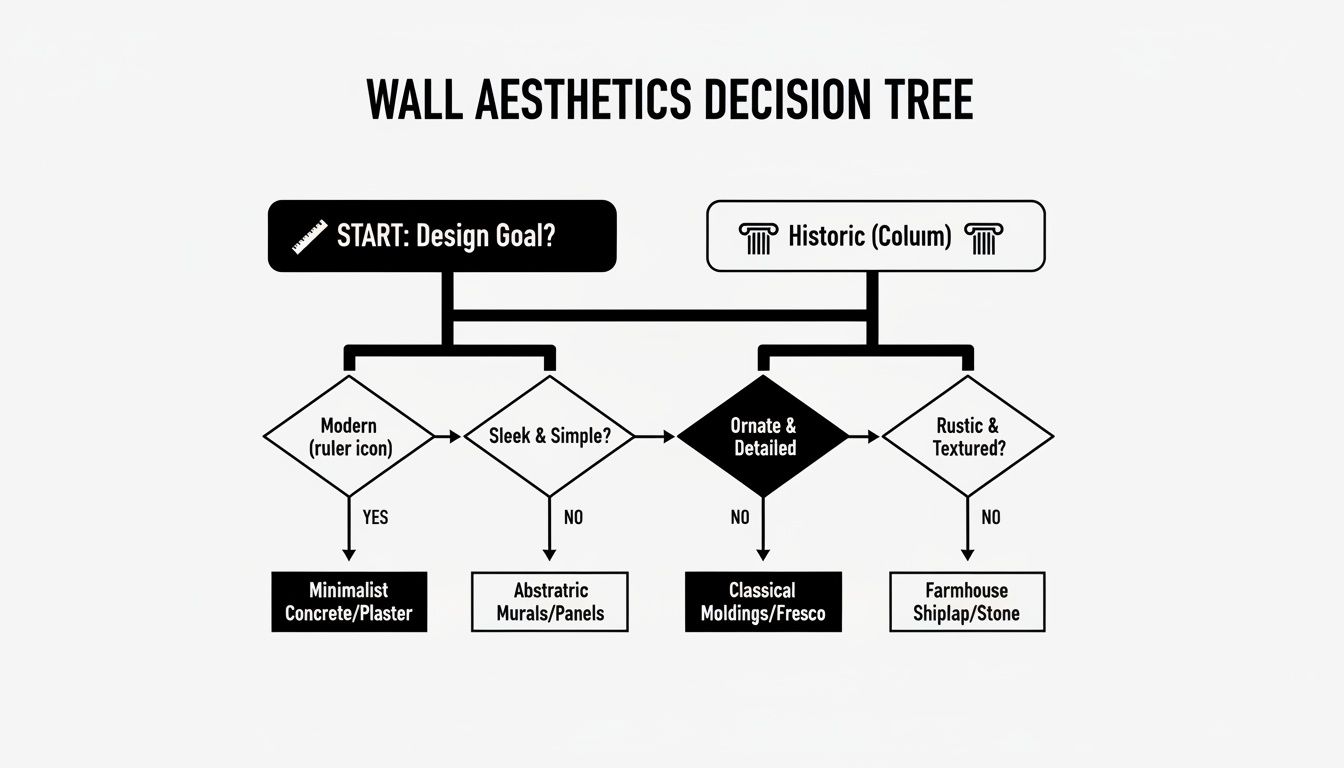

As you can see, both paths lead to beautiful interiors. The choice really splits between the clean precision of modern styles and the rich, textured character of historic finishes. At the end of the day, plaster is an investment in artisanal craftsmanship—something you choose when the budget and timeline take a backseat to achieving a very specific, high-end look.
Frequently Asked Questions
When you're building a custom home here in Southwest Florida, the choice between lath and plaster versus drywall is bound to bring up some questions. We get it. We’ve pulled together the most common things clients ask us to give you clear, straightforward answers from a builder's perspective, keeping our unique climate and building challenges in mind.
Think of this as your guide to understanding the real-world impact of your wall choice, making sure it’s the right fit for your vision of a tough, beautiful Florida home.
Can Old Lath And Plaster Walls Be Repaired During A Renovation?
Yes, absolutely. Original lath and plaster can be repaired, but it's not a job for just anyone—it's a true craft that needs a skilled artisan. For small hairline cracks, you can often get away with modern plaster compounds. But for the big stuff, like when the plaster has broken loose from the lath behind it, the fix is much more complicated. It involves re-keying the plaster to the wood strips, which is a whole different ballgame.
This kind of repair is a lot more time-consuming and expensive than just patching a hole in drywall. That's a huge factor to weigh when you're budgeting for a renovation in an older home.
How Do Humidity And Storms Affect Drywall Vs Plaster Over Time?
Here in Southwest Florida, the humidity is no joke. Plaster has a natural edge because it can breathe, which helps it resist mold. Standard drywall, on the other hand, has a paper face that can trap moisture and become a breeding ground for mold if it gets wet. This is exactly why moisture-resistant drywall is essential in bathrooms, kitchens, and laundry rooms.
When a hurricane hits, a solid plaster wall is more rigid and can sometimes handle the minor flexing of the house structure from high winds a bit better. Drywall seams are the weak points and are more likely to show stress cracks after a storm. But let's be clear: both are just one part of a much bigger system that's engineered to meet Florida’s tough hurricane codes.
The most critical factor for insurance and storm safety isn't the interior wall material but the home's overall compliance with modern building codes—including impact windows, roof connections, and proper elevation.
Is There A Middle-Ground Option Between Full Plaster And Drywall?
You bet. If you love the rock-solid feel and smooth look of plaster but don't want the time and expense of a full-blown traditional system, a veneer plaster system is a fantastic modern solution. It’s a hybrid approach. We install a special type of gypsum board, often called "blueboard," which is made to bond perfectly with a thin, hard coat of plaster skimmed over the top.
The result is a surface that's way tougher and more impact-resistant than regular drywall. We see this a lot in new custom homes because it gives you that premium, high-end feel at a more manageable price and on a much faster timeline than traditional lath and plaster.
Does My Wall Choice Affect Homeowners Insurance In A Hurricane Zone?
For the most part, no. Your insurance company in Cape Coral or Fort Myers isn't likely to change your premium based on whether you have plaster or drywall. They are far more interested in the home's ability to withstand wind and water.
Their focus is squarely on the big-ticket items that really protect your home:
- The age and type of your roof and how it's strapped down to the frame.
- Whether you have hurricane-impact rated windows and doors.
- Your home's elevation and whether it's above the flood line.
As long as the home is built to today's Florida building codes (or exceeds them), the stuff your interior walls are made of just isn't a major factor in how they calculate your rate.
At Sinclair Custom Homes Inc, we’re here to walk you through every one of these decisions, making sure your new home is built with the quality, integrity, and strength the Florida lifestyle requires. Contact us today to start planning your vision.