


Finding the right land for sale in Lee County, Florida, is more than just the first step in building your dream home—it's the foundation of your entire vision. Whether you're picturing a life on the canals of Cape Coral or in a quiet Fort Myers neighborhood, the lot you choose sets the stage. Right now, our local custom home industry is buzzing with activity, fueled by strong demand for new construction featuring the latest in design, efficiency, and hurricane resilience.
Finding Your Slice of Paradise in Lee County
Your journey to a custom home in Southwest Florida starts with the perfect piece of land. The market here is dynamic, shaped by significant growth and a real hunger for newly built homes. This directly impacts the availability and price of lots, from Fort Myers Beach all the way to our beautiful inland estates. Understanding this landscape is key to making a smart investment in your future home.
The demand for vacant lots is a direct reflection of our healthy residential market. In early 2025, Lee County had seen 21,194 residential properties change hands over the previous year alone, with the median home value sitting right around $400,000. That kind of activity makes for a competitive environment when a great piece of land comes up for sale, especially for those looking to build.
Matching the Property to Your Custom Home Vision
Choosing a lot isn't just about acreage; it's about picking the backdrop for your future lifestyle and the specific home you want to build. Lee County's diversity is one of its biggest strengths, offering a canvas for any custom home design.
- Gulf-Access Waterfront: These are the premium spots, especially in Cape Coral. They're prized by boaters for a reason—direct access to the Gulf of Mexico. They naturally come with a higher price tag but are the foundation for the ultimate waterfront custom home.
- Freshwater Canals: If you love scenic water views without constant saltwater maintenance, freshwater lots are a fantastic choice. They offer a peaceful setting perfect for a custom home designed around tranquility and backyard recreation.
- Spacious Inland Estates: Moving away from the coast gives you more land for your money. This opens up possibilities for larger custom homes, detached garages or workshops, and the sprawling outdoor living areas that are a hallmark of new Florida builds.
Here’s a piece of advice from my years in the custom home industry: think beyond the view. Your lot choice impacts your build. Does it have room for a whole-home generator, now a near-standard feature? Can you orient the house to maximize energy efficiency with solar panels or shade from the afternoon sun? These considerations, driven by recent news and storm experiences, are central to building a modern home in Southwest Florida.
First-Look Factors for Your Ideal Lot
Before you get too deep into the weeds of due diligence, a quick preliminary check can save you a ton of time and help narrow your search.
First, think about accessibility. How close is the property to major roads, good schools, and healthcare? That's huge for day-to-day life.
Next, look into local development news. Is a new shopping center or community park planned nearby? Recent trends show that proximity to new infrastructure seriously boosts property value and is a key factor for discerning custom home clients.
A great way to get started is by browsing our listings of available lots. It gives you a real-world picture of what’s on the market right now and helps you start to visualize what’s possible for your custom build. This initial homework sets a strong foundation for a successful purchase.
Mastering Due Diligence for Your Florida Lot
So you've found a lot that looks promising. Great! Now, the real work begins. Proper due diligence is hands-down the most critical phase when you're buying land for sale in Lee County, Florida. This is where you uncover the hidden issues that could completely derail your custom home project or saddle you with massive, unexpected costs.
This isn't just about kicking the dirt and liking the view. It's about digging deep into zoning codes, utility availability, and the unique environmental and elevation challenges that define building in Southwest Florida today.
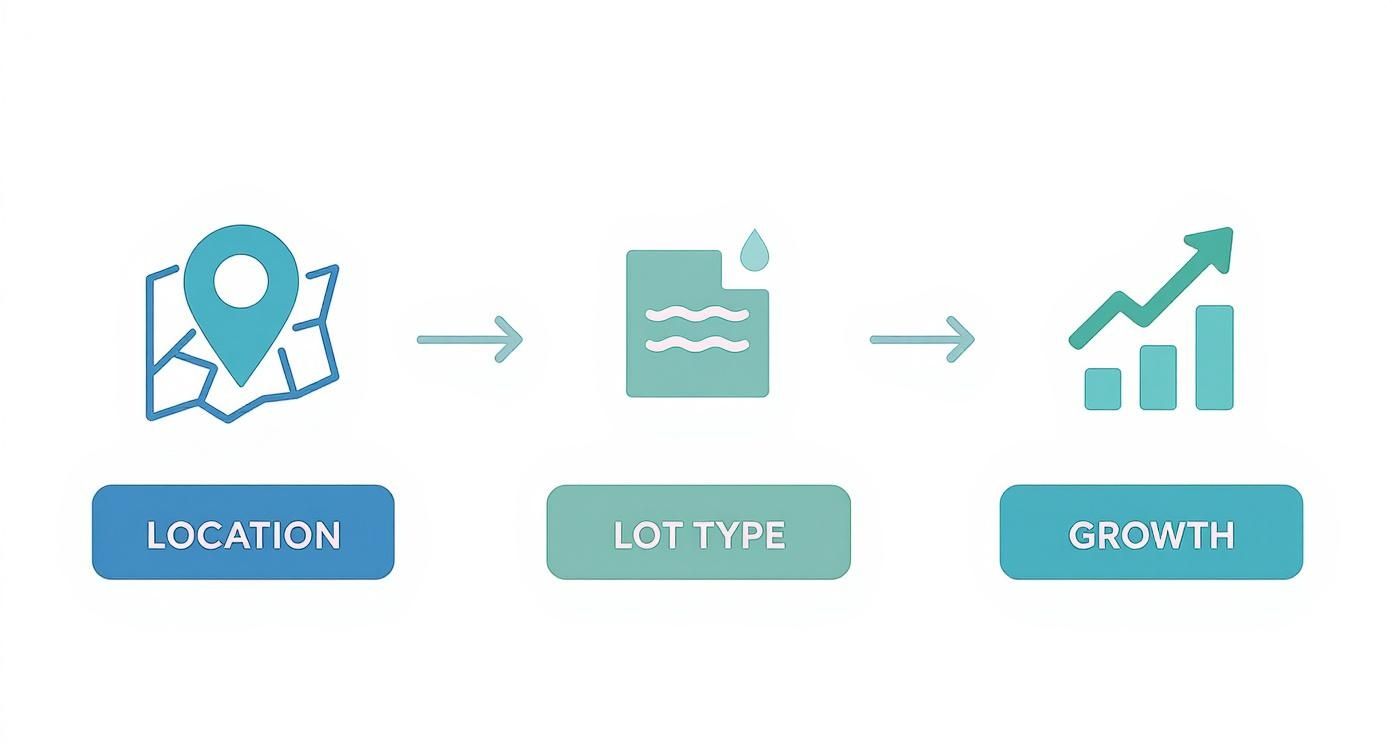

As you can see, a smart purchase is a balancing act. You need a great location and a lot that fits your vision, all while keeping an eye on where the area is headed.
Decoding Zoning and Utility Access
The very first question you have to answer is a simple one: can you legally build the home you envision on this property? Zoning rules control everything—from whether you can build a single-family home to setback requirements that dictate how far your house must be from the property lines. These regulations can literally shrink your home's potential footprint.
Imagine finding the perfect piece of land, only to learn a local ordinance won't allow the two-story design or detached garage you've always wanted. That’s why verifying these details with the city or county planning department isn't just a good idea; it’s non-negotiable.
Utility access is just as crucial. Never assume that city water, sewer, and electricity are a given, especially on parcels that are more rural or in newly developed areas. A quick call to LCEC for power and the local municipality for water and sewer can save you from a $20,000 to $50,000 surprise for utility hookups or the even higher cost of installing a new well and septic system.
Your Essential Due Diligence Checklist for Lee County Land
Before you sign any contract, it's vital to have a clear roadmap for your investigations. We've put together this checklist to help you navigate the critical steps every land buyer must take before committing to a lot for a custom home in Southwest Florida. Think of it as your pre-flight check before building your dream.
| Investigation | Why It's Critical in SWFL | Where to Find Information |
|---|---|---|
| Zoning & Land Use | Confirms you can build your desired home type (single-family, etc.) and size. Prevents costly design changes later on. | Lee County Department of Community Development, or the specific city's (Cape Coral, Fort Myers) Planning/Zoning Department. |
| Utility Availability | Determines if city water, sewer, and electricity are accessible. Avoids tens of thousands in unexpected connection or installation fees. | Local utility providers: LCEC (electric), City of Cape Coral/Fort Myers Utilities (water/sewer). |
| Environmental Survey | Identifies protected species (like gopher tortoises) or wetlands that can restrict your buildable area or require expensive mitigation. | A licensed environmental consultant. Your builder can often recommend a trusted professional. |
| Boundary & Topo Survey | Establishes precise property lines, easements, and the natural elevation of the land. It's the foundation for your site plan. | A licensed land surveyor. This is a non-negotiable step for any land purchase. |
| Flood Zone Verification | Determines your property's flood risk, which dictates foundation requirements, building height (BFE), and flood insurance costs. | FEMA Flood Map Service Center and a surveyor-prepared Elevation Certificate. |
| Title Search | Uncovers any liens, easements, or ownership disputes tied to the property that could prevent a clean transfer of ownership. | A reputable title company or real estate attorney. This is typically part of the closing process but should be ordered early. |
| Permit & Impact Fees | Calculates the government fees required for building. These can add a significant amount to your overall budget and vary by location. | The local building department for the jurisdiction where the lot is located. |
| Soil & Geotechnical Test | Assesses the soil's stability to determine the type of foundation required. Crucial in sandy, low-lying coastal areas. | A geotechnical engineering firm. Recommended for lots with questionable soil conditions or for large, complex home designs. |
This list might seem like a lot, but tackling each item methodically is the only way to protect your investment. A few hundred dollars spent on an expert consultation or survey upfront can save you from a six-figure mistake down the road.
Navigating Florida's Environmental Landscape
Building in Southwest Florida means respecting the local ecosystem. Our area is home to protected wildlife, and the one we encounter most often is the gopher tortoise. If a survey reveals active tortoise burrows on your lot, you'll need a state-permitted, humane relocation before any site clearing can start.
Wetlands are another huge factor. Parts of your lot could be designated as protected wetlands, which severely restricts where you can build and may require costly mitigation efforts. An environmental assessment by a professional is the only way to know for sure.
My most critical piece of advice for any land buyer is this: never, ever skip the professional survey and environmental review. These reports are far more than just paperwork. They are your absolute best defense against budget-busting surprises that can shrink your buildable space or stop your project dead in its tracks.
Lee County spans about 814 square miles of incredibly diverse terrain, from dense urban areas to fragile barrier islands. While beautiful, this geography creates unique building challenges, especially the high vulnerability to flooding and hurricanes across our extensive coastline, which is always in the news.
Understanding Flood Zones and Elevation
Of all the due diligence items, this is the big one. Your property's flood risk will have the single biggest impact on your build. FEMA flood maps designate specific zones, and the zone your lot is in will dictate everything from foundation requirements to your annual insurance bill. Recent updates to these maps and building codes in Florida mean this is a moving target that your builder must be on top of.
An Elevation Certificate is a document prepared by a licensed surveyor that is absolutely essential. It confirms your lot's elevation and determines the required Base Flood Elevation (BFE)—the minimum height for your home's main living floor.
A major new builder trend is adding "freeboard," which means building the home even higher than the BFE requires. It adds to the initial construction cost, but it can slash your flood insurance premiums for years and provides invaluable peace of mind during a storm. As you explore lots, it's also wise to research any local rental regulations in Cape Coral, FL, as these can be tied to flood zones and insurance mandates.
To get a better handle on the risk in different areas, take a look at our guide to the Fort Myers flood zone map. Getting this part right ensures your home isn't just beautiful, but resilient enough to last a lifetime.
Designing a Hurricane-Ready Custom Home
So, you’ve secured the perfect land for sale in Lee County, Florida. Now the real fun begins. Your focus shifts from acquiring a piece of property to creating the home you’ve always envisioned.
Building in Southwest Florida isn’t just about aesthetics; it's about engineering a fortress designed to stand up to Mother Nature. The custom home industry here is driven by resilience. Modern design must meet the demanding reality of our coastal climate, a fact reinforced by recent hurricane seasons and subsequent changes in Florida building codes.
Building a home here means thinking about its strength from the ground up. Every design choice, from wall materials to roof pitch, plays a critical role in its durability and your family's safety. This is the top priority for any reputable custom home builder in the region.

The Foundation of a Storm-Ready Structure
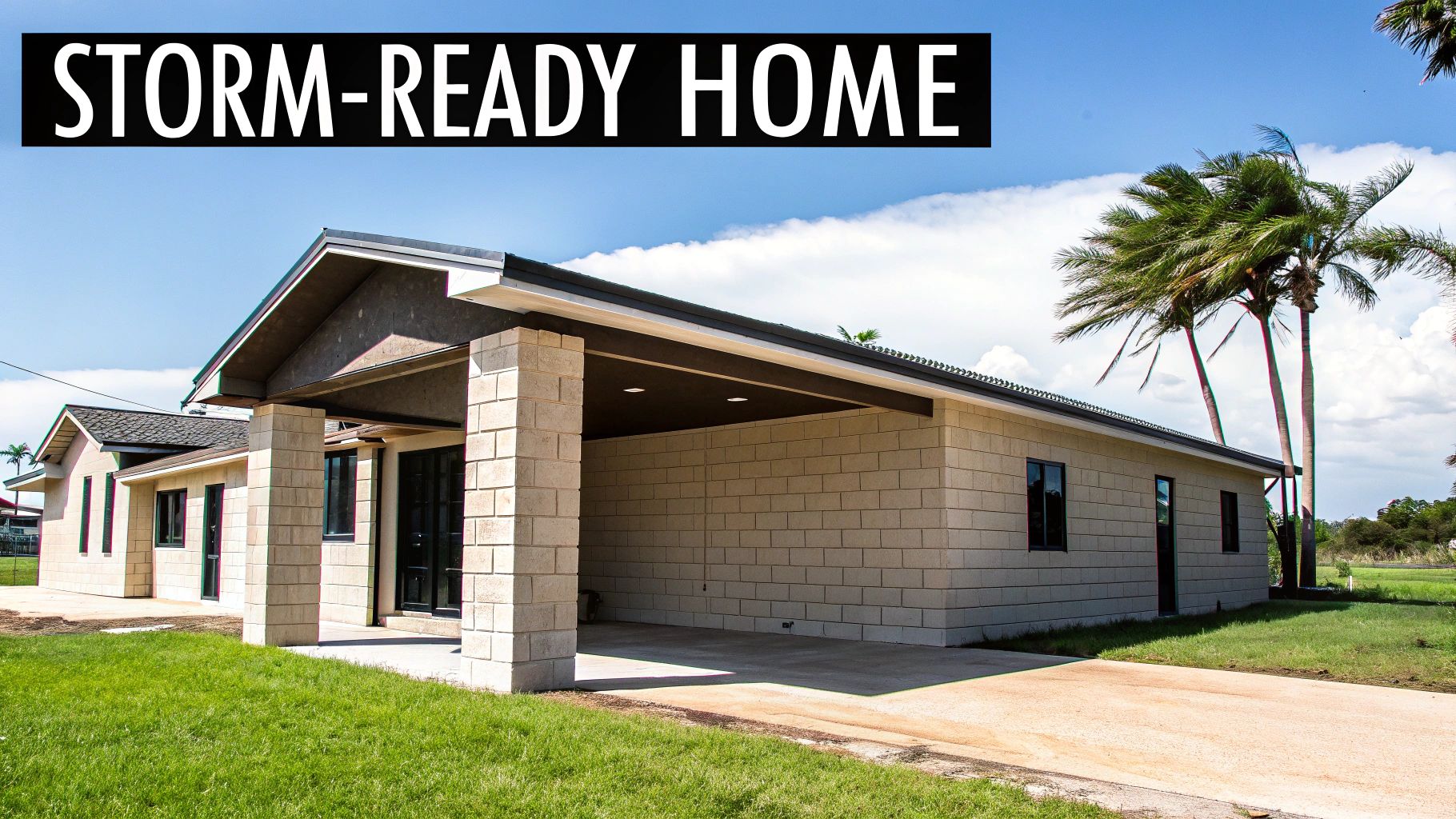
In Florida, any serious conversation about structural integrity starts with one thing: reinforced concrete block construction. While wood-frame homes are common elsewhere, concrete block is the undisputed king in Lee County for its immense strength against high winds, moisture, and termites. It’s the standard for a reason.
After the walls, the roofing system is your home's first line of defense. A leading builder trend is the adoption of standing-seam metal roofs, prized not just for their sleek, modern look but for their superior performance. They offer wind ratings that far exceed traditional shingles and have a lifespan of 50 years or more, a smart, long-term investment in your home's protection.
Meeting Florida's stringent building codes is just the starting point. These codes are among the toughest in the nation and are constantly updated based on lessons from past storms, ensuring every new home incorporates critical hurricane impact features.
- Hurricane-Impact Windows and Doors: This is a non-negotiable feature. Modern impact glass is a laminated sandwich of glass and polymer that can withstand direct hits from flying debris without shattering, protecting your home from devastating wind and water intrusion.
- Reinforced Garage Doors: Your garage door is often the largest—and most vulnerable—opening. A wind-rated, reinforced door is essential to prevent a catastrophic failure during a storm.
- Advanced Roof Strapping: Builders use specialized metal connectors (hurricane straps) to securely anchor roof trusses to the concrete block walls. This critical component prevents the roof from lifting off in severe winds.
Embracing the Florida Climate in Your Design
A resilient home should also be a comfortable one. Great design in Southwest Florida goes beyond safety; it embraces our climate to create efficient, enjoyable living spaces. New design features focus on energy efficiency to combat rising utility costs.
Strategic design choices can make a world of difference. For instance, carefully planned roof overhangs provide essential shade, keeping the intense Florida sun from baking your windows. This passive cooling technique is a hallmark of smart, regional architecture.
This thoughtful approach extends to your home's mechanical systems. High-efficiency, multi-zone HVAC systems are no longer a luxury but a necessity for managing both temperature and humidity. When paired with high-quality spray foam insulation, you create an airtight building envelope that keeps the cool air in and your FPL bill down.
One of the biggest shifts we've seen in custom home design is the focus on seamless indoor-outdoor living. It's about more than just a patio; it's about creating expansive, covered lanais with features like summer kitchens and comfortable seating areas that truly function as an extension of the home's interior living space.
The Rise of the Whole-Home Generator
Recent storms in Florida have taught residents a hard lesson about power grid fragility. As a result, one of the most requested new design features is a whole-home generator. It's no longer seen as an upgrade but as crucial home infrastructure, especially during hurricanes.
Unlike a portable generator, a whole-home system is permanently installed and wired directly into your electrical panel. It automatically activates within seconds of a power outage, running everything from your air conditioning and refrigerator to lights and internet.
This feature provides more than just convenience; it offers invaluable peace of mind. During a prolonged outage following a storm, a generator ensures your family remains safe and comfortable, preserving a sense of normalcy when it's needed most. It’s a powerful statement about preparing for the realities of living in Southwest Florida.
Navigating Land Loans and Closing Costs

Getting a loan for a vacant lot isn’t anything like financing an existing home. Lenders just see raw land as a bigger risk, so they’re naturally going to have stricter requirements for you to meet. It’s a huge financial step in your journey, and you really need to understand the lay of the land before you dive in.
When you start looking for land for sale in Lee County, Florida, you’ll find that your best bet is almost always a local bank or credit union. These folks know the market inside and out—from the specifics of a waterfront property in Cape Coral to the growth patterns in Fort Myers. They have a real stake in the community and tend to be more flexible than the big national lenders who might not get our local building codes and nuances.
Land Loans Versus Construction-to-Permanent Financing
You’ve got two main routes for financing your land and build: a standalone land loan or a combined construction-to-permanent loan. They each have their place, and the best choice really boils down to your timeline.
- Land Loans: This loan is just for buying the lot itself. It’s a solid option if you want to secure your piece of land now but know you won't be ready to build for another year or two. Just be ready for higher interest rates and a bigger down payment, usually somewhere between 20% to 50%.
- Construction-to-Permanent Loans: This is what most people ready to build will choose. It's a single, streamlined loan that covers the land purchase, all construction costs, and then converts to a standard mortgage once your home is finished. It’s a "one-time close," which means you save a ton of time and money by not having to pay closing costs twice.
When a local lender looks at your application, they're going to zero in on your credit score, your debt-to-income ratio, and the detailed plans for the home you're building. They want to see a solid project backed by a builder with a great reputation.
Understanding the Intense Lee County Market
The financial stakes here in Lee County are no joke, thanks to the fierce demand for any land that can be developed. Recent news continues to highlight this pressure; a massive $620 million deal for about 1,900 acres of rock mining land in 2024 completely shattered the record for the highest land sale in county history. That kind of transaction really underscores the supply-and-demand pressure that drives up land values and, in turn, what lenders require from buyers.
In a hot market like this, lenders get even more careful. They need absolute confidence that the lot you're buying is a sound investment for the home you plan to put on it. This is where having your builder chosen and a clear plan in hand gives you a major advantage.
Breaking Down the Closing Process
Once your loan gets the green light, it’s time to head to the closing table. This is where the property officially becomes yours. Two key players will get you across the finish line: the land surveyor and the title company.
First, a boundary survey is non-negotiable. It confirms the exact property lines and identifies any easements or encroachments that could cause headaches later. Both your lender and the title company will require a fresh, legally binding survey—don't try to rely on old fence lines or markers.
The title company is responsible for the legal transfer. They’ll run a comprehensive title search to make sure the land is free of any hidden liens or claims. They also issue title insurance, which protects both you and the lender from any ownership disputes that might pop up down the road.
Your closing statement will break down all the final costs. You can expect to see:
- Survey Fees
- Title Search and Insurance Premiums
- Attorney Fees
- Recording Fees (for the deed)
- Loan Origination Fees
A good rule of thumb is to budget 2-5% of the land's purchase price for these costs. Planning for them upfront means no nasty surprises. Getting through closing is the final hurdle before the real fun begins! To see how these financial steps fit into the bigger picture, check out our guide on how to build a custom home.
Preparing Your Site for Construction
With the deed in your name, the dream of your custom Florida home starts to feel real. This is the moment when the raw land for sale in Lee County, Florida, you carefully chose begins its transformation into an actual homesite. The site prep phase isn't just one step; it's a series of crucial, carefully planned events that create the literal groundwork for everything to come.
This isn't just about moving dirt around with a bulldozer. It’s a thoughtful process of shaping the land, clearing what’s necessary while respecting the local environment and adhering to new building regulations that affect Southwest Florida. Here, your vision truly merges with your builder's expertise.
Land Clearing and Grading With a Purpose
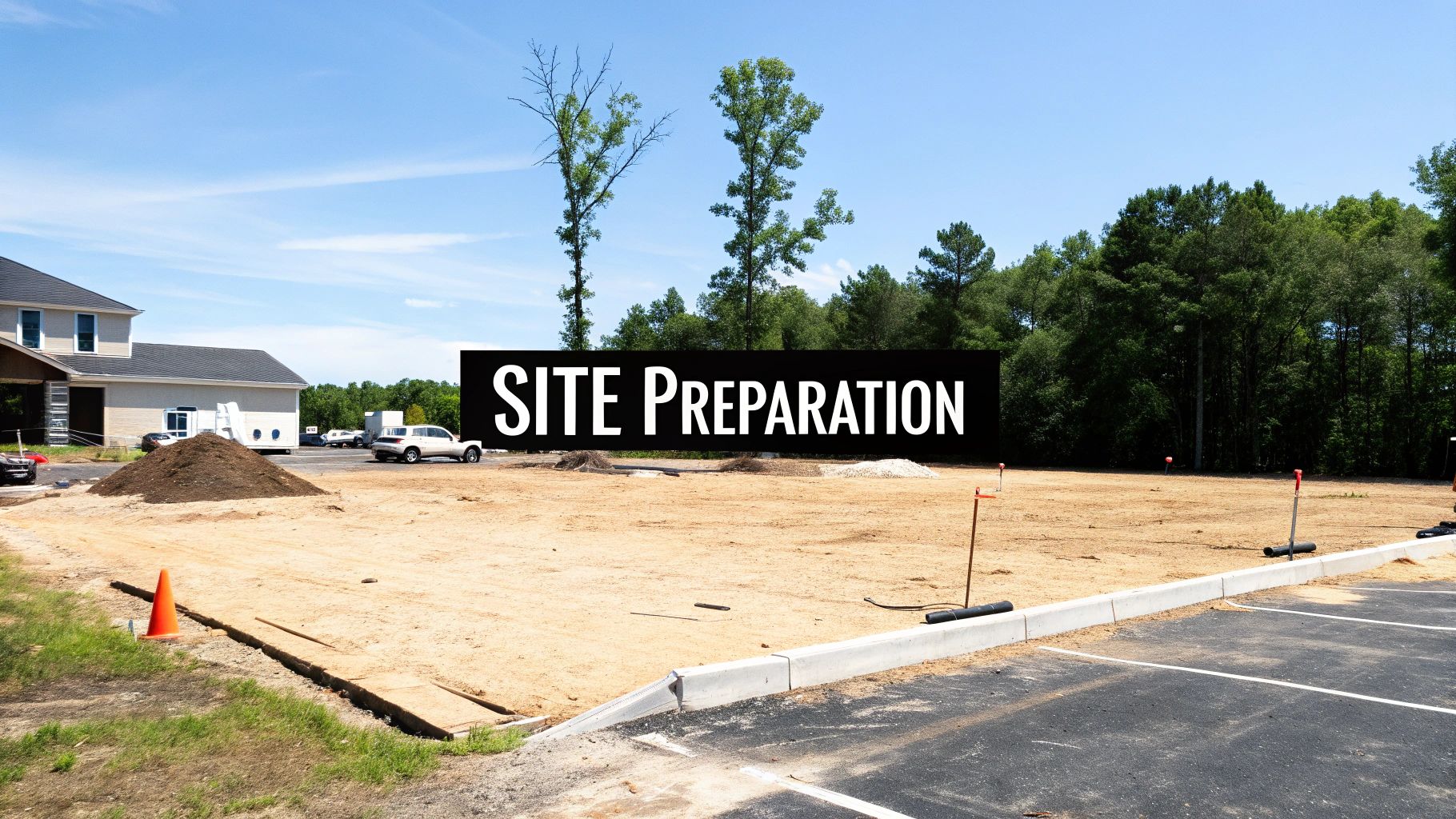
The first big job is clearing the lot, but it's far from a scorched-earth operation. Lee County and cities like Cape Coral have specific rules about tree removal, especially for native species like mature pines or oaks. A good builder knows these regulations inside and out, securing the right permits while saving valuable trees that can add character and much-needed shade to your final landscape.
After clearing, the focus turns to grading. In a low-lying area like Southwest Florida, this is non-negotiable. Proper grading is the art of sculpting the land so that rainwater flows away from your foundation, preventing pooling and the potential for water damage later on. This is especially critical for achieving the required elevation to minimize flood risk, a key concern for any new construction.
The most overlooked part of site prep is almost always drainage. A well-graded lot doesn't just protect your foundation—it keeps your yard from turning into a swamp after every summer storm. It's a foundational detail that quality builders nail from the get-go.
Building the Foundation Pad
With the lot graded, your builder will construct the foundation pad. Think of this as the stable, compacted base of soil and fill dirt where your concrete slab will be poured. The height and makeup of this pad aren't just guesswork; they're precisely determined by two key documents:
- The Soil Test: This report tells engineers everything they need to know about the soil's stability, informing the specific foundation design required to support your home's weight without settling.
- The Elevation Certificate: This survey confirms the pad's final height will meet or exceed the Base Flood Elevation (BFE) set by FEMA and local building codes, which are constantly being updated in Florida.
Getting this pad right ensures your home starts on a solid, level, and compliant footing, safeguarding your investment for decades.
Logistics and Permits: The Unseen Essentials
Before the first concrete truck rumbles onto the site, your crew needs power and water. Your builder will handle coordinating with utility companies to install temporary power poles and water hookups. This is an essential step that allows all the different trades to run their equipment and work efficiently.
At the same time, the critical process of securing building permits from Lee County or the relevant city is happening in the background. This can be a complex bureaucratic step, involving the submission of detailed architectural and engineering plans for review. An established local builder’s rapport with the permitting office is invaluable here, helping you sidestep delays that could stall your project before it even starts.
Once the site is prepped and the foundation is in, the next big milestone is the structural build. You may need to look into professional framing services to ensure this critical phase is handled with precision. With permits approved and the site ready, you finally get to see your home begin to rise from the ground.
Common Questions About Buying Land in Lee County
The idea of finding the perfect piece of land for sale in Lee County, Florida, and sketching out your custom home is exciting. But it also brings up a ton of questions. From costs that pop up out of nowhere to the latest design must-haves for new builds, getting solid answers is the only way to move forward with confidence. We get these questions all the time, so let's tackle them head-on.
Getting these details sorted out early is what makes the journey from an empty lot to your finished custom home feel smooth instead of stressful. It’s all about meshing your vision with the practical realities of building in Southwest Florida today.
What Are the Biggest Hidden Costs When Buying Land Here?
Beyond the purchase price of the lot itself, the biggest financial curveballs almost always come from site preparation and municipal impact fees. These are the costs that aren't on the listing sheet but are absolutely critical to a successful build.
For example, a huge number of lots, especially in canal-heavy areas like Cape Coral, need a surprising amount of fill dirt trucked in. This isn't optional; you have to raise the lot's elevation to meet or exceed the required Base Flood Elevation (BFE). That step alone can easily run into thousands of dollars before you've even poured the foundation.
Other expenses that can sneak up on you include:
- Dense Vegetation: A heavily overgrown lot can add a hefty sum to your budget just for clearing.
- Protected Species: If you have gopher tortoises on your property, their safe and legal relocation is your financial responsibility.
- Utility Hookups: For lots without service, the cost to bring in water, sewer, and power lines can be substantial.
- Impact Fees: These are one-time fees local governments charge on all new construction to help pay for roads, parks, and other infrastructure. They can add a significant chunk to your total project cost.
How Do I Know the Right Elevation for My New Home?
Figuring out the proper finished floor elevation for your home is a science, not a suggestion. It’s all dictated by official FEMA flood maps, which set a specific Base Flood Elevation (BFE) for your property. This is the absolute minimum height your main living floor can be to meet building codes and floodplain rules, a topic of constant news and updates across Florida.
To get it right, a licensed surveyor performs an Elevation Certificate. This document is the official record of your land's current height, giving your builder the baseline they need to calculate exactly how high to build the foundation pad.
Here's a pro tip: Smart builders and homeowners are now adding "freeboard." This means building the home’s floor even higher than the legally required BFE—often by a foot or two. This new builder trend might add to your upfront cost, but the long-term payoff is massive, from better flood protection to a serious discount on your annual flood insurance premiums.
Can I Build a Dock or Seawall on a Waterfront Lot?
Yes, absolutely—but it’s a very specific process that requires a lot of planning and permits. You can't just hire a contractor and start building a new seawall, dock, or boat lift. You first have to work through a multi-layered permitting process that starts right here at the local level.
The City of Cape Coral, for instance, has its own strict requirements and review boards for any construction along its hundreds of miles of canals. Depending on the waterway, you might also need a green light from state agencies like the Florida Department of Environmental Protection (DEP) or even the U.S. Army Corps of Engineers.
This process requires professional surveys and detailed engineering plans. We always recommend partnering with a specialized marine contractor who lives and breathes these specific permitting channels in Lee County.
What New Design Features Are Popular in SWFL Homes?
Current custom home trends are a direct answer to our local climate, lifestyle, and recent storm experiences. It's all about blending hurricane impact features with energy efficiency and the seamless indoor-outdoor living we all love. People want homes that aren't just beautiful but also smart and ready for anything.
On the resilience side, metal roofs and whole-home generators are becoming standard features, not upgrades. In fact, generators are crucial in storms for maintaining power. Inside, that desire for wide-open floor plans that flow right into a huge, screened-in lanai is as strong as ever. These outdoor living rooms often feature full summer kitchens, turning them into a true extension of the home.
Energy efficiency is the other big focus. New design features like spray-foam insulation, high-SEER multi-zone HVAC systems, and integrated smart home tech aren't luxuries anymore; they're expectations. These features deliver incredible comfort while keeping utility bills in check against that relentless Florida heat and humidity.
Turning your vision into a home starts with having the right partner. At Sinclair Custom Homes Inc, we bring decades of hands-on experience and a real commitment to quality, making sure your new home is built to last. We're here to guide you through every single step, from picking the perfect lot to handing you the keys.
Ready to build your dream home in Southwest Florida? See how we can help you get started.