


If you're thinking about building a custom home in Southwest Florida, you're probably not wondering if you need hurricane insurance. The real question on everyone's mind is, how much is this going to cost me?
Let’s be direct: Florida homeowners insurance, which bundles in hurricane coverage, is the most expensive in the entire country. We’re not talking a little more expensive; premiums here can be several times higher than the U.S. average. This isn't just a minor line item—it's a major financial reality that needs to be factored into your budget right from the earliest design stages of your new custom home.
What Is The Real Cost Of Florida Hurricane Insurance?
Figuring out the true cost of hurricane insurance in Florida is more complicated than looking up a single number. Think of it as a complex equation influenced by a history of catastrophic storms, a shaky insurance market, and the specific resilience of your property. For anyone building a custom home in places like Fort Myers or Cape Coral, getting a handle on this financial baseline is absolutely critical.
The numbers are eye-watering. Projections for 2025 suggest the average annual cost for homeowners insurance in Florida could climb to $15,460. To put that in perspective, that’s nearly five times the national average of roughly $3,000.
Florida Hurricane Insurance At-A-Glance Cost Comparison
This table really puts the cost difference into perspective. It shows just how much more Florida homeowners are paying compared to the rest of the country.
| Metric | Florida Average (Projected) | U.S. National Average |
|---|---|---|
| Annual Homeowners Insurance Premium | $15,460 | $3,000 |
This massive gap is a direct result of our state's vulnerability to hurricanes and the ever-increasing costs of storm-related damage. It's not just about paying more; it's about navigating a very tough market.
After taking massive losses from recent storms, many large, private insurance companies have either pulled back from Florida or left the state altogether. This has pushed a huge number of homeowners toward Citizens Property Insurance Corporation, changing the entire dynamic of the market.
The Role Of Citizens Insurance
Citizens was set up by the state to be an "insurer of last resort." Its job is to provide coverage for people who simply can't find a policy in the private market. While it serves as a vital safety net, it was never designed to be the go-to insurer for a huge chunk of the population.
Being insured through Citizens also comes with its own unique set of rules, coverage limitations, and potential assessments. This reality highlights just how important it is to build a home that private insurers actually want to cover.
These aren't just abstract details for those planning a new build—they are central to your home's long-term affordability. Every single choice, from the building materials you select to the home's elevation, has a direct impact on your ability to find and afford good insurance.
The goal when building a new custom home isn't just to find any insurance policy. It's to build a home so strong and resilient that it qualifies for the best possible rates from private carriers, steering clear of last-resort options entirely.
Location And Risk Go Hand-In-Hand
Finally, it’s crucial to remember that where you build is just as important as how you build. Your property’s specific location—especially its elevation and how close it is to the coast—is one of the biggest factors driving your premium.
Understanding your lot's unique risk profile is the first step toward managing these future costs. For a deeper dive into how your address affects your risk, check out our guide on the Fort Myers flood zone map. Armed with this knowledge, you can make smarter decisions long before breaking ground, ensuring your dream home is as insurable as it is beautiful.
Why Florida's Insurance Market Is So Risky
To really get a handle on why hurricane insurance is so expensive in Florida, you have to look past the current sticker shock and dive into the state's chaotic history with major storms. Florida’s peninsula juts out into hurricane alley, making it a natural target. This constant threat has cooked up one of the most complicated and expensive insurance markets on the planet. For anyone building a custom home here in Southwest Florida, understanding this backdrop isn't just helpful—it's essential.
The whole insurance game is built on predicting the future by looking at the past. But Florida is a different beast. The frequency and sheer power of the hurricanes hitting our shores mean insurers are always trying to price for the next "big one"—a catastrophic, multi-billion dollar event that will happen again.
This isn't a new headache. The financial shockwaves from storms nearly a century ago are still being felt. Take the 1926 Great Miami Hurricane. If that same storm hit today, it would rack up insured losses over $128 billion, making it the single worst disaster in state history. The problem for insurers is they just don't have enough data on storms of that magnitude to accurately predict when the next one will hit. That uncertainty makes pricing future risk a nightmare. You can dig deeper into the unique challenges of the Florida insurance market on the NAIC website.
The Vicious Cycle: Big Storms and Fleeing Insurers
When a monster hurricane makes landfall, the damage goes far beyond splintered wood and flooded streets. Insurance companies pay out billions upon billions in claims, draining their cash reserves. One bad season can wipe out smaller companies and make the big national players pack their bags and leave the state for good.
We've seen this movie before. A major storm hits, insurers hemorrhage money, and they react by either jacking up premiums or simply refusing to write new policies in high-risk zones like Cape Coral and Fort Myers. This exodus shrinks the pool of available insurers, which cranks up demand and drives costs through the roof for everyone left.
For us as custom home builders, this cycle drives home a critical point: building a home to meet the bare minimum code just doesn't cut it anymore. The market now demands homes that are built like fortresses—resilient enough to withstand the worst and still qualify for coverage from the few private insurers brave enough to stay.
How the Insurance Crisis Is Forcing Smarter Building
This skittish insurance market has completely reshaped new builder trends in Florida. It's no longer just about curb appeal or fancy finishes; it’s about survival and insurability. That's why you're seeing a massive shift toward new design features and hurricane impact features designed to fight back against hurricane-force winds and water.
- Elevated Living: In coastal areas, building custom homes on raised foundations or stilts is the new normal. Lifting a home above the Base Flood Elevation (BFE) dramatically cuts the risk of storm surge flooding, which is a huge source of insurance claims.
- Concrete Block Construction: Concrete Block Structure (CBS) is now the go-to choice over traditional wood frames. It's simply tougher against high winds and flying debris, making it a much safer bet in the eyes of an insurance underwriter.
- Backup Power Solutions: A growing trend is the inclusion of whole-home generators. After major storms, extended power outages are a certainty. A generator not only provides comfort but prevents secondary damage like mold from lack of air conditioning, showcasing a homeowner's commitment to mitigating all forms of loss.
These building trends are a direct answer to the pressures of a high-stakes insurance market. Every choice we make—from the shape of the roof to the type of windows we install—is a calculated move to lower risk. This proactive, resilient approach isn't just a nice feature anymore; it's a financial necessity for anyone who wants to build and affordably insure a custom home in Southwest Florida.
How Your Custom Home Design Impacts Insurance Rates
When you're trying to figure out how much is hurricane insurance in Florida, the blueprints for your new custom home are one of the most powerful tools you have. Every single design feature and material choice you make during the construction phase directly impacts your insurance premiums for decades.
Think of it this way: an insurer is placing a bet on your home's ability to survive a hurricane. The smarter your design choices, the better the odds are in your favor—and the lower your annual costs will be.
This flowchart shows how Florida's turbulent market, shaped by a history of massive storms, leads directly to the high premiums we see today.
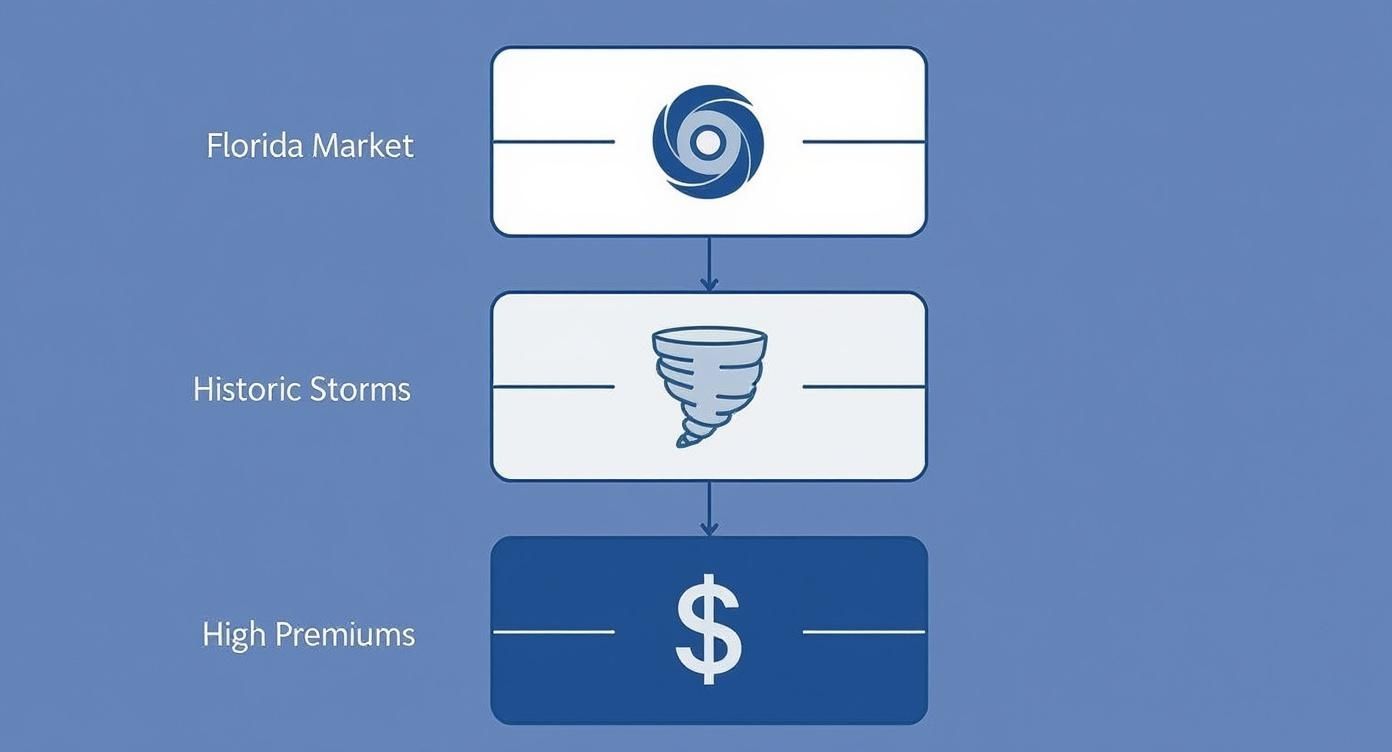

It's a clear picture of why building a resilient home isn't just about safety; it's a financial necessity for any Florida homeowner.
Construction Materials: The Foundation of Lower Premiums
Here in Southwest Florida, the debate between wood-frame and concrete block construction is pretty much over, at least from an insurance perspective. Insurers heavily favor Concrete Block Structure (CBS) for its incredible resistance to both high-speed winds and impacts from flying debris.
A home built with reinforced concrete is just a tougher structure, plain and simple. It's far less likely to fail catastrophically during a major storm. That inherent strength means lower perceived risk for the insurance carrier, which translates directly to a much better premium for you. While wood-frame homes can be built to code, CBS is the undisputed gold standard for resilience in our region.
The Critical Role of Roof Design
After the foundation, your roof is the home's primary line of defense against a hurricane. Its shape is a huge design feature that underwriters look at very, very closely.
- Hip Roof: This design, where all four sides slope down to the walls, is the champion of wind resistance. It's aerodynamic, letting high winds flow over and around the house with less pressure and uplift. Insurers love hip roofs and offer significant discounts for them because they consistently perform better in storms.
- Gable Roof: A gable roof, with its classic triangle shape, is a completely different story. Those flat ends act like sails, catching the wind and creating immense upward pressure that can tear the entire roof off. From an insurance standpoint, a gable roof is a massive liability in Florida.
Building a new custom home with a hip roof is one of the single most effective design choices you can make to slash your long-term insurance costs. The savings over the life of a 30-year mortgage can be absolutely huge.
Modern Hurricane Impact Features Insurers Love
Beyond the basic structure, adding modern hurricane-rated features is key to getting the best rates. These aren't really "upgrades" anymore; they're standard practice for smart, insurable construction in places like Fort Myers and Cape Coral.
- Hurricane Impact Windows and Doors: These products are engineered to take a beating from wind-borne debris. More importantly, they protect the "envelope" of your home, preventing the sudden internal pressurization that can blow a roof clean off.
- Fortified Garage Doors: A standard garage door is often the weakest link in a home's armor. A wind-rated, reinforced garage door is critical to prevent a breach that could lead to catastrophic failure of the whole structure.
- Whole-Home Generators: A permanently installed generator signals a higher level of preparedness. During prolonged power outages common after storms, a generator prevents secondary damage like mold growth and food spoilage, reducing the overall claim potential for an insurer.
Elevation Is Your Best Defense Against Flooding
Finally, let's talk about elevation. Wind and flood are two completely separate insurance coverages, and your home’s height is the key to taming your flood insurance costs. Building your home’s finished floor well above the required Base Flood Elevation (BFE) is an incredibly powerful cost-saving strategy.
Every extra foot of elevation can mean serious savings on your annual flood policy. For custom homes in coastal Southwest Florida, building higher than the BFE isn't just a suggestion—it's a critical financial decision that protects your property and your wallet from the devastation of storm surge.
Navigating The Evolving Florida Insurance Landscape

To really understand the cost of hurricane insurance in Florida, you have to look past the nuts and bolts of your home's construction and see the bigger picture: the turbulent market itself. This landscape is always shifting, reacting to massive storms, new laws, and even global financial trends that have a direct impact on the premiums you pay right here in Southwest Florida.
Recent legislative changes are finally showing some positive effects, designed to stabilize the market and give private companies the confidence to start writing policies here again. This news directly affects building trends in Florida, creating a new dynamic for those of us in the custom home industry. A healthier private market means more choices and real competition, which is always a good thing for homeowners.
The Depopulation of Citizens Insurance
One of the most important pieces of news affecting building in Florida is the "depopulation" of Citizens. This is just the official term for private insurance companies taking policies off the state-backed insurer's books and moving them back into the private sector. The numbers tell the story.
In 2023, Citizens Property Insurance Corporation was carrying around 1.4 million policies. Fast forward to May 2025, and that number plummeted to 841,000. That’s a clear signal that the new laws are working, successfully luring private carriers back into the game.
This is fantastic news for the overall health of Florida's insurance market. As private insurers regain their footing, it opens up more avenues for new custom homeowners to find coverage outside of the last-resort plan. For a builder and their client, this means one thing is crystal clear: constructing a tough, resilient home is more critical than ever to catch the eye of these newly interested private companies.
Understanding the Role of Reinsurance
Another piece of the puzzle, and one that’s often invisible to homeowners, is reinsurance. Think of it as insurance for insurance companies. When our local Florida carriers are staring down the barrel of potential multi-billion dollar losses from a major hurricane, they buy their own coverage on a global market. This protects them from going bankrupt after a catastrophic storm.
Lately, the cost of this reinsurance has gone through the roof, driven by major disasters happening all over the world, not just in our backyard. When global reinsurers charge Florida companies more, those costs get passed directly down to you in the form of higher premiums. It helps explain why even a brand-new, perfectly built home can still come with a surprisingly high insurance bill—your rate reflects risks that extend far beyond your property line.
What This Means for Custom Homeowners
The constant flux in Florida's insurance world means you need to stay vigilant and lean on real expertise. The rules, the carriers available, and the pricing can change dramatically in just a year. Because the market is so complex and shifts so often, homeowners might find they need legal assistance with insurance disputes to work through policy disagreements or claims.
Building a new custom home in this climate is a strategic move. When you prioritize hurricane-resistant design features from the very start—like impact windows, a hip roof, and building above the flood elevation—you make your home a much more attractive risk. This doesn't just protect your investment; it positions you to get the best possible rates from the private insurers who are cautiously but confidently re-entering the Southwest Florida market.
Actionable Strategies To Lower Your Insurance Premiums

While the high cost of Florida hurricane insurance can feel overwhelming, you have more control over your premium than you might think. By making smart decisions during the design phase of your home and actively managing your policy, you can make a real dent in your long-term expenses. These aren't just minor tweaks; they're foundational choices that prove to an insurer that your home is a lower risk.
This isn't just theory—it's a practical checklist for anyone building a custom home in Southwest Florida. Let's get into the most impactful actions you can take to lock in the best possible rate and ensure your dream home is as affordable to insure as it is beautiful.
Maximize Discounts With A Wind Mitigation Inspection
The single most powerful tool for slashing your premium is a Wind Mitigation Inspection. This isn’t a friendly suggestion; it's an absolute must for every single Florida homeowner. An inspector formally documents your home's hurricane-resistant features, and each verified feature can unlock some serious discounts.
When you're building a new custom home, you have the incredible advantage of baking these features in from day one. Your goal should be to check every possible box on that inspection form, which means focusing on things like:
- Superior Roof-to-Wall Attachments: We're talking about "hurricane clips" or straps that securely anchor the roof trusses directly to the walls.
- Secondary Water Resistance (SWR): This is an extra protective layer under your roofing material that’s your last line of defense against water getting in if shingles get torn off.
- Impact-Rated Openings: You need verification that every single window, door, and garage door meets Florida's tough standards for impact resistance.
A clean wind mitigation report is your golden ticket to lower insurance premiums. By working with your builder to incorporate these features, you're not just building a safer home; you're creating a document that proves its resilience and forces insurers to give you the credits you deserve.
Smart Policy Management Strategies
Beyond the physical structure, how you manage your policy itself can lead to big savings. It’s critical to be an active participant here instead of just accepting whatever renewal notice shows up in the mail each year.
One of the biggest levers you can pull is your hurricane deductible. This isn't your standard $1,000 deductible. A hurricane deductible is a percentage of your home's total insured value, typically 2%, 5%, or even 10%. Choosing a higher deductible, like 5% instead of 2%, means you’re taking on more of the initial risk, but it can dramatically lower what you pay annually. It's a strategic trade-off that's absolutely worth discussing with your insurance agent.
And don't forget the power of bundling. Most carriers will offer a discount if you hold multiple policies with them, like your home, auto, and flood insurance.
Have The Right Conversations With Your Builder
The best time to lower your insurance costs is before a single shovelful of dirt is ever moved. Your custom home builder is your most important ally in this fight. Having specific, informed conversations during the design phase is absolutely key.
Ask your builder about elevating your home even higher than the required Base Flood Elevation. Every single foot of this "freeboard" can slash your flood insurance costs. Building on an elevated foundation is a core part of resilient design, and you can see how this works by exploring the benefits of Florida stilt homes, which are purpose-built for our coastal environment. Find out more about them here: https://www.sinclaircustomhome.com/florida-stilt-homes/
Make it crystal clear that a top-tier wind mitigation report is a priority for you. This signals to them that they need to specify the best roof-to-wall attachments and install that critical secondary water barrier. Beyond these hurricane-specific features, you can also explore broader practical tips to reduce your overall insurance premiums across all your policies. By focusing on resilience from the very start, you can lock in savings for decades.
Your Blueprint For Insuring A Florida Custom Home
Trying to make sense of Florida hurricane insurance can feel overwhelming, but the cost isn't completely out of your hands. For those of us in the custom home world, the keys to affordable insurance are proactive design, smart mitigation features, and being diligent with your policy. The journey to an insurable, protected home starts long before the first shovel hits the dirt.
This all comes down to a critical partnership between you and your builder. From day one, the goal should be creating a resilient home that private insurers want to cover. This means going beyond just aesthetics and focusing on things like advanced hurricane impact features and ensuring your home’s elevation is perfectly suited for its specific spot in Southwest Florida.
Your Final Checklist For An Insurable Custom Home
If you're building a new home in Cape Coral, Fort Myers, or anywhere nearby, this is more than just another bill to pay—it's a strategic investment in protecting your dream. The choices you make now have real power.
- Prioritize Wind Mitigation Early: Talk to your builder from the very beginning about specific design features like hip roofs and secondary water barriers. A perfect wind mitigation report is your single best tool for earning discounts.
- Understand Your Lot's Unique Risks: Every piece of land is different. You need to know your exact flood zone and elevation requirements to make smart decisions that can dramatically lower your flood insurance premiums.
- Work With The Right Experts: Team up with a builder who truly understands resilient construction and an independent insurance agent who specializes in Florida’s ever-changing market. They are your best advocates.
Building a custom home is a detailed journey. Getting familiar with the entire custom home building process helps ensure that insurance isn't an afterthought, but woven into every stage from the initial sketches to the final walkthrough. By taking a hands-on, informed approach, you can build a home that is not only beautiful and strong but also financially sustainable for years to come.
Frequently Asked Questions About Florida Hurricane Insurance
When you're building a new custom home in Southwest Florida, insurance is a topic that comes up fast. It can feel complicated, but it doesn't have to be. Here are some straightforward answers to the questions we hear most often from our clients.
Is Hurricane Insurance A Separate Policy In Florida
This is a common point of confusion, and the short answer is no. Windstorm coverage—the part that protects you from a hurricane—isn't a separate policy you buy on its own. It's actually baked into your standard homeowners insurance.
But here’s the critical detail: it comes with its own hurricane deductible. Unlike your regular deductible, this isn't a flat dollar amount. It’s typically a percentage of your home's total insured value, often 2% or 5%, which can be a substantial number.
And remember, this only covers wind damage. Flood damage is a completely different animal and is not covered by your homeowners policy. You’ll need a separate flood insurance policy, which is a must-have for just about any new home being built in coastal areas like Fort Myers and Cape Coral.
How Much Can A Wind Mitigation Inspection Really Save Me
A whole lot. The savings from a wind mitigation inspection can be massive—we’re talking hundreds, and sometimes thousands, of dollars knocked off your premium every single year. For a new custom home, this is where you get a huge return on your investment right out of the gate.
Insurers offer major discounts, or "credits," for specific construction features that make a home tougher against high winds. The inspection report is the official proof you need to claim those credits and lock in a lower rate.
When you build a new home with us, it’s designed from the ground up to meet the latest codes. Features like a hip roof, stronger roof-to-wall connections, impact-rated windows, and a secondary water barrier are all designed to maximize these savings from day one.
Why Are National Insurance Companies So Hard To Find In Florida
If you’ve tried shopping for insurance lately, you've probably noticed that many of the big national names are missing. It's true—many major carriers have either pulled back from Florida or stopped writing new policies here entirely, especially in high-risk coastal areas.
This is a direct result of the staggering financial hits they took from recent storms like Hurricane Ian. Their exit left a huge gap in the market, which is now filled mostly by smaller, Florida-based insurers and the state-run "insurer of last resort," Citizens Property Insurance.
For anyone building a custom home, this just highlights how critical it is to build a highly resilient property that private insurers want to cover. Working with an independent agent who knows the ins and outs of this unique market is key to finding the best possible coverage for your new home.
Ready to build a custom home designed for resilience and insurability in Southwest Florida? At Sinclair Custom Homes Inc, we integrate hurricane-mitigation features into the core of our designs, ensuring your home is as strong as it is beautiful. Contact us today to start planning your dream home.