


Finding the best home builders in Lee County Florida isn't just about picking someone who can build a house. It's about finding a partner who understands the unique demands of the custom home industry in Southwest Florida—from engineering homes that can withstand a hurricane to incorporating the latest design trends that define coastal living. You're not just hiring a contractor; you're investing in a team with proven, on-the-ground expertise in our specific environmental and regulatory world.
Why Finding the Right Lee County Builder Is Crucial
Choosing a custom home builder in Lee County is one of the most significant financial decisions you'll make. Southwest Florida is experiencing dynamic growth, and our subtropical climate presents a unique set of challenges and opportunities for new construction. A builder’s local experience isn't just a bonus; it's absolutely essential for the long-term safety, value, and enjoyment of your custom home.
The right builder gets it. They possess a deep understanding of local building requirements, stay current on news affecting construction in Florida, and navigate the maze of regulations that can otherwise complicate a project. They are specialists in the custom home industry, not just general construction.
Navigating Florida's Unique Building Landscape
Building a custom home in this part of Florida demands specialized knowledge. An experienced local builder lives and breathes the critical details that directly impact your home's quality and resilience.
- Hurricane-Impact Features: Any reputable builder has mastered the latest in hurricane-resistant design. This includes everything from reinforced concrete block construction to impact-rated windows and doors that don't just meet Florida's stringent building codes—they exceed them for maximum protection.
- Generators in Storms: With powerful storms becoming a regular threat, a whole-home generator is no longer a luxury but a crucial component of a resilient home. A skilled custom builder knows how to seamlessly integrate these systems with automatic transfer switches for uninterrupted power.
- Elevation and Flood Mitigation: In our coastal and low-lying areas, proper site elevation is non-negotiable. The best builders conduct meticulous site analyses and often build to elevations well above FEMA minimums to safeguard your home against storm surge and flooding.
A builder's portfolio should do more than just show pretty pictures. It must demonstrate a mastery of new builder trends and design features suited for the Florida lifestyle—think expansive indoor-outdoor living spaces, energy-efficient systems, and smart home technology.
Adapting to New Trends and Regulations
The custom home industry here is constantly evolving. Top builders stay ahead of the curve, embracing new design features and construction technologies that discerning homeowners expect. This means everything from sourcing sustainable materials to designing layouts that maximize natural light and coastal breezes.
When you choose a builder who is not only compliant with today's rules but is also anticipating tomorrow's standards and news that affects building in Florida, you ensure your investment is both beautiful and built to last. For a broader look, you can learn more about what sets apart the best home builders in Florida in our detailed guide. Arming yourself with this knowledge is the key to finding a true professional for your project.
How to Vet a Builder's Credentials and Reputation

Before you get swept away by a gorgeous portfolio, you need to do some homework. The first, most critical step is confirming a builder's qualifications. This isn't just red tape; it's about protecting your investment and ensuring your project is in capable, legitimate hands from day one.
The absolute non-negotiable is their license. Here in Florida, any builder constructing a custom home must hold a Certified General Contractor (CGC) license. You can—and absolutely should—verify this using the Florida Department of Business and Professional Regulation (DBPR) online portal. It's a quick check that confirms they're legally allowed to do the work and have met the state's tough requirements.
Next up is insurance. Any professional builder worth their salt will carry both general liability and workers' compensation insurance. Don't be shy about asking for proof. These policies are your financial shield against accidents, property damage, or injuries on your job site.
Digging Deeper Into a Builder's History
A license and insurance are just the baseline—a builder’s reputation tells the rest of the story. Lee County’s population exploded by 24.5% between 2010 and 2018, and the construction industry boomed right along with it. With so many contractors in the market, it's more important than ever to find the established pros.
Start with their digital footprint. A strong online presence often signals a well-run, professional operation. Builders who understand the importance of things like a targeted Local SEO for builders are typically investing in their business's visibility and long-term reputation.
Don’t just skim the five-star reviews. Look for patterns in the feedback, both good and bad. Do multiple clients rave about their communication skills? Or do you see recurring complaints about missed deadlines and surprise budget increases? The patterns are what tell the real story.
Assessing Past Work and Financial Stability
Online research will only get you so far. The best way to truly gauge a builder's quality is to see it with your own eyes.
- Drive by past projects: Ask for a list of recently completed homes. Taking a drive gives you a real-world look at their curb appeal, the quality of the materials they use, and the overall craftsmanship from the outside.
- Check public records: It's also a smart move to search for any liens or lawsuits filed against the builder. This simple check can uncover red flags about their financial health or business practices that you wouldn't find anywhere else.
Taking these steps gives you a complete picture of a builder's professionalism, financial stability, and the actual quality of their work. This groundwork is absolutely essential for finding a trustworthy partner among the many home builders in Lee County Florida.
Matching a Builder's Portfolio to Your Vision

Think of a builder's portfolio as their professional resume—it tells you everything you need to know about their style, quality, and capabilities within the custom home industry. When you start flipping through one, it’s easy to get lost in the beautiful photos. But you need to look closer for evidence of their expertise.
Focus on the details that truly matter for a home here in Southwest Florida. You're looking for consistency, precision in the finishes, and clear proof they can build homes that are not only stunning but also engineered to stand up to our coastal environment.
This is where you'll immediately spot the difference between a production builder offering a limited menu and a true custom builder. A custom home builder’s portfolio should showcase a diverse range of architectural styles and new design features, proving they have the flexibility and skill to bring completely unique visions to life.
If you’re still refining your own ideas, take some time to explore a gallery of custom home design ideas. It’ll help you zero in on what you want to see in a builder’s past projects.
Analyzing a Builder's Design Philosophy
Every builder has a different way of approaching design. Some have architects and designers on staff, while others prefer to collaborate with outside firms. Neither way is necessarily better, but it's crucial that you understand their process. A good portfolio will give you hints about their design philosophy and whether they're in tune with modern Florida living and new builder trends.
A truly forward-thinking portfolio will show more than just static images. To truly understand a builder's aesthetic and functional approach, look for portfolios that utilize advanced tools like rendered floor plan visualization, allowing you to see their designs in stunning 3D.
When you sit down with potential home builders in Lee County Florida, use their portfolio to guide the conversation. Ask them specific questions about the homes that caught your eye. This is your chance to dig into their experience with the features that are becoming essential in our region.
Essential Features to Look For
Your main goal is to find a builder whose work proves they understand the unique demands of building in Southwest Florida. Their portfolio should be full of homes that include these critical elements:
- Hurricane Impact Features: Look for obvious signs of storm readiness, like impact-rated windows and doors, reinforced roofing systems, and other storm-hardening details.
- Seamless Indoor-Outdoor Living: It's the Florida way. Do their past projects feature expansive lanais, fully equipped summer kitchens, and massive sliding glass walls that blur the line between inside and out?
- Proper Site Elevation: This one is hard to spot in photos, so you'll have to ask. Inquire about the elevation strategies they used for the waterfront or low-lying properties in their portfolio. It’s a great way to gauge their expertise in flood mitigation.
- Generators and Modern Systems: Don't be afraid to ask about their experience installing whole-home generators and smart home technology. These are quickly becoming standard in new custom builds, reflecting the latest builder trends for resilience and convenience.
Building for Resilience in Southwest Florida
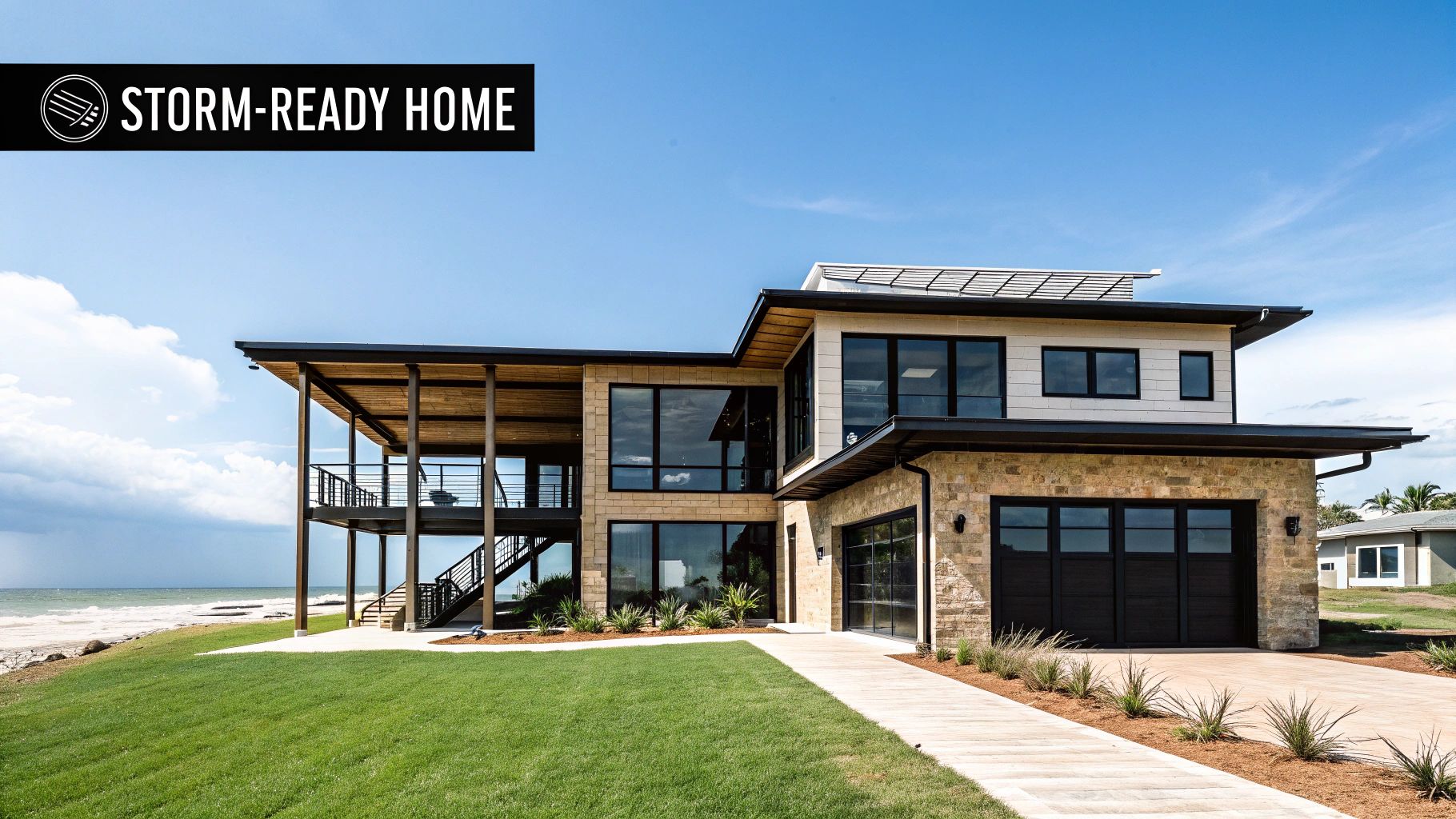
When you decide to build a custom home in Lee County, you’re signing up for more than just a beautiful design—you're building a fortress. Living on the coast means engineering for resilience isn't just a good idea; it's a fundamental necessity. An experienced local builder gets this. They have a deep-seated respect for Mother Nature and know that protecting your family and investment requires the most advanced construction methods available.
This commitment has to go way beyond just meeting the minimums of Florida's already tough building codes. The truly elite home builders in Lee County Florida are proactive, weaving hurricane impact features into the very DNA of your home’s design. They're constantly on top of the latest building science to make sure your home is ready for whatever a hurricane season throws at it.
Non-Negotiable Hurricane-Ready Features
When you're interviewing builders, the conversation needs to get specific. You must talk about the non-negotiable elements of hurricane-ready construction. These aren't just add-ons; they are systems that work in concert to create a truly secure home.
- Hurricane Impact Windows and Doors: Modern impact glass is an absolute marvel. It’s engineered to stand up to violent winds and flying debris without shattering. You need to ask builders if they use multi-layered laminated glass and reinforced frames that are rated for our high-velocity wind-borne debris region.
- Reinforced Roofing Systems: The roof is your home's primary shield. Dig into their methods for roof-to-wall connections. Are they using hurricane straps and clips? These small pieces of metal are absolutely critical for preventing the roof from lifting off during a major storm. Also, press them on their high-wind-rated shingle or metal roofing options.
- Monolithic Concrete Slab Foundations: It all starts with the foundation. The best builders often use monolithic slabs, where the footing and the slab are poured as a single, continuous piece of concrete. This creates an incredibly strong and stable base for the entire home.
Getting granular on details like these is what separates a standard house from a genuinely resilient one.
A critical factor that's often overlooked in the excitement of design is site elevation. An expert builder won't just follow the baseline FEMA maps. They'll conduct a thorough analysis to determine the precise finished floor elevation required to mitigate flood risks, often building well above the minimum standard.
To help you cover all your bases, we've put together a checklist of crucial features to discuss with any potential builder. These are the questions that will reveal their true level of expertise in coastal construction.
Essential Hurricane-Resilience Features Checklist
| Feature Category | Key Element | Question for Your Builder |
|---|---|---|
| Windows & Doors | Impact Glass & Frame Integrity | What specific wind-borne debris region standards do your windows and doors meet? Are they Miami-Dade certified? |
| Roofing System | Roof-to-Wall Connection | Can you explain the specific hurricane straps and clips you use and how they are installed to prevent roof uplift? |
| Roofing Material | High-Wind Rating | What are the wind speed ratings for the shingles or metal roofing you recommend for this area? |
| Foundation | Type and Reinforcement | Do you build with a monolithic slab foundation? How is it reinforced for our specific soil conditions? |
| Wall Structure | Concrete Block & Steel | Are your exterior walls concrete block filled with poured concrete and rebar? How do you ensure structural integrity? |
| Site Elevation | Flood Mitigation | How do you determine the final finished floor elevation? Is it based on the minimum FEMA requirements or a more cautious standard? |
| Backup Power | Generator Integration | Do you include a whole-home generator with an automatic transfer switch in your standard builds or as a seamless option? |
Use this table as a starting point. A builder who can confidently and knowledgeably answer these questions is one who takes building for resilience seriously.
Powering Through the Storm
Recent hurricanes have taught Southwest Florida a tough lesson: long-term power outages are a real and present danger. Because of this, a whole-home generator has shifted from a luxury item to a near-standard feature in new custom homes. It’s about safety, comfort, and peace of mind during and after a storm.
A truly knowledgeable builder doesn’t just plop a generator on a concrete pad and call it a day. They design its integration from the very beginning. This means it’s positioned correctly for safety and noise, wired seamlessly with an automatic transfer switch, and fully compliant with all local codes.
This thoughtful integration is what you're looking for. It means that within seconds of the power going out, your home automatically switches over, keeping the AC running, the food in your fridge cold, and the lights on. It’s this focus on total resilience that defines the best builders in our region. By asking these pointed questions, you can find a partner who is truly committed to building you a safe, secure, and lasting home in Lee County.
Navigating Contracts, Costs, and Timelines

This is where the rubber meets the road—where your vision starts taking shape on paper and lines up with the practical realities of contracts, costs, and schedules. Getting these documents right is absolutely essential for a smooth build, especially when you're working with home builders in Lee County Florida, where market news and building activity are constantly evolving.
Think of your builder's contract as the blueprint for the entire project. It deserves your full, undivided attention.
You’ll typically see two main kinds of contracts: fixed-price and cost-plus. A fixed-price contract is exactly what it sounds like; it locks in the total cost right from the start, giving you solid budget certainty. On the other hand, a cost-plus contract bills you for the actual labor and material costs plus a builder's fee. This can offer more flexibility but comes with less cost predictability.
Decoding the Builder's Bid and Contract
When you get a bid from a builder, don't just skip to the bottom line. A good, detailed proposal will break everything down, clearly itemizing what's included and what's considered an upgrade.
One area to watch closely is the allowances. These are essentially budget placeholders for things you'll pick out later, like your countertops, flooring, and light fixtures. If a builder sets these allowances unrealistically low to make their initial bid look more attractive, you could be in for a nasty surprise with significant budget overruns down the road.
A solid contract should also clearly lay out:
- A Clear Payment Schedule: This tells you exactly when payments are due as the project hits specific construction milestones. It ensures the builder gets paid as work gets done, keeping everyone happy.
- The Change Order Process: Life happens, and you might want to make a change. The contract needs to spell out precisely how any changes you request will be documented, priced out, and approved to avoid confusion.
- A Comprehensive Scope of Work: This is the nitty-gritty. The contract must list all materials, including brand names and even model numbers, to guarantee you’re getting the level of quality you're paying for.
The growth in Lee County has been nothing short of explosive, putting a ton of pressure on builders. The Cape Coral–Fort Myers area is the fastest-growing spot in Southwest Florida. In fact, back in March 2025, Lee County led the entire region with a staggering 854 new residential construction permits.
This incredible demand, a key piece of news affecting building in Florida, can really affect timelines and material costs. This makes a transparent, well-defined contract more critical than ever. You can dig into more details about the booming Lee County real estate market on thenaplesflagent.com.
Managing Timelines in a Dynamic Market
Even with the best contract in the world, timelines can sometimes feel like a moving target. Things like supply chain hiccups, labor shortages, and, of course, unpredictable Florida weather can all throw a wrench in the works.
A truly experienced builder knows how to anticipate these potential roadblocks. They’ll communicate with you proactively, giving you regular updates and revised schedules so you're never left in the dark.
A great builder isn’t just a contractor; they're a skilled project manager. They have systems in place to manage all the subcontractors, order materials far in advance, and navigate the permitting maze to keep your build on track.
At the end of the day, effective home construction project management is what separates a stressful build from a smooth one. It all comes down to meticulous planning and constant, open communication. That kind of transparency from your builder is what gives you peace of mind and lets you truly enjoy watching your dream home come to life.
Common Questions We Hear About Building in Lee County
Embarking on a custom home journey is a huge step, and naturally, it comes with a lot of questions. We've been doing this for a long time, so we've heard just about everything. To help you feel more comfortable as you move forward, here are some answers to the most common things people ask when looking for home builders in lee county florida.
How Long Does It Really Take to Build a Custom Home Here?
This is usually the first question on everyone's mind. From the day we finalize the design to the day we hand you the keys, a custom home in Lee County typically takes about 12 to 18 months.
Of course, that's a general timeframe. The actual timeline can shift based on a few things: the complexity of your home's design, how smoothly the local permitting process goes, and even the current availability of specific materials and skilled tradesmen. A great builder won't just give you a number; they'll give you a detailed, realistic schedule and keep you in the loop the entire time. No surprises.
What’s Trending in Southwest Florida Home Design Right Now?
The new builder trends and design features in custom homes here are constantly evolving. One of the biggest shifts is the focus on true indoor-outdoor living. It's more than just a patio; we're talking about massive lanais, full summer kitchens, and pocketing sliding glass doors that completely open up the house.
Energy efficiency has also gone from a "nice-to-have" to a "must-have." We're integrating features like solar-ready roofs, incredibly efficient high-SEER HVAC systems, and advanced insulation right from the start.
And with our weather, whole-home generators have become the new standard for peace of mind. Top custom builders are now designing homes with these systems fully integrated for automatic, seamless power during a storm. It’s all about building for resilience.
How Do I Make Sure a Builder Is Properly Insured?
This is a non-negotiable step to protect yourself. You need to ask any potential builder for their Certificate of Insurance (COI). Don't be shy about it. This is a standard document that clearly shows their general liability and workers' compensation coverage.
Don't just file the paper away. Take the extra five minutes to call the insurance agency listed on the certificate. Confirm that the policies are active and that the coverage amounts are actually enough for a project the size of yours. Any professional builder will expect this and should welcome your diligence.
Are Local Builders Keeping Up with Market Changes?
The Southwest Florida building market is always on the move. Just look at the numbers: in August 2025, Lee County saw 967 single-family building permits issued. While that was a small dip from the year before, it was a 12% jump from the previous month, which shows you how active things are. You can dig into more regional building permit trends at fgcu.edu.
This is exactly the type of news that affects building in Florida that a top-tier builder follows closely. In a market with changing interest rates and limited land, the best custom builders get creative. They're offering smart incentives like rate buy-downs or including high-end construction upgrades to deliver more value. This kind of flexibility is a huge sign of a builder who truly gets the local landscape.
What's the Best Way to Actually Compare Builders?
It's tempting to just line up the bids and pick the lowest number, but that's a mistake. A true comparison goes much deeper. You need to get a feel for their communication style, how transparent their contract is, and the real-world quality of their homes.
Try making a personal checklist to keep things straight. It might include:
- Portfolio Match: Does their past work genuinely reflect the style you want?
- Past Client Feedback: What do their references really say about the process?
- Contract Clarity: Is the bid broken down in detail, or is it vague?
- Hurricane Impact Features: How are they building beyond the basic code for hurricane resilience?
When you focus on these points, you're not just picking a contractor. You're choosing a partner who will be with you every step of the way, turning your vision into a home that's built to last.
Building a custom home is a journey of a thousand details, and having the right guide makes all the difference. At Sinclair Custom Homes Inc, Matthew Sinclair is on your job site, ensuring every element meets his exacting standards of quality and over-engineered strength. If you value honesty, integrity, and unparalleled craftsmanship, discover the Sinclair difference today. https://sinclaircustomhome.com