
When you’re building a custom home in Southwest Florida, your kitchen cabinets are one of the biggest decisions you'll make. This isn't just about picking a color you like; it's about choosing cabinetry that looks fantastic and can handle our unique coastal climate. We’re talking intense sun, high humidity, and the need for a home that's ready for anything storm season throws at it.
Your Blueprint for a Florida-Ready Kitchen
Building a new custom home in Fort Myers or Cape Coral means your kitchen is more than just a place to cook. It’s the heart of your home, the hub of family life, and a key part of your home’s overall strength and resilience. The choices you make right now for your cabinetry set the tone for your daily life and the long-term value of your home, especially as building codes and design trends evolve in Florida.
Before you get lost in door styles and paint swatches, you need to nail down exactly how you need your kitchen to work. This early planning is your best defense against the common headaches that come with building in a coastal area. It’s where your personal style meets the practical demands of living in paradise.
To get you started, here's a quick rundown of what to keep in mind.
Quick Guide to Cabinet Choices
| Consideration | Key Focus Area | Southwest Florida Tip |
|---|---|---|
| Lifestyle Needs | How you cook, entertain, and live day-to-day. | Prioritize durable, easy-to-clean finishes. Think about storage for hurricane supplies or a dedicated space for generator controls. |
| Functionality | Storage solutions, workflow, and accessibility. | Pull-out shelves and deep drawers are a must. Plan for smart tech integration and resilient design features. |
| Local Climate | Humidity, UV exposure, and potential for storms. | Choose materials that resist warping and finishes that won't fade. Hurricane-ready construction is a must. |
| Aesthetics | Your personal style and the home's overall design. | Coastal modern, transitional, and light, airy styles are popular here for a reason—they complement Florida's architecture. |
This table is just the starting point. The real magic happens when you dive into the details of your own life and how your kitchen can make it better.
Defining Your Lifestyle and Functional Needs
First things first: think about how you and your family actually use the kitchen. A great kitchen design should feel like it was made just for you, flowing perfectly with your daily routines.
Are you a serious home chef who needs acres of counter space and slick storage for every gadget imaginable? Or is your kitchen the main spot for entertaining, where a massive, welcoming island is non-negotiable?
Let's get specific:
- Family Life: If you have young kids running around, you’ll probably want durable, wipeable surfaces and soft-close drawers to save tiny fingers. Smart storage for bulk snacks from Costco is a game-changer.
- Entertaining: For the host with the most, integrated wine storage, a second prep sink in the island, or some beautiful glass-front cabinets to show off your good dishes might be at the top of the list.
- Thinking Ahead: How might your needs change in 5, 10, or 20 years? If you're planning for this to be your forever home, features like pull-out shelves, drawers instead of deep lower cabinets, and varied counter heights can make the space comfortable and accessible for the long haul.
We're seeing a lot of our clients in Southwest Florida ask for "dual-purpose" kitchen features. Think a dedicated coffee bar that also serves as a compact morning workstation, or integrating smart-home hubs right into the cabinetry to keep countertops clean and uncluttered. It's all about making the space work harder for you.
Integrating Florida-Specific Design Trends
Beyond your personal needs, your kitchen has to be ready for the realities of living in Florida. This means thinking about more than just looks. How does your kitchen function when the power goes out or a hurricane is on the way?
For instance, more and more custom homes we build now include a dedicated cabinet to neatly house the controls for a whole-home generator. This keeps critical equipment easy to get to but completely out of sight, preserving that clean, custom look while ensuring you're prepared for storms.
And it goes without saying, but choosing materials and finishes that can take the heat—literally—is a must. You need cabinets that won't warp in the humidity or fade under constant UV exposure. Getting this right from the start ensures your beautiful new kitchen stays that way.
The kitchen cabinet market is a huge part of the home construction industry. In fact, kitchen cabinets command a 60.8% share of the global cabinet market, which was valued at USD 132.10 billion and is only expected to grow. This just underscores how central the kitchen is to modern homes. By focusing on materials and styles that are a perfect fit for our region, you ensure your project is a smart investment. You can see more details about the cabinet market on marketdataforecast.com.
Choosing Hurricane-Ready Materials and Construction
Here in Southwest Florida, picking kitchen cabinets goes way beyond just looks—it's about making a smart choice for long-term durability. Our unique coastal environment, with its salty air and relentless humidity, is incredibly tough on homes. Materials that work perfectly fine elsewhere can warp, swell, or start peeling apart here. That’s why you have to get serious about what’s inside your cabinets.
When you’re trying to figure out which cabinets will actually last, the material of the cabinet box is the first thing you need to lock down. While solid wood doors look beautiful and timeless, the boxes themselves are often better off being made from engineered materials built for stability in our climate.
This little decision tree is a great starting point. It helps you connect the dots between how you live, our local weather, and the style you're going for.
As you can see, thinking through your lifestyle, factoring in the Florida climate, and defining your style leads you right to a solid design plan.
Cabinet Box Materials Built for Humidity
Think of the cabinet box as the unseen hero of your kitchen. It provides all the structural support. In a place where humidity is a constant battle, your choice here is absolutely crucial.
Choosing the right material from the start is the best defense against the moisture and salt in our air. Below is a quick comparison of the most common options we see and how they hold up in a climate like ours.
Cabinet Material Comparison for Humid Climates
| Material | Pros | Cons | Best For Florida Climate |
|---|---|---|---|
| Marine-Grade Plywood | Top-tier moisture resistance, uses waterproof glue, void-free core prevents delamination. | Highest cost, may be overkill for all cabinets. | Excellent. The gold standard, especially for sink bases and high-moisture areas. |
| Furniture-Grade Plywood | Great structural strength, good moisture resistance, less prone to warping than solid wood. | More expensive than particle board or MDF. | Very Good. A solid, reliable choice for the entire kitchen. |
| Solid Wood | Beautiful for doors, strong and classic aesthetic. | Prone to expanding and contracting with humidity, leading to joint stress and warping. | Poor for boxes. Best reserved for cabinet doors and face frames only. |
| MDF (Medium-Density Fiberboard) | Very smooth surface, perfect for a flawless painted finish. | Acts like a sponge when wet, swells irreversibly and disintegrates over time. | Avoid. Generally not recommended, especially near any water source. |
After years of building homes here, we've learned that investing a little more in the right materials pays off tenfold down the road. You simply can't afford to cut corners on the bones of your kitchen.
Expert Tip: Even if you use furniture-grade plywood for most of the kitchen, always upgrade the cabinet box under the kitchen sink to marine-grade plywood. It’s a small extra cost that provides serious protection in the one spot most likely to have a leak.
Framed vs. Frameless Construction
Another big decision is the construction style. This choice impacts not only the look of your kitchen but also how it functions day-to-day.
Framed cabinets are the traditional American style. They have a solid wood face frame on the front of the cabinet box, and the doors and drawers attach to it. They're known for being incredibly sturdy and having that classic, substantial feel.
Frameless cabinets, which you’ll often hear called "full-access" or "European-style," do away with the face frame. The doors mount directly to the cabinet box walls. The big win here is a bit more storage space and a sleek, modern look that’s really popular in new homes. But in a high-humidity place like Fort Myers, the quality of frameless cabinets has to be top-notch—perfect alignment is everything.
The entire journey of building your home is a series of such important choices. You can explore more about the step-by-step journey of building a new home by reviewing our detailed guide on the custom home building process.
The First Line of Defense: A High-Quality Finish
The finish on your cabinets is like armor, shielding them from the Florida sun and humidity. A cheap finish will quickly fade, peel, or turn yellow, especially with the intense UV exposure we get year-round.
We insist on using a catalyzed conversion varnish. This isn't just paint; it’s a premium finish that cures to a hard, chemical-resistant surface. It’s fantastic at shrugging off moisture, scratches, and spills. More importantly for us, it contains UV inhibitors that protect the wood and paint from fading. It’s a huge step up from basic lacquer and is practically a necessity for a new custom home in our region.
Matching Cabinet Styles to Florida Architecture
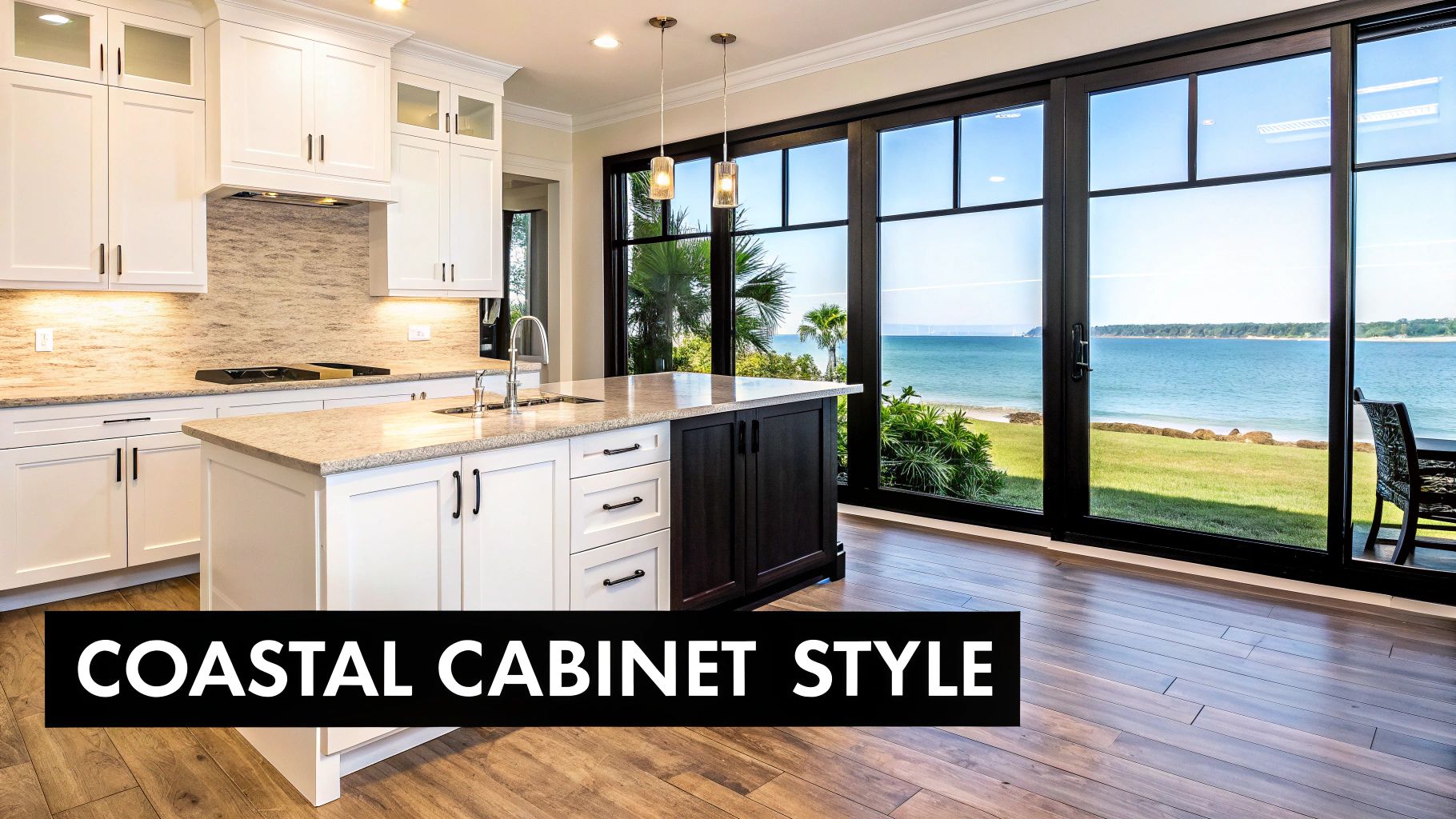
Your kitchen cabinets are so much more than just storage boxes. They're a massive part of your home's design story, and they need to feel like they belong. Here in Southwest Florida, the best custom kitchens feel connected to our environment—blending that sophisticated, clean look with a relaxed coastal vibe. Getting the cabinet style right is the key to creating a space that feels cohesive and just plain beautiful.
We're seeing a definite shift towards styles that feel light, airy, and uncluttered. It makes sense. These designs don't just look amazing; they echo the architecture we see all around us, from modern coastal homes in Fort Myers to those gorgeous West Indies-inspired estates in Cape Coral.
Defining Your Look with Door Profiles
The profile of your cabinet doors is probably one of the biggest decisions you'll make. It really sets the tone for the entire kitchen. In the new custom homes we're building across Southwest Florida, a few styles keep coming up for their timeless feel and incredible versatility.
- Shaker Style: This is the undisputed champion, and for good reason. Its simple, clean frame-and-panel look is a perfect fit for everything from a transitional beach house to a more contemporary space. We love it because it’s a perfect canvas for almost any hardware or finish.
- Flat-Panel (Slab) Doors: If you're going for a truly modern or minimalist kitchen, nothing beats the sleek, clean look of a flat-panel door. They create a smooth, unbroken surface that’s also a breeze to clean. This style lets other elements, like a dramatic countertop or a stunning backsplash, be the star of the show.
- Louvered Doors: For that distinctly coastal or West Indies flavor, louvered doors add fantastic texture and visual interest. We often use them as accent pieces on a pantry or an island. They also have a subtle but practical benefit in our humid climate: they promote air circulation.
The level of detail in these profiles is a true art form. To get a better sense of how custom builders bring these elements to life, it's worth learning more about what is architectural millwork and the impact it has on a home’s interior.
Current Color and Finish Trends
Color is where your personality really gets to shine in the kitchen. A classic white kitchen will never go out of style, of course, but the latest trends are leaning into warmer, more nuanced palettes that feel tied to our natural surroundings.
A new builder trend we're really leaning into is the "grounded island." The idea is to keep the perimeter cabinets light and airy—think a soft white or a light wood tone. Then, the central island becomes a real focal point with a bold, contrasting color like a deep coastal blue, an earthy green, or even a sophisticated charcoal.
Light-toned woods are incredibly popular right now, especially white oak or maple with a natural finish. They bring in warmth and organic texture without making the room feel heavy. We’re also designing a lot more two-toned kitchens, maybe pairing those light woods on the uppers with a painted finish on the lower cabinets for a truly custom, layered look.
As you think about styles and finishes that fit the Florida aesthetic, it’s a good idea to check out the latest kitchen cabinet color trends to see what sparks your imagination. The market is definitely reflecting this desire for more personalized spaces; forecasts show trends like larger kitchens and breakfast bars are now preferred in 55% of remodels.
Smart Budgeting for Your Cabinet Investment
When you're building a custom home here in Southwest Florida, you want to know exactly where your money is going. This is especially true for your kitchen cabinets. It’s a huge decision that doesn’t just affect your upfront budget—it shapes your home's long-term value and how you enjoy your kitchen every single day. Let's break down the options so you can make a choice that perfectly aligns with your financial plan and vision.
You can think of cabinet choices in three main tiers, and each one comes with its own set of trade-offs in cost, quality, and how much you can personalize.
-
Stock Cabinets: These are your most budget-friendly options. They're mass-produced in standard sizes and ready to go. The downside? You get very little flexibility in design, size, or finishes. They often require filler pieces to fit your space, which means you're losing valuable storage.
-
Semi-Custom Cabinets: This is the happy medium. You're starting with standard cabinet sizes, but you have a much wider selection of finishes, door styles, and clever storage features to choose from. For many projects, this tier strikes a great balance between personalization and price.
-
Custom Cabinets: For a true custom-built home, bespoke cabinets are the gold standard. They're crafted to your exact specifications, giving you a perfect fit for any layout, no matter how unique. This is where we can get really creative and integrate specialized features, like hiding generator controls or designing unique storage solutions built for our coastal lifestyle.
The Clear Shift Toward Custom Cabinetry
Homeowners are increasingly prioritizing personalization and durability, and the market shows it. Recent industry data reveals a major trend toward custom work. Custom options jumped from a 20% market share in 2022 to 25% by mid-2024.
At the same time, sales for mass-produced cabinets saw a 5.7% year-over-year decline. It's a clear signal that people understand a higher initial investment often pays for itself down the road. You can dive deeper into these cabinet market trends to see the full picture.
Thinking Beyond the Initial Price Tag
While stock cabinets have a lower upfront cost, custom cabinetry offers a powerful long-term value proposition, especially in the competitive Southwest Florida real estate market. A thoughtfully designed, high-quality kitchen isn't just a feature; it's a major selling point.
Investing in custom cabinets isn't just an expense; it's an asset. Their superior construction means they often last 20-30 years, compared to the 10-15 year lifespan of typical stock options. That kind of durability is critical in our humid climate, where lower-quality materials can quickly warp and fail.
A truly custom kitchen just makes life better. It’s built around your workflow and storage needs, eliminating all those little daily frustrations that come with a one-size-fits-all design. And when it's time to sell, a unique, well-crafted kitchen can significantly boost your home's resale value and appeal, making it a wise investment for your future.
Cost-Effective Alternatives and Updates
Of course, a full set of custom cabinets isn't always in the cards for every project. Sometimes, your existing cabinets just need a refresh, not a complete replacement. For homeowners looking to revitalize their space without starting from scratch, updating what you already have can be a fantastic choice.
This approach saves money and reduces waste. If you're considering a new look, you can find some great, practical advice on how to update a wooden kitchen cabinet. Whether it’s through professional refinishing or simply swapping out the hardware, a thoughtful update can dramatically change the look and feel of your kitchen. It's proof that smart budgeting can also be incredibly stylish.
Working with Your Builder for a Flawless Installation
Picking out the perfect kitchen cabinets is a huge step, but it's really only half the battle. The magic truly happens when you and your custom home builder work together to bring that vision to life. This is where a great partnership shines, turning designs on paper into the functional, beautiful heart of your new home.
Think of your builder as the conductor of an orchestra. Building a custom home in Southwest Florida means juggling timelines, coordinating suppliers, and managing a whole crew of skilled trades. Cabinets, in particular, have to fit in perfectly with the work of electricians, plumbers, and flooring installers. Your builder makes sure every note is hit at the right time.
Key Questions to Ask Your Builder
Clear, open communication is your best friend here—it prevents those costly headaches down the road. Before a single cabinet box is ordered, you need to sit down with your builder and get completely on the same page.
Here are a few essential questions to get that conversation started:
- Cabinet Suppliers and Quality: "Who are your go-to cabinet suppliers, and what makes you stick with them? Can we see some examples of their work in other homes you've built?"
- Timeline and Coordination: "What's the typical lead time for the cabinets we've picked out? How do you schedule the installation around other trades like plumbing and electrical to keep things moving smoothly?"
- Installation Protocols: "Who will actually be installing the cabinets? Are they your own crew or subcontractors? What's your process for quality control while they're working?"
- Adapting to Florida's Climate: "What specific techniques do you use to deal with Southwest Florida's humidity? How do you prevent issues like wood swelling or joints separating over time?"
Getting solid, detailed answers to these questions builds confidence. You'll know right away that your builder prioritizes true craftsmanship and that your investment is in good hands.
Communicating Your Vision Effectively
Your builder is an expert in construction, not a mind reader. It’s up to you to clearly communicate not just what you want your kitchen to look like, but how you need it to function. Don't just show them a Pinterest board; explain the "why" behind your choices.
For instance, instead of saying, "I want a big island," try explaining why: "We need a large island with seating for four because the kids do their homework here, and it's where everyone gathers when we have friends over." That context is golden—it helps your builder recommend the right materials and design features that will actually work for your family.
We're seeing a critical trend in new custom homes around Fort Myers and Cape Coral: planning for resilience. This means designing cabinetry to discreetly house controls for whole-home generators or even integrating reinforced pantries that can double as a secure space during a hurricane. Communicating these unique needs early on ensures they're woven into the design from the start, not shoehorned in as an afterthought.
The On-Site Inspection Checklist
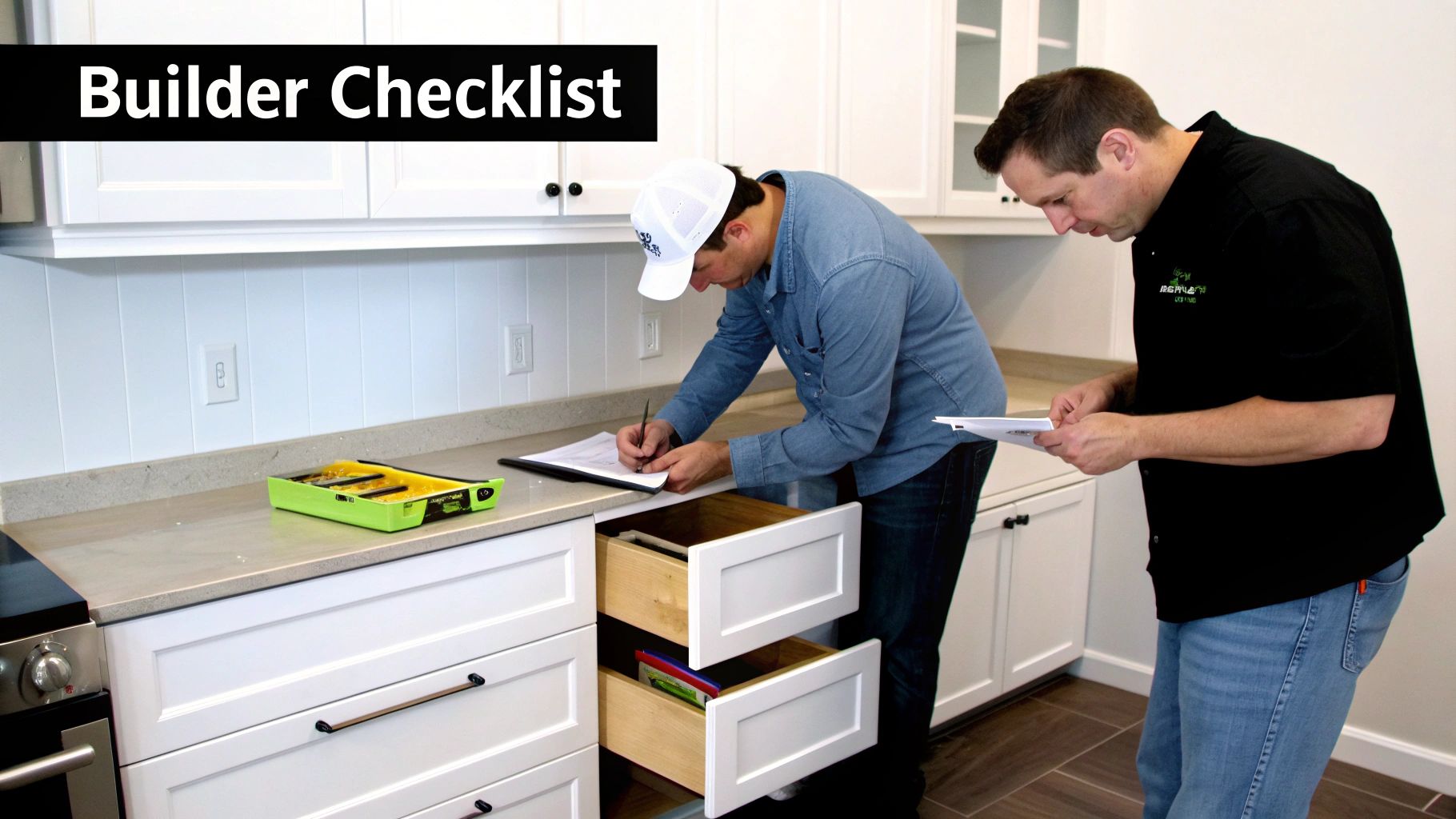
Once the installation is done, the final walkthrough with your builder is your moment to shine. This is your chance to get up close and make sure every last detail meets the high standards you expect from a Sinclair Custom Homes project. Take your time with this—a thorough inspection now guarantees you'll love your kitchen for years to come.
Use this checklist as your guide during the on-site review:
- Alignment and Leveling: Do all the doors and drawers line up perfectly? The gaps should be consistent all the way around. Grab a level and check that the countertops and cabinet runs are perfectly flat.
- Finish Quality: Look at every surface in good light. You're searching for any scratches, paint drips, or spots where the stain looks off. The finish should be silky smooth and uniform everywhere.
- Hardware and Operation: Open every single door and pull out every single drawer. They should glide smoothly and quietly. Check that all the soft-close features work as they should. Give the handles and pulls a little tug to make sure they're secure and level.
- Interior and Trim: Peek inside the cabinets. Are the shelves secure? Is the crown molding, light valance, and toe-kick installed with tight, clean joints?
This final check is a non-negotiable part of our quality assurance process. For a deeper dive into our standards, check out our construction quality assurance checklist. By working together, you and your builder can ensure your new kitchen isn't just beautiful, but built to last a lifetime.
Frequently Asked Questions About Florida Kitchen Cabinets
When you're building a custom home in Southwest Florida, choosing kitchen cabinets isn't just about color and style. It's about making smart choices for our unique coastal environment. After years of building homes in Fort Myers and Cape Coral, we’ve heard just about every question you can imagine.
Here are the most common ones we get, with straightforward answers based on our hands-on experience. We're talking about everything from hurricane-ready features to finishes that can handle the Florida sun.
How Can I Protect My Cabinets From Florida’s Humidity?
This is, without a doubt, the number one concern we address. And for good reason—our humidity can be brutal on woodwork. The best defense starts with the core material of your cabinets.
You absolutely want to insist on furniture-grade or marine-grade plywood for the cabinet boxes. Materials like MDF or particle board are like sponges; once they soak up moisture, they swell up and are ruined for good. Quality plywood, on the other hand, holds its shape and provides the stability your investment needs to last.
Your finish is the next critical line of defense. Standard lacquer just doesn't hold up to our salty, damp air. For any new build in this region, a professionally applied catalyzed conversion varnish is non-negotiable. It creates a tough, non-porous barrier that seals moisture out, protecting the wood underneath.
Are White Cabinets a Good Choice for Southwest Florida?
White cabinets are a fantastic choice and remain incredibly popular here. They beautifully capture that bright, coastal vibe so many of us love, reflecting our abundant sunshine and making kitchens feel spacious and airy.
The trick is dealing with that intense sunlight. You have to be selective about the paint and finish to prevent them from yellowing over time. High-quality cabinet paints today often come with built-in UV inhibitors. Pair that with a non-yellowing topcoat, like a water-based polyurethane, and your cabinets will stay a crisp, true white for years to come. Just be sure to steer clear of oil-based topcoats, as they are notorious for yellowing, especially with constant sun exposure.
Here's a pro tip we share with all our clients: Make sure every white surface in your kitchen—cabinets, trim, and ceiling—is painted with the exact same paint color and sheen. Even slightly different shades of white can make one look dingy or yellowed next to the other.
What Cabinet Features Are Trending in New Florida Homes?
The latest trends are all about blending style with resilience—a perfect match for the modern Florida lifestyle. We’re seeing a huge demand for features that are both beautiful and incredibly practical.
A few popular requests include:
- Integrated Generator Cabinetry: We're designing custom pantry or utility cabinets that discreetly hide the control panels for whole-home generators. This keeps your essential systems protected and accessible during a storm without disrupting your kitchen's aesthetic.
- Appliance Garages: Homeowners want clean, uncluttered countertops. Appliance garages with pocket or bi-fold doors are the perfect solution for stashing away coffee makers, toasters, and blenders.
- Durable Hardware: Salt air corrodes metal, so hardware choice is key. People are choosing finishes that can withstand the elements, like high-grade stainless steel or hardware with a PVD (Physical Vapor Deposition) coating for extreme durability.
Should I Worry About Formaldehyde in My Cabinets?
Yes, this is something you should definitely have on your radar. Indoor air quality is a big deal, especially in the tightly sealed, energy-efficient homes we build today. Many engineered wood products, like particle board and some types of MDF, are made with adhesives that contain urea-formaldehyde, which can release fumes into your home over time.
The solution is simple: look for cabinets that are CARB 2 (California Air Resources Board) compliant. This is the national gold standard for ensuring low formaldehyde emissions. By choosing solid wood or high-quality, CARB 2 compliant plywood with low-VOC (Volatile Organic Compound) finishes, you're ensuring a healthier home for your family. It's one of those behind-the-scenes details that has a major impact on your well-being.
Your dream kitchen is the heart of your custom home, and getting every detail right is what Sinclair Custom Homes is all about. We combine expert, in-house craftsmanship with a deep understanding of what it takes to build lasting, beautiful homes in Florida. If you’re ready to start planning your new home in Cape Coral or Fort Myers, contact us today.