


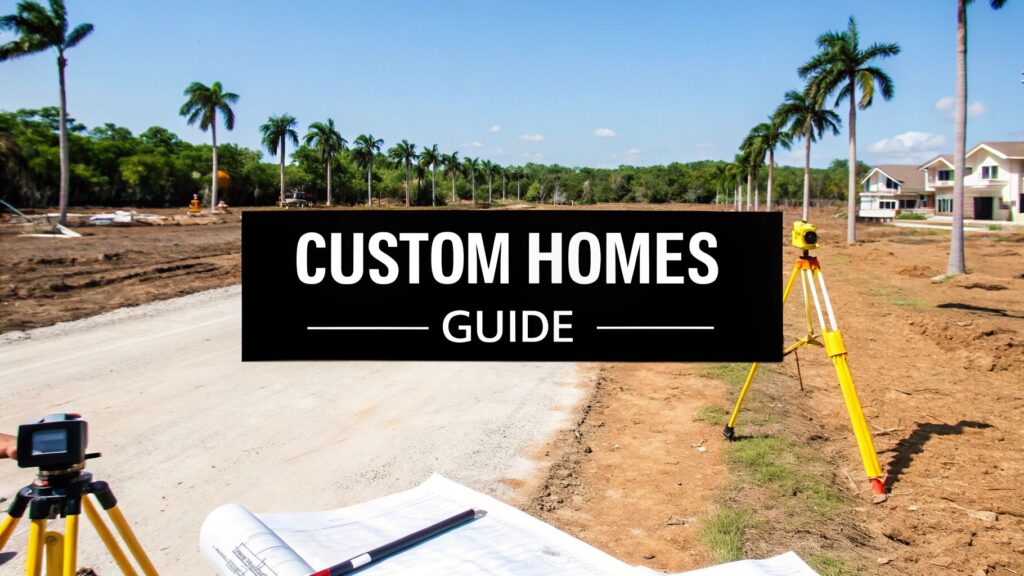
Building a custom home on your lot is about more than just construction; it's the ultimate expression of your personal vision. It's the freedom to create a space perfectly suited to your lifestyle on a piece of land you already love. This is your chance to move beyond the cookie-cutter designs and hand-pick every detail, from the floor plan to the fixtures, creating a true, long-term investment in your future.
Your Vision, Built in Paradise
Imagine waking up in a home designed just for you, in the exact Southwest Florida location you already know and love. This isn't just a dream; it's a completely tangible goal that gives you a level of control and satisfaction you just can't get any other way. When you build on your own lot, you are firmly in the driver's seat, making every decision to reflect your unique tastes.
Unlike buying a pre-existing house, this path lets you weave the latest building science and design trends into your home's DNA from day one. You can finally have that seamless indoor-outdoor living space with an expansive lanai, design a true gourmet kitchen, or create a floor plan that comfortably accommodates multi-generational living—a growing trend in the custom home industry.
Building for the Florida Lifestyle
Here in Southwest Florida, building a custom home means designing for both stunning beauty and formidable resilience. Our region's unique climate and geography aren't just an afterthought; they demand a specialized approach right from the start. This is where modern building science truly shines, offering smart solutions that protect your investment and give you real peace of mind.
Key considerations for a Florida custom home include:
- Hurricane-Ready Features: This goes way beyond basic storm shutters. We're talking about a fully integrated system of impact-resistant windows and doors, reinforced concrete block construction, and advanced roof strapping that creates a truly fortified structure. New design trends favor clean lines and large glass expanses, which are achievable with modern impact-rated products.
- Elevation and Flood Protection: Building above FEMA flood elevations isn't just a good idea—it's non-negotiable, especially with evolving flood maps in Florida. An expert local builder knows how to manage the critical site work, including bringing in the right amount of fill dirt to make sure your home sits safely above any potential storm surge.
- Reliable Power Solutions: With our intense storm season, a whole-home generator feels less like a luxury and more like a necessity. Integrating a generator into your initial build plan is the smartest way to ensure your family stays safe and comfortable during inevitable power outages caused by hurricanes.
Building a custom home on your lot in Southwest Florida is about creating a sanctuary that is as strong as it is beautiful. It’s a proactive approach to homeownership, where you plan for the elements from the ground up, rather than reacting to them later.
Consider this guide your roadmap for navigating this exciting journey. We'll break down everything from prepping your land and securing permits to choosing a local builder who truly understands the demands of our coastal environment. By the end, you'll have the clarity and confidence to turn your empty lot into the resilient, beautiful home you’ve always envisioned.
Decoding Your Land and Preparing Your Foundation
Think of your home's foundation like the hull of a ship. Without a rock-solid hull, even a small storm can cause big problems. Here in Southwest Florida, that hull needs to be tough enough to handle our unique mix of shifting sandy soils, high water tables, and strict flood elevation codes.
This is why a thorough site assessment is the absolute first step—it's completely non-negotiable. Before a single shovel hits the dirt, we need to understand exactly what we're building on.
That means getting boots on the ground to perform crucial tests and surveys. You'll need:
- Soil Testing: To find out what the ground is made of and how much weight it can safely support.
- Elevation Survey: This determines the required height of your home's base, keeping it safely above FEMA flood levels. This is critical as Florida's building news often includes updates to flood zone maps.
- Water Table Analysis: We need to know where the groundwater is to prevent any future moisture issues.
Why Your Lot's Unique Profile Matters
Every lot is different, which is why a one-size-fits-all approach just doesn't work. The data we gather from these assessments dictates the entire engineering strategy for your foundation. Ignoring these details is like building a ship without checking for leaks—you're just asking for trouble in the form of settling, cracks, and costly repairs down the road.
“Site prep is the unseen hero of any custom build,” says local civil engineer Tom Martinez. He’s seen firsthand how investing in proper foundation work upfront saves his clients tens of thousands in future repairs.
Getting a Handle on Site Prep Costs
Nobody likes budget surprises, so it's smart to get a rough idea of what site preparation involves. The main costs usually come from a few key areas:
- Land Clearing: Removing trees, brush, and any old debris can typically run between $1,500 and $5,000, depending on how dense the vegetation is.
- Fill Dirt: To meet those mandatory elevation levels, we often have to bring in engineered fill dirt, which costs around $20 to $40 per cubic yard.
- Utility Connections: The cost to run water, sewer, or septic lines to your homesite can vary quite a bit based on the distance and terrain.
For more insights on local lot availability and costs, check out our guide on Land For Sale in Lee County Florida.
To help you keep track, here's a checklist of the essential site prep steps and what you can expect.
Southwest Florida Site Preparation Checklist
This table breaks down the key assessments you'll need to prepare your lot for construction and gives you a ballpark on the potential costs.
| Assessment Step | Key Consideration | Potential Cost Impact |
|---|---|---|
| Soil Testing | The mix of clay, sand, or shell determines foundation design. | $500–$1,200 |
| Elevation Survey | Must meet the base flood elevation plus a safety margin. | $800–$1,500 |
| Fill Dirt & Grading | Amount of fill needed to satisfy FEMA and county codes. | $2,000–$8,000 |
| Utility Hookups | Connecting to city water, septic, or sewer lines. | $1,000–$10,000+ |
Getting these steps right is foundational (pun intended!) to the long-term health of your home.
Making the Right Foundation and Utility Choices
Understanding your lot also helps you choose the right foundation type. For example, some homes may require deep pilings, while others are fine with a monolithic slab. If you're considering a specific construction style, it's worth learning about things like steel building foundation requirements to see what's involved.
Your utility strategy is another big decision point. You'll need to weigh the pros and cons of:
- Septic vs. Sewer: Septic systems work well for more rural lots but require ongoing maintenance, whereas a sewer connection is more hands-off.
- Well vs. City Water: A private well offers independence, but city water provides convenience and consistency.
- Generator Prep: In Florida, planning for a whole-home generator provides invaluable peace of mind during storm season. A new builder trend is integrating these systems seamlessly with smart home technology.
Hiring a local expert for your site assessment is one of the best investments you can make. They know the ins and outs of our area—from seasonal rains to potential sinkhole risks—and can spot challenges before they become expensive problems.
What Comes Next: Permits and Approvals
Once the site prep plan is locked in, the next step is getting everything approved by the county. Your elevation certificate and soil reports are the key documents needed to secure grading permits and floodplain approvals.
Here's the typical workflow:
- Submit your elevation certificate to prove compliance with all local and FEMA codes.
- Get your grading permit, which allows for moving fill dirt and shaping the land.
- Finalize quotes for bringing water, sewer, and electricity to the site, plus that generator hookup.
Tackling these steps early on keeps the project moving smoothly and avoids frustrating delays. With this critical groundwork done, you can move on to pouring the foundation, confident that your new home is built on solid ground.
Navigating Local Building Permits and Zoning
The road to building your custom home runs straight through your local government office. It’s easy to think of permits and zoning as a roadblock, but it’s better to see it as a series of gates. To get through each one, you need the right key—whether that’s an approved plan, a specific document, or a passed inspection. You can't move on to the next gate until you've unlocked the one before it.
For anyone building in Southwest Florida counties like Lee, Collier, and Charlotte, this can feel like trying to solve a puzzle. You're not just dealing with one agency; you're coordinating with several, and each has its own set of rules. Your project won't just need one building permit. It will likely need separate approvals for your pool, septic system, seawall, or boat dock.
Understanding Florida-Specific Building Regulations
Living in a unique coastal environment means Florida's building codes are some of the toughest in the country. They’re designed to protect us, our homes, and our delicate ecosystems. Several key rules will have a direct say in your home's design and exactly where it can sit on your property.
Here are a few of the big ones:
- Setbacks: These are non-negotiable distances your home has to be from property lines, roads, and the water. They’re in place for privacy, safety, and to keep a consistent look in the neighborhood.
- Lot Coverage Limits: The county puts a cap on the percentage of your lot that can be covered by hard surfaces like the house itself, the driveway, and your lanai. This is a critical rule for managing stormwater runoff.
- Coastal Construction Control Line (CCCL): If your lot is close to the coast, you might be in the CCCL zone. Building here requires special engineering and extra permits to make sure the home can withstand a major storm.
A builder who gets these local nuances isn't just a contractor—they're your guide through the bureaucracy. Their expertise prevents expensive design changes down the road and makes sure your plans are good to go from day one.
Getting these rules wrong can bring your project to a dead stop. Imagine designing your dream home, only to find out it’s five feet too close to the property line. That’s not a small tweak; that’s a complete—and costly—redesign. It's a surprisingly common trap for people who aren't familiar with the local rulebook.
The Value of Local Expertise in Permitting
While the dream of a fully custom home is as strong as ever, the market is showing a slight shift. In 2024, custom homes built on the owner’s lot made up 17.5% of all new single-family home starts in the U.S. That's a small dip from previous years, and it highlights just how important an efficient, predictable building process is. Speeding through the permitting maze is a huge piece of that puzzle. You can read more about the custom home building market from the National Association of Home Builders.
An experienced local builder has spent years building relationships with the permitting officials in cities like Cape Coral and Fort Myers. They know the people behind the desk, understand exactly what each department needs for a submission, and can often spot potential red flags before they cause delays. That kind of rapport is priceless.
For example, a veteran builder knows what a plan reviewer in Lee County looks for in hurricane strapping, and how that might differ from a reviewer in Collier County. They can put together a complete, accurate permit package on the first try, avoiding the frustrating back-and-forth that can add weeks, or even months, to your timeline. You can dive deeper into the specifics of Cape Coral building permits to get a sense of just how detailed this process is.
Ultimately, working with a builder who has deep local roots turns the permitting process from a headache into a streamlined, predictable step. They handle the stacks of paperwork, coordinate all the inspections, and manage the conversations with officials. That frees you up to focus on the fun parts of building your home, knowing the crucial groundwork is being handled by an expert. It saves time, money, and a whole lot of stress.
Designing a Resilient, Hurricane-Ready Home
Here in Southwest Florida, a beautiful home has to be more than just a pretty face—it needs to be a fortress. When you build custom homes on your lot, you get the massive advantage of engineering that resilience right into the bones of the structure from day one, instead of trying to bolt it on later.
True hurricane readiness isn't about one single feature. It's a complete system where every single component works together to protect what matters most: your family and your investment.
This all starts with a powerful structural core. While wood-frame construction is common in other parts of the country, reinforced concrete block construction is the undisputed gold standard here. Think of it as creating an armored shell. Each block is filled with concrete and reinforced with steel rebar, creating solid, monolithic walls that can take a punch from extreme wind pressures and flying debris.
But strong walls are only half the battle. Your roof is the home's first line of defense, and modern building science has proven its shape is just as critical as the materials it's made from.
Building a Stronger, Smarter Structure
An aerodynamically superior hip roof design, where all sides slope down to the walls, is a game-changer. This shape allows hurricane-force winds to flow over and around the house with far less resistance, dramatically reducing the dangerous uplift forces that can literally peel a roof off a home. It's a simple, elegant solution that is proven to be tougher than a traditional gable roof.
To create an unbreakable connection from the roof down to the foundation, we rely on a critical system of straps and ties. Imagine them as steel ligaments holding your home's entire skeleton together. Hurricane straps anchor the roof trusses directly to the concrete block walls, which are then anchored to the foundation. This creates a continuous load path that channels the immense force of the wind safely into the ground.
Building a hurricane-ready home is about creating layers of defense. It’s not just one feature, but a series of integrated systems that work in concert to withstand nature’s power. From the foundation to the peak of the roof, every connection is engineered for strength.
Once the frame is secure, we have to seal and protect the outer shell. This is where high-performance features become non-negotiable:
- Impact-Resistant Windows and Doors: These are an absolute must. Made of laminated glass, they’re designed to withstand a direct hit from flying debris without shattering, which is crucial for preventing wind and water from getting inside.
- Reinforced Garage Doors: Your garage door is often the largest and most vulnerable opening on your house. A hurricane-rated door is essential to prevent a catastrophic structural failure during a major storm.
- Proper Insulation: In Florida's climate, good insulation is key for energy savings, but it also contributes to a stronger home envelope. It's worth understanding insulation options like spray foam vs. blown-in for South Florida to make the right choice.
Modern Systems for Uninterrupted Living
True resilience isn't just about surviving the storm; it's about living comfortably in the aftermath. Power outages are a given after a major hurricane, which is why planning for a whole-home generator during your initial build is one of the smartest moves you can make.
Unlike a portable generator you have to wheel out and hook up, a whole-home system is permanently installed and wired right into your electrical panel. It senses an outage and kicks on automatically within seconds, powering everything from the A/C and refrigerator to your lights and medical equipment. This provides not just convenience, but critical safety and peace of mind when the grid is down for days, or even weeks.
The great thing is that today’s design ideas for new homes prove that safety and style absolutely go hand-in-hand. You don't have to sacrifice beautiful aesthetics for a resilient home. Large pocketing sliding glass doors made with impact glass can create those stunning indoor-outdoor living spaces that are also storm-ready. Smart landscaping can act as a natural windbreak, while elevated construction can provide both incredible views and superior flood protection.
Building a custom home on your lot in Southwest Florida is the ultimate opportunity to create a sanctuary that is just as intelligent and strong as it is beautiful.
Choosing a Builder with Local Expertise
When you’re building a custom home on your lot in Southwest Florida, picking your builder is the single most important decision you'll make. Period.
A builder with deep local roots isn't just a contractor; they're your navigator. They know the ins and outs of county regulations, the nuances of hurricane codes, and who to talk to at the permit offices. It's a skill learned from years in the trenches, not from a manual.
At Sinclair Custom Homes, we’ve spent decades building strong relationships with the best subcontractors, suppliers, and permitting officials across Lee, Collier, and Charlotte counties. This isn’t just about being friendly—it translates directly into benefits for you.
- Faster Permits: Our established rapport with local agencies means we know how to prepare and submit paperwork that gets approved without unnecessary delays.
- Reliable Scheduling: We work with a vetted network of subcontractors who trust us and prioritize our projects. That means your job stays on track.
Questions to Ask Your Builder
When you start interviewing builders, you need a game plan. Having a solid set of questions helps you cut through the sales pitch and get to what really matters.
- Are you licensed and insured to build in my specific county?
- Can I speak with homeowners and see some of the homes you’ve completed nearby?
- How do you approach hurricane-specific design? What features do you recommend?
- What’s your process for making sure we stay on budget and on schedule?
- What kind of warranties and post-construction support do you offer?
These aren't just checkbox questions. The way a builder answers will tell you everything you need to know about their reliability and how much they care about the details.
Verifying Credentials and Insurance
Don't just take their word for it. Before you even think about signing a contract, you have to do your homework and verify everything yourself.
- Check the builder’s state license number on the Florida DBPR database.
- Request a current certificate of insurance that clearly lists general liability and workers’ compensation.
- Confirm their bond status to protect yourself from liens or unfinished work.
Here’s a real-world example: A builder might have a great reputation with the local Home Builders Association, but if their insurance lacks sufficient coverage for flood zone construction, your home is vulnerable. You need a builder who understands the specific risks of coastal weather events and is properly insured for them.
A truly experienced local builder is more than a contractor; they act as a guide through each regulatory gate, preventing costly redesigns and delays.
A Quick Look at Land Availability
While local conditions are paramount, it’s helpful to see what’s happening in other high-demand markets. For instance, the custom home market is facing a serious land shortage in places like northern Nevada, where desirable neighborhoods have all but run out of lots. This crunch drives up land prices and pushes buyers toward rural sites with hefty infrastructure costs. You can read more about Nevada's custom home outlook to see how these trends compare.
Walking Through Completed Homes
There’s no substitute for seeing a builder's work up close. It’s one thing to look at glossy photos, but walking through a finished home gives you a true feel for their quality.
Ask to tour at least 3 recently finished custom homes.
As you walk through, pay attention to the things that matter in Florida:
- Structural integrity, like reinforced concrete block construction.
- Proper elevation and flood-resistant design features.
- Smart integrations, like whole-home generator systems for storm readiness.
Walkthrough Tips
- Look closely at the craftsmanship. Are the trim, cabinetry, and paint finishes clean and professional?
- Open and close windows and garage doors. Do they feel solid and rated for impact resistance?
- Ask the builder about any challenges they faced on that project and how they solved them.
This hands-on inspection says more than any brochure. It reveals a builder’s consistency, attention to detail, and problem-solving skills in the real world.
| License Type | Verification Source | Why It Matters |
|---|---|---|
| General Contractor | Florida DBPR Website | Ensures they are legally allowed to build your home. |
| Worker’s Compensation | Insurance Certificate | Protects you from liability if a worker gets injured on your property. |
| Floodplain Endorsement | Builder’s Professional License | Confirms they have the specific expertise for flood-zone construction. |
Choosing a local pro like Sinclair Custom Homes means you're not just hiring a builder; you're gaining a partner with over 20 years of firsthand regional experience.
We’re the ones managing the permit packages, scheduling the crucial inspections, and troubleshooting issues on the fly so you don’t have to.
Your builder should be your biggest advocate, anticipating challenges before they become problems. With detailed on-site updates, you’ll feel connected and informed every step of the way.
Final Takeaways for Homeowners
Remember, building a home on your lot is a partnership, not just a transaction.
Your decision should come down to communication, transparency, and proven local credentials.
When you find the right builder, you're not just putting up walls. You're turning an empty piece of land into a storm-ready, beautifully personalized home.
Ready to get started? Reach out to Sinclair Custom Homes to begin your journey with a team that truly knows Southwest Florida.
Your Blueprint For Building On Your Lot

Turning your vision from sketches into a standing home is a lot like plotting a cross-country road trip—you need a reliable map. This blueprint distills the journey into clear steps so you can move forward with confidence.
Building custom homes on your lot in Southwest Florida follows a sequence of milestones. Each phase stacks on the last, guiding you from raw land to a resilient, hurricane-ready retreat.
Your Action Checklist From Lot To Move-In
- Lot and Site Assessment: Pair soil tests, elevation surveys, and a utility analysis. This diligence sets a realistic budget and reveals any hidden challenges.
- Design and Engineering: Collaborate on plans that withstand coastal storms. Key features include reinforced concrete block walls, hip roofs, impact-rated windows, and provisions for a whole-house generator.
- Permitting and Approvals: Your builder submits architectural drawings, site plans, and engineering reports to local Southwest Florida agencies. Navigating red tape takes patience—and a pro who knows the process.
- Construction Milestones: From foundation pours and framing to roofing and mechanical installs. Keep on-site meetings scheduled so you stay in sync with your builder.
- Final Finishes and Walkthrough: Cabinets, flooring, fixtures—the details you chose finally appear. The final walkthrough is your chance to compile a punch list before taking ownership.
The infographic drives home that finding the right builder means more than chasing the lowest bid. It’s about thorough vetting, credential checks, and forging a true partnership.
A successful build starts with a strong collaboration. Choosing an experienced local builder who guides you with expertise and honesty is the most critical decision you’ll make.
Building on your own lot offers an unmatched level of personalization and control. With a step-by-step plan and the right local partner, you can confidently turn your land into the home you’ve always wanted.
Still Have a Few Questions? Let's Clear Things Up.
Taking the first steps toward building a custom home on your own land in Southwest Florida is exciting, but it almost always comes with a lot of questions. We get it. This final section tackles some of the most common things we hear from homeowners, giving you direct, honest answers to help you move forward.
How Long Does It Really Take To Build a Custom Home?
While every single project has its own unique path, a good rule of thumb for a timeline—from the first design meeting to getting your keys—is about 12 to 18 months here in Southwest Florida. A few local realities can definitely stretch that out.
The complexity of your home's design, how backed up the permitting offices are in your specific county, and, of course, our infamous hurricane season can all shift the schedule. Any experienced local builder worth their salt can give you a much more realistic timeline once they’ve walked your lot and seen your plans.
What Are the Biggest Hidden Costs I Should Watch Out For?
If there’s one area where budgets can get derailed, it’s almost always in the site preparation. These are the costs that pop up because of the unique quirks of your specific piece of land.
Some of the most common surprise expenses we see are:
- Needing way more fill dirt than anyone first thought to meet FEMA flood elevation rules.
- Finding out the soil isn't as stable as it looks, which means you'll need extra foundation engineering.
- The sticker shock of running utilities like water, sewer, and power to your build site, especially if your lot is a bit off the beaten path.
Getting a professional, in-depth site assessment done from the very beginning is the single best way to head off these kinds of surprises before they can blow a hole in your budget.
Think of a thorough site assessment as a financial insurance policy. Investing a little upfront to understand your land completely can save you from tens of thousands of dollars in unexpected costs down the road.
Do I Need to Hire an Architect and a Builder Separately?
Not necessarily. In fact, a lot of homeowners in Southwest Florida are now choosing to work with a design-build firm. This just means you have one company managing everything—from the architectural drawings to the construction itself—all under one roof. This is a significant trend in the custom home industry.
This integrated approach makes communication so much simpler. It helps keep the design aligned with your budget from day one and usually leads to a smoother project from start to finish. Of course, the traditional route of hiring an architect first and then finding a builder to bring their plans to life is still a great option, too.
What is the Real Cost Per Square Foot to Build?
Honestly, the "cost per square foot" number can be all over the map for a custom home in our area. It’s a bit of a misleading metric because it depends so heavily on your location, the level of finishes you choose, and the specific structural needs—especially for hurricane-ready features like impact windows and reinforced concrete.
A simple square footage number just doesn't tell the whole story. A trustworthy builder will give you a detailed, line-item budget after they’ve had a chance to fully understand your design, your material choices, and the specific challenges of your land. This transparent approach gives you a much clearer, more accurate picture of exactly where every dollar is going.
The desire for a home that’s truly yours is stronger than ever. Custom home building on an owner's lot has been growing steadily. In the second quarter of 2025, there were 54,000 custom home starts, which is a 4% increase from the same time in 2024. This shows that more and more people are choosing this path, even when the overall housing market is a bit shaky. You can read more about the growth trends in custom home building.
Your dream home is closer than you think. At Sinclair Custom Homes Inc, we bring together decades of hands-on, local Southwest Florida experience with a genuine commitment to quality and transparency. We’re here to make sure your vision becomes a reality.
Ready to take that next step? Contact us today to schedule your consultation and start building your future.