


Trying to pin down the real cost to build a custom house in Florida can feel like chasing a moving target. If you're looking for a quick answer, a standard custom home will typically run you somewhere between $160 to $295 per square foot. But in highly sought-after coastal areas like Southwest Florida, that number is often just the starting line.
This guide is designed to pull back the curtain and show you exactly what's driving those costs, focusing on the custom home industry trends, hurricane-resilient design, and the specific news affecting construction in Southwest Florida.
Your Quick Guide to Florida Home Building Costs
Building a custom home in Florida is a completely different ballgame than building almost anywhere else. The Sunshine State throws a unique mix of curveballs at builders and homeowners—from coastal proximity and tricky soil conditions to some of the most stringent building codes in the nation. It all adds up to a financial picture that requires a seasoned local expert to navigate.
Just multiplying your desired square footage by a generic average might give you a number, but it won’t be a real one. It won't account for the critical details that make a Florida custom home beautiful, durable, and resilient against hurricanes.
Statewide Averages vs. Southwest Florida Reality
While it's helpful to know the general statewide figures, the market here in Southwest Florida really tells its own story. For most new custom homes, costs have settled into that $160 to $295 per square foot range.
However, once you get near the water, the dynamics change. Coastal properties often start higher, usually from $185 to $295 per square foot and can easily go up from there. If you want a deeper dive, you can explore more about these statewide building trends and see how they stack up against specific local markets.
So, what's behind the price jump for coastal builds? A few key factors are at play:
- Tougher Hurricane Codes: Building in a High-Velocity Hurricane Zone (HVHZ) isn't optional, and it demands specific—and often more expensive—materials like impact glass and reinforced concrete to keep your home safe.
- Elevation and Site Prep: Many lots in prime coastal spots like Cape Coral or Fort Myers need a significant amount of fill and specialized foundations just to meet modern flood elevation requirements, a major upfront cost driven by recent news and FEMA map updates.
- Labor and Material Demand: The constant demand for luxury custom homes, combined with post-hurricane rebuilding efforts and general growth in Southwest Florida, puts a premium on both skilled labor and high-quality materials.
An experienced local builder knows that real value isn't just about meeting the minimum code. It's about having the foresight to build for the next big storm, ensuring the site is properly elevated above new FEMA standards, and choosing materials that can actually stand up to our harsh sun, salt, and humidity.
Before we go any further, here’s a quick snapshot of what you can expect.
Florida Custom Home Building Cost at a Glance
This table breaks down the estimated per-square-foot costs for building a new custom home in Florida, showing how statewide averages compare to the unique market conditions here in Southwest Florida.
| Region | Standard Custom Home (Per Sq. Ft.) | High-End Coastal Custom Home (Per Sq. Ft.) |
|---|---|---|
| Florida (Statewide Average) | $160 – $295 | $250 – $400+ |
| Southwest Florida | $185 – $295 | $300 – $500+ |
As you can see, where you build matters just as much as what you build. These figures are a solid starting point, but they're just one piece of the puzzle.
More Than Just a Number
Thinking about your home's cost in purely per-square-foot terms can be seriously misleading. It's a useful metric, but it doesn't tell the whole story.
For example, a 2,500-square-foot home with a simple, rectangular layout and standard finishes will cost dramatically less to build than a 2,500-square-foot home with complex architectural angles, vaulted ceilings, luxury finishes, and major storm-hardening features like a whole-home generator and comprehensive impact protection.
The initial numbers are just the beginning of the conversation.
Decoding Your Builder's Quote: A Line-by-Line Breakdown
Getting a builder's quote can feel a little intimidating. It's a dense document, packed with industry terms and figures that represent what is likely your single biggest investment. But getting comfortable with this breakdown is the key to seeing exactly where your money goes and appreciating the real value baked into a well-built custom home.
It shifts the conversation from a generic per-square-foot number to the tangible pieces that create a strong, beautiful, and lasting home here in Southwest Florida. Think of the quote less like a bill and more like the story of your home's construction, told chapter by chapter through numbers.
This chart gives you a quick snapshot of how construction costs can differ between the statewide average and our specialized market in Southwest Florida.
As you can see, building on the SWFL coast definitely commands a premium. That extra cost is a direct result of the specific, high-stakes requirements we’re about to walk through.
To give you a clearer picture of how a budget is allocated, here's a typical breakdown for a custom home in our area.
Sample Custom Home Budget Allocation in Southwest Florida
| Construction Phase | Percentage of Total Budget | Key Cost Drivers |
|---|---|---|
| Site Work & Foundation | 10% – 15% | Lot clearing, fill dirt for elevation, concrete, engineered plans |
| Framing & Exterior (Shell) | 15% – 20% | Concrete block (CBS), lumber, trusses, impact windows/doors, roofing |
| Exterior Finishes | 8% – 12% | Stucco, soffit/fascia, exterior paint, garage doors |
| MEP Systems | 10% – 15% | HVAC unit and ductwork, electrical wiring, plumbing lines, fixtures |
| Interior Finishes | 25% – 35% | Drywall, insulation, cabinetry, countertops, flooring, paint, trim |
| Final Site & Other Costs | 10% – 15% | Landscaping, irrigation, driveway, permits, insurance, builder fees |
This table shows that while interior finishes take the largest slice, the foundational and structural elements represent a massive part of the investment, safeguarding everything else.
Site Work and Foundation: The Unseen Investment
Long before any walls go up, a huge chunk of your budget is invested right into the ground. A good portion of your home building cost is tied up in this initial groundwork; this expert guide to site preparation excavation helps clarify why this phase is so critical. Here in Southwest Florida, this is way more than just leveling a patch of dirt.
- Land Clearing: We start by removing all vegetation, trees, and any old structures to create a perfectly clean slate for your new home.
- Fill and Elevation: Most lots, especially in places like Cape Coral and Fort Myers, require thousands of cubic yards of fill dirt. This is to raise the foundation above FEMA's Base Flood Elevation (BFE)—a non-negotiable step for flood protection and getting proper insurance, and a cost that has risen with recent FEMA map updates.
- Foundation: While many Florida homes use a monolithic concrete slab, properties in coastal and flood zones often need more complex and expensive foundations, like elevated stem walls or even deep-driven pilings.
This is where an experienced local builder’s foresight really pays off. Getting the site prep and foundation right provides the stable, resilient base that protects your entire investment from the ground up.
The Shell: Framing and Exterior Walls
Once the foundation is cured, the skeleton of your home starts to take shape. This is the "shell"—the framing, sheathing, roofing, and exterior finishes that form a protective envelope. In Florida, this shell is your home's primary defense against hurricanes, so quality here is everything.
Material costs have been a major factor in rising construction prices. Florida's building material costs jumped 5.1 percent in one year alone, adding roughly $10,000 to the cost of an average new home. Key materials like lumber, drywall, and concrete all saw significant price hikes.
This phase is where we build in critical hurricane-resistant features:
- Concrete Block (CBS) Construction: The gold standard for building durable, storm-ready homes in our region.
- Impact-Rated Windows and Doors: This is a significant investment, but it's absolutely essential for protecting your home from wind-borne debris during a storm.
- Advanced Roofing Systems: This means high-wind-rated shingles or metal roofing, plus robust truss tie-downs that securely anchor the roof to the walls.
MEP and Interior Systems: The Brains and Brawn
With the shell complete, it's time to install the home's vital systems. "MEP" stands for Mechanical, Electrical, and Plumbing—basically, the arteries and nervous system of your house.
This category covers everything from the HVAC system and all its ductwork to the complete electrical wiring and plumbing lines. In today's custom homes, it also includes low-voltage wiring for smart home features, security systems, and high-speed internet. A growing trend in Southwest Florida is pre-wiring for whole-home generators, giving you power and peace of mind when a storm hits.
Finishes and Final Touches: Where Your Style Shines
This is the final phase, where your personal style truly comes to life and where the budget can vary the most. It’s the most visible part of your investment, covering every surface you see and touch every day.
Key line items in this category include:
- Insulation and Drywall
- Flooring (Tile, LVP, Wood)
- Custom Cabinetry and Countertops
- Paint and Trim Work
- Light Fixtures and Appliances
- Landscaping and Irrigation
Seeing the project broken down into these distinct phases helps demystify the total cost of building a house in Florida. It shows that the final price isn't just one number, but a carefully calculated sum of many parts, each one contributing to your home's quality, strength, and long-term value.
Why Building in Cape Coral Is Not Like Building in Orlando
It’s a common—and costly—misconception to think the cost of building a house in Florida is the same everywhere. A budget for a custom home in an inland city like Orlando looks dramatically different than one for Southwest Florida, especially in coastal communities like Cape Coral. Down here, the unique geography, climate, and local rules create a whole different set of challenges and expenses.
Building on the Gulf Coast means dealing with factors that are far less of a concern just a few hours east. Everything from the ground you build on to the local labor market and the ever-present threat of hurricanes shapes the financial reality of your project. This is precisely where a builder’s deep, local knowledge becomes your most valuable asset.
The Land and Labor Equation
The first big difference you'll run into is the cost and condition of the land itself. In Southwest Florida, the demand for waterfront and canal-front lots keeps land prices high. But it’s not just the purchase price that gets you; it’s what you have to do to the land before a single concrete block is laid.
Many lots in Lee County are in designated flood plains, which means a serious investment in site work is needed just to meet modern FEMA elevation standards. This often involves trucking in dozens of loads of fill dirt to raise the home's foundation—a substantial upfront cost that’s much less common in higher-and-drier Central Florida.
On top of that, the labor market here is highly specialized and in constant demand. The region’s explosive growth, plus the massive rebuilding efforts after recent hurricanes, has created a very competitive environment for skilled tradespeople who are experts in coastal construction. That demand naturally drives up labor rates.
Understanding the quirks of each specific city is critical. The permitting process, impact fees, and elevation requirements can vary wildly even between neighboring towns. Local expertise isn't just a bonus; it's a non-negotiable part of the process.
Navigating High-Velocity Hurricane Zones
Perhaps the biggest single factor driving up costs is that Southwest Florida sits squarely in a High-Velocity Hurricane Zone (HVHZ). This designation kicks off a whole cascade of tough building code requirements designed to make homes stand up to powerful storms. These aren’t just suggestions; they're mandatory, and they add a significant amount to the budget.
Key costs driven by HVHZ requirements include:
- Impact-Resistant Windows and Doors: These are standard issue here, but they are significantly more expensive than the non-impact versions used inland.
- Reinforced Concrete Construction: Concrete block (CBS) walls are the norm, giving homes superior strength against brutal winds and flying debris.
- Advanced Roof-to-Wall Connections: Engineers require heavy-duty hurricane straps and tie-downs to make sure the roof stays firmly attached to the home during a major storm.
You can see this regional difference reflected in construction costs across Florida. While Orange County (Orlando) might have more moderate costs, say $165–$255 per square foot, premium coastal markets like Palm Beach County see prices from $200–$310 per square foot. That higher range is much more in line with the reality of building in Fort Myers and Cape Coral.
Local Market Dynamics and Permitting
The specific market conditions in Lee County also play a massive role. The post-hurricane rebuilding boom has put immense pressure on material supply chains and the schedules of the best builders and subcontractors. In this environment, you need a builder with rock-solid local relationships and sharp project management skills to keep things on track and on budget.
Permitting in coastal areas is also a more tangled web. You have to navigate specific requirements for seawalls, docks, and other environmental considerations. This requires an intimate understanding of local regulations. Our guide on Cape Coral building permits breaks down how this intricate process works and why having an expert guide is so essential. An Orlando builder simply wouldn't have the boots-on-the-ground experience to manage these unique coastal hurdles effectively.
Building for the Storm: The Price of Peace of Mind
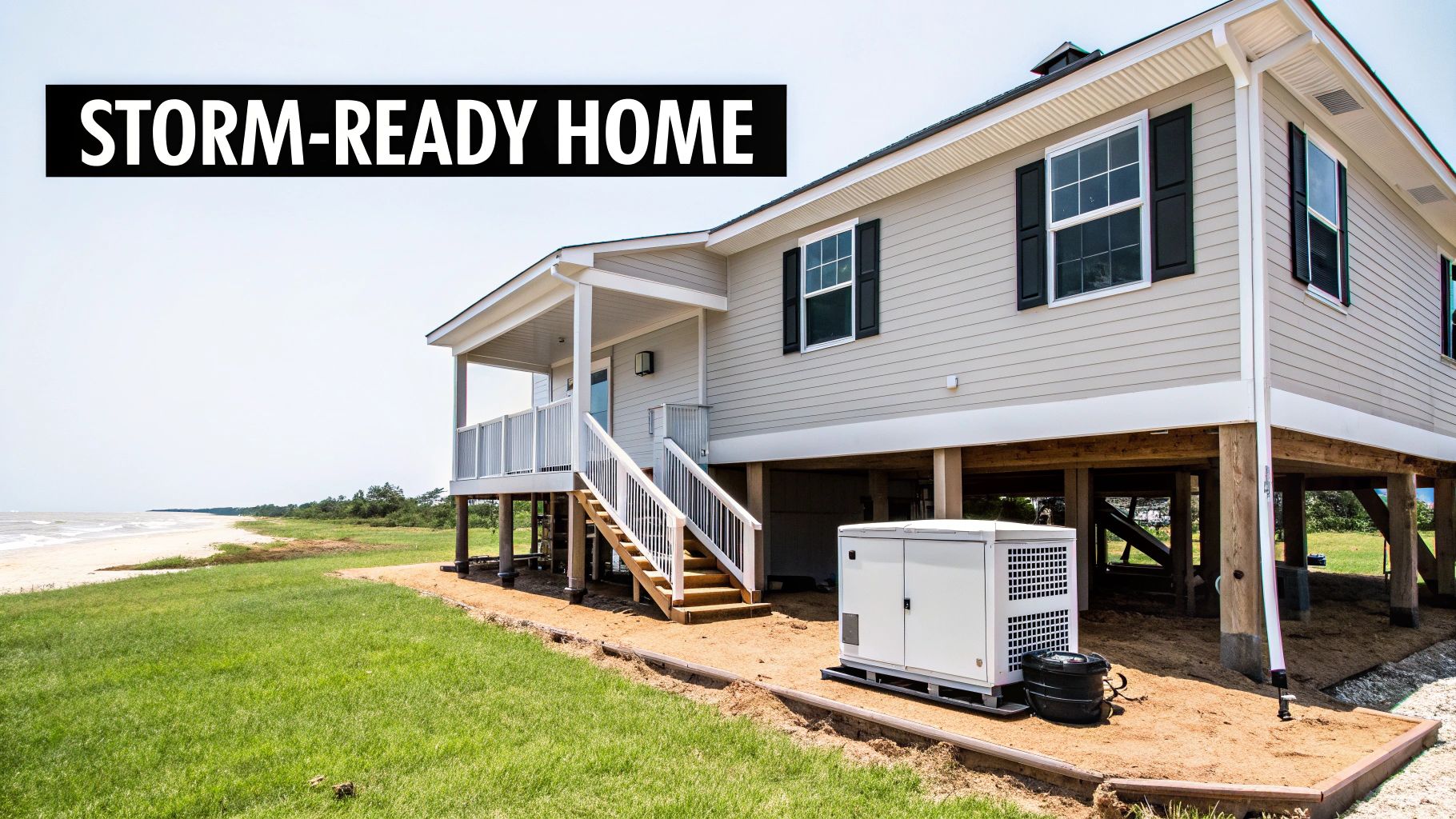

Here in Florida, real peace of mind isn't a luxury—it’s engineered. The cost of building a house in Florida, particularly in Southwest Florida, is fundamentally shaped by the constant reality of hurricanes.
These storm-ready features aren't fancy add-ons or optional upgrades. They are non-negotiable investments into the safety of your family and the long-term strength of your home.
Think of it like buying a new car. You wouldn't consider the airbags or brakes to be optional. In the same way, impact-resistant windows, reinforced concrete walls, and advanced roof tie-downs are the essential safety systems of a modern Florida home. They are designed and built-in from day one, creating a protective shield that’s integral to the home's very structure.
This approach isn't just about meeting the minimum building code. It’s about creating a home that not only survives a major storm but allows you to live through it with security and comfort.
The Unseen Strength of Concrete Block Construction
The foundation of a storm-ready home in Southwest Florida starts with its walls. Concrete Block Structure (CBS) is the gold standard here, and for good reason. Unlike typical wood-frame construction, CBS offers immense resistance to high-velocity winds and the brutal impact of flying debris.
It's a heavier, more substantial way to build. While it adds to the upfront cost, it delivers unparalleled strength when it matters most, creating a fortress-like shell that protects everything—and everyone—inside. It’s your first and most critical line of defense.
Windows and Doors: Your Shield Against the Wind
During a hurricane, a home's most vulnerable points are its windows and doors. A single broken window can cause a catastrophic pressure change inside the house, potentially leading to the roof being lifted off and walls collapsing. This is why impact-resistant windows and doors are a non-negotiable part of the budget.
These aren't your average windows. They're engineered with laminated glass and heavily reinforced frames designed to take a direct hit from debris flying at hurricane-force speeds. They are a significant investment, but they're critical:
- Protect the Building Envelope: They stop wind and rain from getting inside, which is the primary cause of structural failure.
- No More Shutters: This adds a huge amount of convenience and ensures your home is protected 24/7, even if you're out of town.
- Lower Insurance Premiums: Insurance companies love to see certified impact protection and often reward homeowners with better rates.
And don't forget the garage door—it's like a giant sail in a hurricane. Wind-rated garage doors are heavily reinforced to keep from buckling under intense pressure, protecting what is often the largest and weakest opening in a home.
The New Standard: Whole-Home Generators
Recent hurricane seasons have taught Southwest Florida a powerful lesson: going without power for days or even weeks isn't just an inconvenience; it can be downright dangerous. This stark reality has turned whole-home generators from a luxury item into a new standard for custom homes.
A permanently installed generator, typically fueled by natural gas or a large propane tank, kicks on automatically the second the power goes out. Your A/C keeps running. The refrigerator stays cold. Lights and essential medical equipment stay on. It’s more than just comfort—it provides a vital layer of safety and self-sufficiency in the chaotic aftermath of a storm.
The true value of a resilient home isn't just measured in dollars. It's measured in safety, security, and the ability to get your life back to normal quickly. Every dollar invested in hurricane protection pays you back in reduced risk and lower long-term costs of ownership.
Building for the storm also means choosing materials that stand up to Florida’s punishing climate year-round. For instance, when it comes to outdoor living spaces, comparing composite deck vs wood in Florida's climate helps you make a choice that balances durability with long-term value. These decisions all add up to a stronger, more resilient home.
Ultimately, investing in these features has a direct impact on your ability to get affordable insurance. To see how it all connects, take a look at our detailed guide on what drives hurricane insurance costs in Florida. A well-built, storm-ready home isn't just safer—it’s a much smarter investment.
How Design Choices and New Trends Shape Your Final Budget
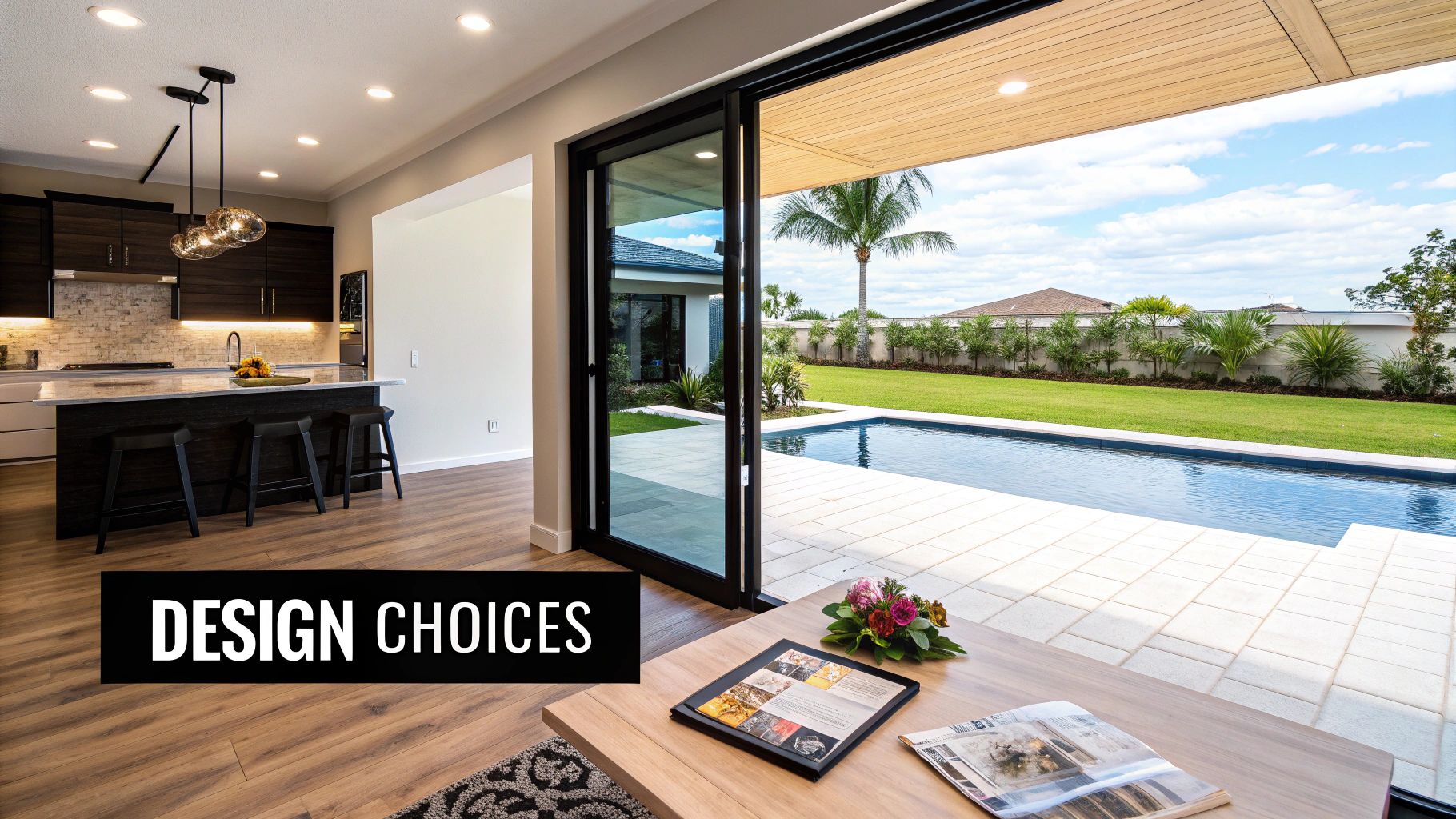
Once you’ve accounted for the essentials—the foundation, the structure, and all the storm-hardening required in Florida—the fun part really begins. This is where your personal style comes to life, but it’s also where your choices have the most direct and immediate impact on the final cost of building a house in Florida. Every single design feature, from the floor plan you fall in love with to the faucets in the guest bath, plays a part in your overall budget.
The selections you make here are a big deal because the price of materials and labor are huge factors in a home's final price tag. In fact, direct construction costs now make up a whopping 64.4 percent of the average new home's sale price, which is a noticeable jump from years past. It's a trend we're seeing across the board, and you can see how it influences budgets nationwide by checking out these national construction cost trends.
Embracing Florida's Indoor-Outdoor Lifestyle
Here in Southwest Florida, one of the biggest new design trends is erasing the line between inside and out. Homeowners want to create a seamless flow from the great room straight onto the lanai, making one massive, fluid space for entertaining, relaxing, and just enjoying the weather.
Pulling off this signature look involves a few key design features, and each has its own budget implications:
- Expansive Sliding Glass Walls: Pocketing or multi-panel sliding glass doors are the key to this whole concept. They create a stunning, wide-open feel, but these large, impact-rated systems are a serious investment compared to your standard sliders.
- Summer Kitchens: A simple grill sitting on the patio doesn't cut it anymore. Today’s homeowners are looking for fully equipped outdoor kitchens with built-in grills, sinks, refrigerators, and durable, weatherproof cabinetry.
- Custom Pools and Spas: A custom-designed pool isn't just a place to swim; it's the centerpiece of the backyard. Adding new features like a sun shelf, waterfalls, or an integrated spa adds considerable value and, of course, cost.
Kitchen and Bath Design Trends
The kitchen is still the heart of the home, and it’s a room where your budget and style are on full display. Open-concept gourmet kitchens with huge islands are practically standard now, but the specific materials you choose are what really drive the cost.
For example, opting for high-end quartz or a beautiful slab of natural stone for your countertops will be a much bigger line item than standard granite. In the same way, custom-built, solid wood cabinetry from a true craftsman offers incredible quality that will last a lifetime, but it comes at a premium compared to semi-custom or stock options.
The same thinking applies to the bathrooms. New design features like elegant freestanding tubs, zero-entry showers with frameless glass, and designer plumbing fixtures create that spa-like retreat everyone wants, but they also bump up the final price tag.
The key to getting your dream home without blowing your budget is being strategic. Maybe you splurge on that show-stopping countertop for the kitchen island but choose a more cost-effective (yet still beautiful) tile for the guest bathrooms.
Finishes and Smart Home Integration
Flooring is another area where your choices make a big difference. Luxury vinyl plank (LVP) has become incredibly popular, and for good reason—it’s durable and water-resistant, which is perfect for Florida. While it's often more affordable than high-end porcelain tile or engineered hardwood, the price still varies quite a bit depending on the quality and brand you select.
Finally, smart home technology has gone from a cool add-on to a real expectation. Most custom home buyers want integrated systems for lighting, climate control, security, and entertainment. Planning and wiring for this tech during construction is by far the smartest way to do it, but it's an important line item to factor into your initial budget.
For a little inspiration on how all these modern features can come together, you can explore some of these and other custom home design ideas.
Choosing a Builder Who Protects Your Investment

When all is said and done, the final cost to build a house in Florida isn't just a number on a spreadsheet. It's a direct reflection of the quality, integrity, and hands-on expertise of the person steering the ship. The right builder does a whole lot more than just assemble lumber and concrete; they become your partner, protecting your investment at every single turn.
Their true value goes far beyond what a simple price-per-square-foot quote could ever hope to capture.
This is especially true in a dynamic market like Southwest Florida. We're constantly dealing with new builder trends, evolving hurricane codes, and unpredictable supply chains. In this environment, a hands-on, on-site builder isn't just a nice-to-have—they're your single greatest asset. Their daily oversight ensures that top-tier materials are actually being used and that every last detail lines up perfectly with the engineered plans.
The On-Site Advantage
Think about it: a builder who is physically on your job site every day is actively managing your money and preventing expensive mistakes before they happen. This boots-on-the-ground presence means subcontractors are held to the highest standard. Potential issues are caught and corrected on the spot, not discovered weeks later when the fix is ten times more disruptive and costly.
This is a world away from the experience you get with a large company where your project is just one of many, overseen by a supervisor who might only swing by once or twice a week. A dedicated builder’s daily commitment translates directly into a higher-quality home and a much smoother, more transparent process for you.
A true custom home builder doesn’t just build houses; they build relationships founded on trust and a shared vision. Their reputation for integrity is your best insurance policy—it’s the assurance that your budget is being managed responsibly and your home is being built to last a lifetime.
Choosing your builder is the single most important decision you'll make in this entire process. Their hands-on approach, unwavering commitment to quality, and deep local knowledge are what transform a complex and potentially stressful project into a rewarding journey. The end result is a home that delivers lasting value and, most importantly, peace of mind.
Frequently Asked Questions About Building a Home in Florida
When you start digging into the process of building a custom home in Florida, you’ll find the big questions about budget and design are just the beginning. It's the practical details—timelines, unexpected expenses, and navigating our unique coastal building codes—that really matter.
Let's tackle some of the most common questions we get from clients every day.
How Long Does It Really Take to Build a Custom Home?
This is the big one, and the honest answer is: it depends. That said, a realistic timeline for building a custom home here in Southwest Florida, from the first design sketch to finally getting the keys, is anywhere from 12 to 18 months.
That timeframe covers everything: the back-and-forth of architectural design, navigating the local permitting maze, prepping the site properly, all phases of construction, and adding those final interior and exterior finishes that make it your home.
Of course, things can shift. A particularly complex design, a surprise visit from a hurricane, or a snag in the global supply chain for a specific material can all stretch the schedule. It's just part of the process.
What Are the Biggest "Hidden" Costs I Should Plan For?
A detailed builder's quote should be rock-solid and transparent, but some necessary costs always fall outside the main construction contract. You absolutely need to have these on your radar.
- Impact Fees: Think of these as a one-time tax from the city or county. They're meant to help public services like roads, schools, and parks absorb the impact of a new home being added to the community.
- Utility Connections: The cost to physically connect your new home to the water, sewer, and electrical grids is a separate, and often significant, line item.
- Serious Site Work: If your lot is a jungle that needs clearing, sits at a low elevation requiring tons of fill dirt, or has tricky soil, the prep work costs can climb higher than initially estimated.
- Landscaping and Irrigation: A full landscaping package—sod, plants, trees, and the sprinkler system to keep it all alive—is typically budgeted separately from the house itself.
And don't forget the long-term expenses. Property taxes and crucial flood insurance aren't part of the build cost, but you need to factor them into your overall financial plan right from the start.
How Do Florida's Building Costs Compare Nationally?
It’s always helpful to zoom out and see where Florida sits in the bigger picture. Right now, the national average cost to build a new home has hit $428,215. For a typical home, that works out to about $162 per square foot.
So where does that put us? Florida's typical range of $160–$295 per square foot shows just how diverse our state is. On one end, you have more straightforward builds on inland lots, and on the other, you have high-end, hurricane-rated estates right on the coast. For a deeper dive, you can check out the latest report on national home building costs.
Ready to turn your vision into a reality with a builder who prioritizes quality, integrity, and on-site expertise? At Sinclair Custom Homes Inc, we believe in an over-engineered approach that protects your investment for a lifetime. Start the conversation about your dream home today.