


Bringing a custom home to life in Southwest Florida should be one of the most exciting journeys you ever take. But let's be honest—even with the best team, disagreements can pop up, turning that dream into a stressful reality. Think of construction dispute resolution not as a sign that things have gone wrong, but as a professional, structured way to get everyone back on the same page and keep your project moving forward.
Navigating Conflicts When Building Your Florida Dream Home
Building a custom home in places like Cape Coral or Fort Myers comes with a unique set of challenges you won’t find elsewhere. Our coastal environment means construction issues often have a distinct Florida flavor, where a simple misunderstanding can quickly snowball into major delays and budget blowouts.
This guide is for homeowners who want to be prepared. We'll walk you through construction dispute resolution as a powerful tool to have in your back pocket, not just a last resort. Understanding the process is the single best way to protect your investment and ensure the home you move into is the one you envisioned.
Florida-Specific Building Challenges
The Sunshine State’s climate and regulations create specific hurdles that can become flashpoints if they aren't clearly spelled out from day one. A builder's interpretation of a requirement might not line up with your expectations, leading to friction that needs a formal process to smooth out.
Here are some of the most common areas where we see conflicts arise in Southwest Florida:
- Hurricane Impact Features: It’s common to have disagreements over the specific ratings, brands, or installation methods for hurricane-impact windows and doors.
- Site Elevation and Drainage: With ever-changing FEMA flood maps and local rules, arguments over the final floor elevation and proper site grading are on the rise.
- Generator Installations: Conflicts often surface around the size, placement, and hookup of whole-home generators, especially when it comes to noise rules and storm readiness.
- New Design Trends: Misunderstandings about how to execute complex new designs—from floating staircases to huge outdoor living spaces—can lead to expensive rework.
A well-defined plan for construction dispute resolution is like having a good insurance policy for your project. You hope you never need it, but it provides immense peace of mind and a clear path forward if challenges appear.
Ultimately, knowing how to handle these potential issues is just as important as picking out the right countertops. It empowers you to stay in control and work collaboratively with your builder to get the job done right, making sure your custom home is everything you dreamed it would be.
Why Do Construction Disputes Happen in Florida?
Think of your custom home contract as the architectural blueprint for your entire project. It's supposed to lay out every single detail before the first shovel hits the ground. But when terms are vague or details are missing, it’s like leaving out a supporting beam—you’ve created a weak spot in what should be a rock-solid plan.
When expectations aren't clearly documented, simple misunderstandings can quickly become cracks in the foundation of your project. These small gaps can widen into expensive conflicts that destroy trust and pile on emotional stress.
Common friction points often look like this:
- Vague specs for product brands or model numbers
- Verbal change requests that never get written approval
- Different interpretations of complex coastal building codes
- Assumptions about how certain materials should be installed
Even homeowners with a healthy budget feel the pressure when a minor error in wording sparks a major disagreement. The key is to recognize these common patterns early and build safeguards into your contract and communication from day one.
In Florida, disputes often come with an extra layer of complexity—and cost—thanks to hurricane modifications and flood mitigation requirements. These hyper-local issues can push a project's budget into an entirely new tier almost overnight.
Unclear Specifications for Hurricane-Rated Features
So many disputes start with fuzzy details about hurricane windows, doors, and shutters. A builder might install a window rated for 130-mph winds, but the homeowner was under the impression the contract called for 150-mph protection.
For example, simply naming a brand without specifying the exact model number leaves the door wide open for debate over performance and quality. This is a particularly sensitive issue in Southwest Florida, where storm codes and a buyer's expectations for safety have to be perfectly aligned.
Clear contract specs are the hurricane straps of your agreement—they secure every expectation firmly in place.
Getting these details wrong isn't a small fix. It can mean re-ordering and replacing an entire house full of windows, costing you thousands of dollars and weeks of lost time.
Coastal Material Delays From Supply Chain Chaos
Building on the coast often means using high-end materials like Ipe or teak decking, specialty stucco finishes, or custom-impact glass. These materials are beautiful, but they can be incredibly vulnerable to supply chain disruptions and long lead times. These delays frustrate homeowners who are eager to see progress and can easily spark conflict when the schedule starts to slip.
- Orders for imported stone can get stuck in customs at the port.
- Specialty hurricane-rated glass might need custom fabrication with a long backlog.
- Global events like wildfires or shipping bottlenecks can push delivery dates out by months.
This is exactly why your contract needs to include clauses for alternative suppliers and built-in buffer time. It’s a critical step for keeping the project moving smoothly. We saw this firsthand when a Fort Myers homeowner had to wait three extra months for custom coastal tile, putting all the interior finish work on hold until it finally arrived.
Flood Plain Rules and Elevation Compliance
With FEMA continually updating its flood maps, disagreements over a home's final floor elevation are more common than you'd think. Builders can interpret the requirements differently, especially if the flood grades and official benchmarks aren't spelled out with absolute clarity in the plans.
These aren't minor disagreements; they have huge financial implications. Globally, the average construction dispute value hit $52.6 million in 2021. Closer to home, North American projects saw a staggering 42% jump in dispute values between 2021 and 2022, showing just how expensive these conflicts can get. You can find more statistics on construction dispute values on nixlaw.com.
| Common Dispute Trigger | A Real Florida Example |
|---|---|
| Unclear Specs | Misinterpreting a window's wind-speed rating. |
| Material Delays | Teak decking for a lanai held up at a shipping port. |
| Elevation Dispute | Disagreements over new FEMA flood benchmarks. |
| Unapproved Changes | A verbal "okay" for a change vs. a signed order. |
In one Cape Coral project, a home's foundation had to be raised another 6 inches after the initial grading work was done, leading to an unexpected $15,000 charge for the homeowner.
Misaligned Finishes and Informal Change Orders
What seems like a simple request—"let's change the paint color in the guest room"—can spiral into budget overruns if it’s not handled formally. A homeowner might think a quick email is enough, but a professional builder needs a signed change order to officially modify the contract, budget, and schedule.
Misaligned expectations really come to a head during the final walkthroughs. This is when disagreements over the shade of tile grout, the finish on cabinet hardware, or the texture of the drywall suddenly become major issues. If the builder hasn't provided regular progress updates, this frustration can quickly turn into mistrust.
Here’s how it usually goes wrong:
- Skipping the formal change-order process for "small" tweaks.
- Relying on verbal agreements that are never documented.
- Forgetting to update the project timeline and budget after a change is approved.
In one case, an unapproved switch from a matte to a glossy tile in a master bathroom resulted in a $5,200 bill and three weeks of rework to tear out the wrong tile and install the new one.
This toxic mix of poor communication and undocumented changes is a recipe for disputes that can cost tens of thousands of dollars. Understanding these triggers is the first step in protecting your project. By demanding clear contract language, formal change orders, and regular check-ins, you protect both your investment and your peace of mind.
Up next, we’ll walk through the step-by-step pathways for resolving conflicts—negotiation, mediation, arbitration, and litigation—so you’ll know exactly what to do if a problem arises. This guide will give you clarity and confidence for every stage of the process.
Your Guide to the Four Levels of Dispute Resolution
When a conflict pops up during your custom home build, it can feel like the whole project is about to go off the rails. It’s a stressful situation, no doubt. But having a clear roadmap for construction dispute resolution gives you the power to get things back on track.
Think of it as an escalation ladder. You always start on the lowest, most collaborative rung and only move up if you absolutely have to. Each step offers a different balance of cost, time, and control, and for homeowners here in Southwest Florida, knowing your options is the key to protecting your investment.
Level One: Direct Negotiation
This is always, without exception, the first and best place to start. Direct negotiation is just a professional, structured conversation between you and your builder. The goal isn't to "win" an argument; it's to find a solution you can both live with.
For instance, say the wrong brand of impact-rated windows was installed. You’d schedule a meeting, calmly present the contract specs and photos of what was installed, and talk through a fix. A good outcome might be the builder agreeing to replace them or offering a credit for the difference in value.
A productive negotiation hinges on clear communication and solid documentation. If you want to brush up on how to handle these conversations, learning how to negotiate with contractors can give you the confidence you need to stay in control.
Level Two: Mediation
If you’ve tried talking directly and you’re just not getting anywhere, mediation is the next logical step. This is where you bring in a neutral third party—a professional mediator—who acts as a facilitator, not a judge. Their entire job is to help you and the builder find some common ground.
Mediation is completely confidential and, importantly, non-binding. That means you aren't forced into any agreement you don't like. Imagine a dispute over surprise site prep costs on your Cape Coral lot because of bad soil conditions nobody expected. A mediator would help you both dissect the contract, look at the reports, and guide you toward a fair compromise on who shoulders the extra expense.
A successful mediation is a win-win. It keeps you and your builder in control of the final outcome, preserving the relationship and saving you from the stress and high costs of more formal proceedings.
Level Three: Arbitration
When mediation doesn't lead to a handshake, arbitration is the next level up. This process is far more formal—think of it as a private mini-trial. You and your builder present your cases to an impartial arbitrator (or sometimes a panel of three) who acts as a private judge.
Here's the key difference: the arbitrator's decision is almost always legally binding. Whatever they decide is the final word and can be enforced by a court. A classic arbitration case might involve a complex dispute over a subcontractor's shoddy installation of a whole-home generator, where you need technical evidence and expert testimony to figure out who's at fault.
While arbitration is usually faster and cheaper than a full-blown lawsuit, you do give up your right to a traditional court trial and, in most cases, the right to appeal the decision.
Level Four: Litigation
Litigation is the final stop and the one you want to avoid if at all possible. This means filing a lawsuit in public court. It’s the last resort when every other method has failed, involving teams of attorneys, formal evidence discovery, depositions, and a public trial in front of a judge or jury.
This path is by far the most expensive and time-consuming, often dragging on for years. It can permanently destroy your relationship with the builder and create a massive amount of stress and public record. Litigation is typically reserved for the most severe problems, like major construction defects or huge financial disagreements.
For disputes that do escalate to a formal hearing, understanding the system is crucial. For those interested, there are resources for Navigating Building Disputes Tribunals that can provide more context on these formal processes.
Comparing Dispute Resolution Methods
Choosing the right path depends entirely on your specific situation. This table breaks down the four methods side-by-side so you can see how they stack up in terms of cost, time, and how much control you get to keep over the final decision.
| Method | Average Cost | Typical Timeline | Formality Level | Control Over Outcome |
|---|---|---|---|---|
| Direct Negotiation | Low (your time) | Days to Weeks | Very Low | High |
| Mediation | Low to Moderate | Weeks to Months | Low | High |
| Arbitration | Moderate to High | Months | Medium | Low |
| Litigation | Very High | Months to Years | Very High | Very Low |
As you can see, the higher you climb the ladder, the more you spend and the more control you lose. That's why we always stress starting with collaboration and only escalating when it becomes absolutely necessary.
How to Prevent Disputes Before They Start
The absolute best way to handle a construction dispute is to make sure it never happens in the first place.
It's true. Taking proactive steps before the first shovel hits the dirt is far less expensive and stressful than trying to fix a problem later. Think of it as preventative maintenance for your custom home project; a little foresight saves a world of headaches down the road.
This all comes down to two key things: an ironclad contract and a serious commitment to documentation. Getting these right from day one creates a powerful defense against the common misunderstandings that can derail a custom home build in Southwest Florida.
Crafting an Ironclad Construction Contract
Your construction contract is the most critical document for your entire project. It's not just a formality—it's the official rulebook that guides every single decision, from materials purchased to deadlines. A vague or incomplete contract is a wide-open invitation for conflict.
To protect your investment, your agreement needs to be crystal clear on a few non-negotiables:
- Detailed Scope of Work: The contract needs to get specific. It's not enough to say "impact windows"; it should list the exact brand, model number, and performance ratings. The same goes for every critical component, from roofing to hurricane shutters.
- Transparent Change Order Process: Even small changes need to be put in writing. Every time. Having a formal process for construction change order management is the only way to protect your budget and your timeline from scope creep.
- Realistic Timelines: The schedule must account for the realities of building in Southwest Florida. That means planning for potential supply chain delays for coastal-rated materials and building in buffers for hurricane season. Good contracts even prepare for the unexpected with clear force-majeure clauses.
A strong contract doesn't just outline the work; it builds a framework of accountability. It ensures both you and your builder are operating from the same set of blueprints, eliminating ambiguity.
Meticulous Documentation is Your Best Defense
If the contract sets the rules, then your ongoing documentation provides the proof. Keeping detailed records isn't about mistrust; it's simply about maintaining clarity and creating a factual history of the build. When a disagreement does pop up, these records become the undisputed source of truth.
Just start a digital folder on day one and be consistent. This simple habit can be the deciding factor in settling a potential issue quickly and fairly.
This flowchart shows how clear communication, backed by solid records, is the foundation for avoiding the courtroom.
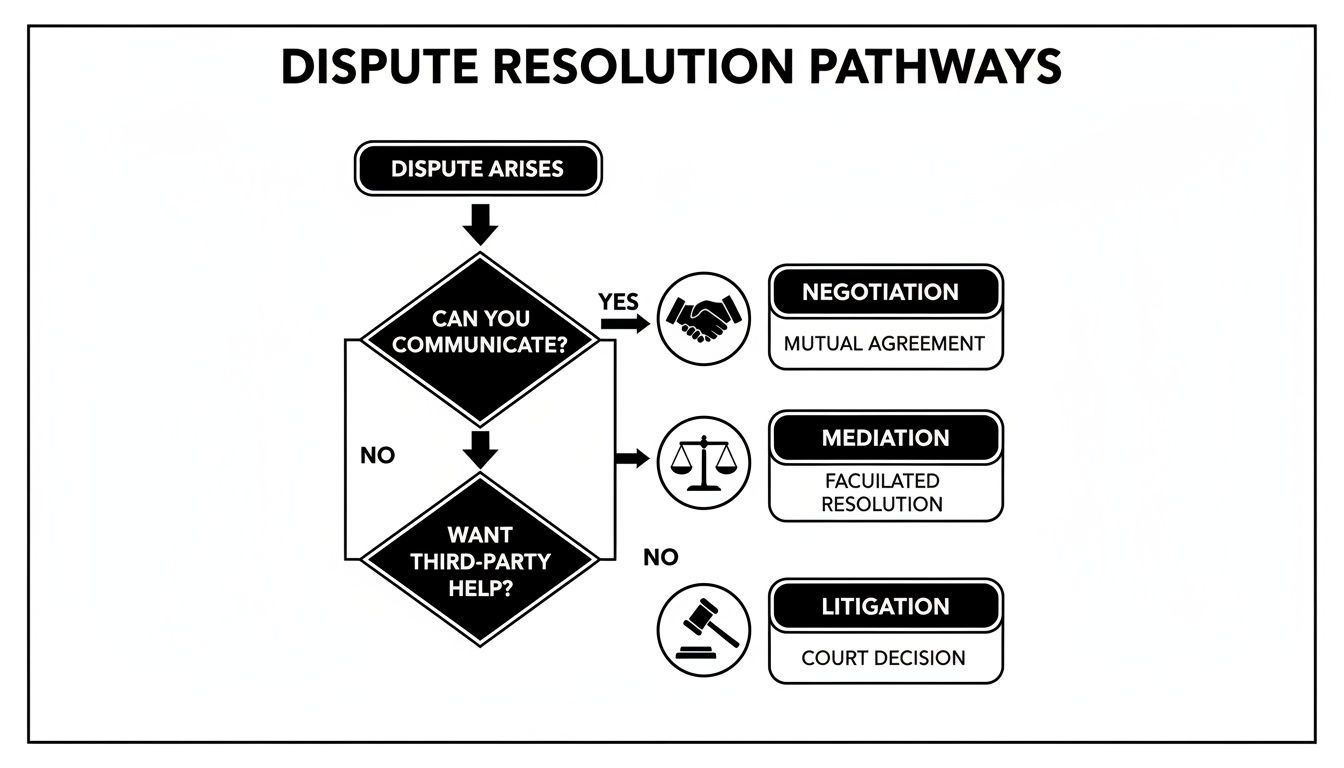

As you can see, the fastest and least costly options—negotiation and mediation—depend entirely on having organized evidence to support your position.
Your Practical Documentation Checklist
Keeping good records doesn't need to be a full-time job. A simple, consistent system is all it takes. Here’s a quick checklist to get you started:
- Log All Communications: Keep a running log of important calls and meetings. Just note the date, who was there, and what was decided. Save every related email and text in that project folder.
- Take Regular Progress Photos: A picture truly is worth a thousand words on a job site. Snap photos from the same angles each week to create a visual timeline. It can instantly clear up questions about progress or workmanship.
- Organize Financials: Save digital copies of every single invoice, receipt, and proof of payment. A simple spreadsheet to track expenses against your budget will help you see where every dollar is going.
- File All Documents: Your central folder should have copies of the contract, plans, permits, all signed change orders, and any official correspondence from suppliers or subcontractors.
In the end, preventing disputes really boils down to choosing a builder who sees the project as a partnership. A contractor who is committed to open communication and regular on-site supervision is your greatest asset. When your builder is a true partner, you solve challenges together long before they can ever grow into disputes.
The Future of Construction Dispute Resolution

The old ways of handling construction disputes are starting to feel, well, old. For homeowners here in Southwest Florida, the future is shaping up to be less about lengthy courtroom battles and more about smart, collaborative problem-solving. We're seeing new builder trends and technologies that cut through the adversarial noise, saving everyone time, money, and a whole lot of headaches.
One of the biggest changes is a fundamental shift in how projects are structured from the get-go. The goal is to get everyone pulling in the same direction from day one.
A Shift Toward Collaborative Building
An approach that’s really gaining traction is Integrated Project Delivery (IPD). Picture this: instead of separate teams, you create a single, unified group from the start—homeowner, builder, and architect, all in it together. It completely gets rid of the separate silos where it's so easy to pass the blame.
This model changes the entire dynamic. Everyone shares in the project’s risks and rewards. So when a challenge pops up—like an unexpected issue with the site elevation or a delay sourcing those specific hurricane-impact windows—the focus isn’t on pointing fingers. It’s on finding a solution. That shared financial stake makes transparency and proactive problem-solving the only path forward, which naturally nips most disputes in the bud.
The Rise of Technology in Resolving Conflicts
Beyond new building models, technology is making the biggest waves. The industry is clearly moving away from drawn-out litigation and toward more efficient, tech-driven alternatives. In fact, 2025 is poised to be a landmark year for using generative AI to resolve construction conflicts, which signals a massive change for the industry.
Think about this scenario: a complex disagreement comes up, involving months of back-and-forth. A traditional review of 100,000 project emails would take a team of lawyers seven weeks and cost around $216,000. With generative AI, that same massive review can be done in just four business days for about $27,000. You can find more details on how AI is changing construction disputes on thinkbrg.com.
This isn't just a small step forward; it’s a complete game-changer for homeowners. Technology is leveling the playing field, making it possible to get to the truth without spending a fortune.
This is especially huge for custom home projects in Florida, where disputes can involve thousands of documents covering building codes, material specs, and change orders. AI-powered tools can sift through contracts, emails, and daily logs in minutes, pinpointing the root cause of a disagreement with stunning accuracy. This gets homeowners and builders to the heart of the matter quickly, armed with facts instead of feelings. Ultimately, the future is about using these tools to keep projects on track and relationships intact.
Building a Strong Partnership with Your Builder

When it comes right down to it, a successful custom home is built on something much stronger than concrete. It’s built on a true partnership, open communication, and an incredibly detailed plan.
While disagreements can pop up, knowing the ropes of construction dispute resolution gives you the power to protect your investment and get the project back on track. This guide has laid out the tools to prevent, manage, and solve conflicts, but the best defense is always a good offense. A well-written contract and diligent documentation are your project's blueprint and insurance policy, all rolled into one.
Your Blueprint for a Smooth Build
Building a custom home in Southwest Florida comes with its own unique set of challenges. We're talking about everything from hurricane impact windows and generators to complex site elevation requirements. Every single one of these details demands you and your builder are perfectly in sync.
- Clarity is Key: Most conflicts start with vague agreements on things like new design trends or material choices. Get it in writing.
- Communication is Everything: Regular, documented check-ins can stop a small misunderstanding from snowballing into a huge, expensive problem.
- A Real Partnership is Powerful: The most important decision you'll make is choosing a builder who genuinely values transparency and collaboration.
A strong builder-client relationship isn't about pretending problems won't happen. It's about having a shared commitment to solving them together when they do. That collaborative spirit is the true sign of a successful build.
By arming yourself with this knowledge and fostering a spirit of cooperation, you can turn a potentially stressful process into an exciting one. Making regular site visits and keeping the lines of communication wide open is non-negotiable. Using a detailed construction quality assurance checklist can give you a solid framework for these important conversations.
With the right information, a solid plan, and a builder you trust, the journey to creating your dream home in Southwest Florida can be a truly remarkable experience, free from the weight of unresolved disputes.
Common Questions About Construction Disputes
Building a custom home in Southwest Florida is a huge undertaking, and it's natural to have questions, especially if a disagreement pops up. Here are some straightforward answers to the questions we hear most often from homeowners.
What’s the First Thing I Should Do If I Disagree with My Builder?
Before you do anything else, take a breath and focus on clear, professional communication. An emotional reaction will only make things more complicated.
Your best first step is to document the issue. Take clear photos, write down the specifics, and then formally ask for a meeting with your builder to talk it through. Coming to the table with a level head and good documentation often clears up misunderstandings right away. It's always worth reviewing your contract first to see what it says about the item in question and how conflicts should be handled. This simple act of direct negotiation is almost always the fastest and cheapest way to get things back on track.
How Long Do I Have to File a Construction Defect Claim in Florida?
Florida law has some very specific deadlines for this. Generally speaking, the Statute of Limitations gives you four years to file a claim, starting from the date you discovered the defect (or reasonably should have discovered it). This is key for problems that don't show up right away, like a slow leak that takes months to become obvious.
But there’s another, harder deadline called the Statute of Repose. This sets a final cutoff of ten years from the date the project was officially completed, no matter when you found the problem. These timelines can get tricky, so it's always smart to talk with a legal professional to be sure you understand how they apply to your home.
Don't sit on a potential defect. The clock starts ticking the moment a problem is identified, and waiting too long could mean losing your right to a solution.
Is a Mediation Agreement Legally Binding in Florida?
This is a great question. The mediation process itself is totally voluntary and non-binding. The mediator is just a neutral third party there to help you and your builder find common ground—they can't force anyone to agree to anything. You're always in the driver's seat.
However, if you do reach an agreement during the session, those terms are written up into a formal settlement document. Once both you and the builder sign it, that agreement becomes a legally binding and enforceable contract. If you can't find a solution in mediation, you're both free to walk away and explore other options like arbitration or heading to court.
At Sinclair Custom Homes Inc, we believe that the best way to handle disputes is to prevent them from ever happening. That's why Matthew Sinclair is on-site, making sure your vision is built with honesty, integrity, and uncompromising quality. If you’re ready to build a home on a foundation of trust in Cape Coral or Fort Myers, start the conversation with us today.