Buying your first home in Florida is a major milestone, and building a custom home in Southwest Florida is a smarter, more achievable reality than you might think. New construction offers advantages that older properties simply can't match, especially when it comes to the latest design trends, hurricane readiness, and long-term energy savings.
Your Path to Florida Homeownership Starts Here
Welcome to your practical guide for a first time home buyer in Florida, with a sharp focus on the custom home industry in vibrant areas like Cape Coral and Fort Myers. We'll cut through the complexities and provide a clear roadmap for building a brand-new home tailored to the unique demands of the Sunshine State.
This guide is designed for first-time buyers who want a home built to today's rigorous standards. The journey from dream to reality can seem complex, but our goal is to break it down, so you feel confident and excited about building a home that’s truly yours.
Why New Construction is the Smart Choice in Florida
Here in Florida, the real estate market—and the weather—has a way of revealing what truly matters. After a major storm, the value of modern building codes and thoughtful design becomes crystal clear. Homes built today are engineered to a higher standard, giving you a level of safety and security that you won't find in older houses.
Here's why building new makes sense for a first time home buyer in Florida:
- Superior Hurricane Resilience: We're talking about integrated systems—hurricane-impact windows, reinforced roofing, and robust structural connections—all designed to withstand Florida’s intense weather.
- Modern Energy Efficiency: New builder trends focus on high-SEER HVAC systems, spray-foam insulation, and energy-efficient appliances. This translates into significantly lower utility bills.
- Total Personalization: You control the layout, finishes, and all the modern design features. Want an open-concept living space that flows to an outdoor kitchen? Done. Need a whole-home generator for uninterrupted power during storms? It's a popular and smart addition.
- Higher and Drier by Design: Building new allows you to strategically set your home’s elevation. This is a crucial defense against storm surge and rising flood risks, directly impacting your peace of mind and insurance costs.
Working with a hands-on builder like Sinclair Custom Homes means you have an expert on-site daily, ensuring every detail aligns with the highest standards. This direct oversight is how your vision for a safe, modern, and beautifully crafted home becomes a reality, built with integrity from the ground up.
Securing Financing for Your Florida Custom Home

Let's discuss the financial side. Securing the right financing is the foundation of your home-building journey. As a first time home buyer in Florida, navigating loan options for new construction can feel overwhelming. However, with the right information, you can approach it with confidence.
Financing a new build is different from buying a resale home. You’ll need a construction-to-permanent loan. This is an all-in-one loan that covers the construction phase and then converts into a traditional mortgage once your home is complete. The major benefit is a single closing process, which saves you significant time, paperwork, and money.
Understanding Your New Construction Loan Options
For first-time buyers in Southwest Florida, several powerful loan options are available. The best choice depends on your financial situation.
- Conventional Construction Loans: Ideal for buyers with good credit (typically a score of 620 or higher) and a down payment of at least 5%. They offer competitive rates and flexible terms.
- FHA Construction Loans: Backed by the government, FHA loans are a great option if your credit score is less than perfect or you have a smaller down payment. You can often get approved with a score as low as 580 and a down payment of just 3.5%.
- VA Construction Loans: An exceptional benefit for veterans, active-duty military, or eligible spouses. VA loans often require no down payment and no private mortgage insurance (PMI).
Working with a builder who is well-versed in these loan types is crucial. We can connect you with local lenders in the Fort Myers and Cape Coral area who specialize in new construction financing, streamlining the entire process.
Florida-Specific Programs Can Lower Your Upfront Costs
The down payment and closing costs are often the biggest hurdle for a first time home buyer in Florida. The good news? Our state has some fantastic assistance programs to help you clear it.
Your go-to resource is the Florida Housing Finance Corporation (Florida Housing). They run several programs that can give you a major leg up, usually through a second mortgage with deferred payments.
The Florida Assist Loan Program is a great example. It can provide up to $10,000 as a 0% interest, deferred second mortgage. You don’t owe a penny on it until you sell the home, refinance, or pay off your main mortgage. That frees up a lot of cash right when you need it most.
Another one to look into is the Hometown Heroes Program. This program helps our frontline community workers—like nurses, teachers, and first responders—with up to $35,000 in down payment assistance. It’s always smart to ask your lender about city and county programs in Lee County, too, as you might find unique local grants. For more guidance, check out these 4 Financial Tips For Buying Your First Home.
Budgeting Beyond the Build Price
When you're building a custom home, the budget is more than just the price of the house itself. You have to look at the total investment to get a true financial roadmap.
Your all-in cost will include a few key pieces:
- Land Acquisition: The price of the lot your home will sit on.
- Site Preparation: This includes clearing the land, soil testing, and setting the proper elevation—a critical step for managing flood risk in Southwest Florida.
- Permits and Impact Fees: Standard fees paid to local governments for public services.
- Utility Connections: The cost to connect your new home to water, sewer, and the electrical grid.
- Upgrades and Finishes: This is where you select the new design features you want, from custom cabinetry to hurricane-impact windows.
- Contingency Fund: I always advise clients to set aside an extra 5-10% of the total project cost. This fund covers unexpected site costs or allows for last-minute design upgrades.
Getting a clear picture of these costs upfront eliminates any surprises later. We break it down even further in our guide on the cost to build a house in Florida. When you plan for the whole project, not just the house, you can move forward with total financial peace of mind.
Choosing Your Build Path: On-Your-Lot vs. Inventory Home
As a first-time home buyer in Florida, one of the most exciting decisions you'll make is how your home comes to life. You have two main paths in the custom home industry: building a completely custom home on a lot you choose or buying a builder’s ready-to-go inventory home. The right choice depends on your vision, timeline, and priorities.
This decision shapes your entire homeownership journey. It can also be helpful to weigh the pros and cons of a Remodel vs New Construction to fully understand what creating a new living space involves.
The On-Your-Lot Custom Build: A Home That’s Uniquely You
Building on your own lot is all about personalization and creative freedom. If you have a specific vision, this is the path for you. From day one, you are in complete control.
You’re not just picking finishes; you’re defining the floor plan. Need a dedicated home office? Want a sprawling lanai with an outdoor kitchen? Looking for specific new design features like a walk-in pantry or a spa-like master bath? A custom build lets you incorporate all the latest builder trends.
Here are the standout benefits of a custom build:
- Total Customization: You select every detail, from the lot and floor plan to handcrafted wood cabinets and modern design features.
- Site-Specific Design: We orient the home to maximize views, preserve natural features, or capture the best light. Crucially, we strategically set the home’s elevation to mitigate flood risk—a vital consideration in Southwest Florida.
- Future-Proofing Features: Build in the latest technology from the start. A whole-home generator for hurricane season, pre-wiring for a smart home system, or an EV charging station in the garage are all possible.
With a custom build, you aren't just buying a house. You're bringing a vision to life—a home that's a true reflection of your family, engineered to the highest standards of quality and resilience.
The Inventory Home: Your Faster Path to a New Front Door
An inventory home, also called a "spec" or "move-in ready" home, offers a more direct and predictable route. These are homes a builder has already designed and constructed based on popular new builder trends and features. You trade deep customization for speed and simplicity.
This is an excellent option for buyers on a tighter timeline or those who prefer a professionally curated design without making thousands of individual decisions.
Here’s why an inventory home might be the perfect choice:
- Faster Move-In: The home is often finished or nearly complete, dramatically shortening the time from contract to closing.
- Predictable Costs: The final price is set upfront, eliminating the budget variables that can arise with a fully custom build.
- Professionally Designed: We’ve already selected a stylish and cohesive package of finishes, incorporating current design trends that appeal to modern buyers.
To help you visualize the differences, here's a quick breakdown of how these two options stack up against each other for Florida buyers.
Build on Your Lot vs Inventory Home: A Comparison for Florida Buyers
| Feature | Build on Your Lot (Sinclair Custom Homes) | Inventory Home |
|---|---|---|
| Customization | Complete control over floor plan, finishes, and features. | Limited to pre-selected design packages; no structural changes. |
| Timeline | Longer process (design, permits, construction); typically 9-18 months. | Much faster; can be move-in ready in 30-90 days. |
| Location | You choose the exact lot in your desired neighborhood. | Limited to the lots and communities the builder has available. |
| Cost | More variables; final price depends on your selections. | Fixed price set from the start; very predictable budget. |
| Decision-Making | High involvement; you make hundreds of decisions. | Low involvement; most design choices are already made. |
| Lot Preparation | You are responsible for lot clearing, fill, and prep costs. | All site work is included in the home's final price. |
Ultimately, both paths lead to a beautiful, brand-new Sinclair Custom Home. The best route simply depends on what matters most to you and your family right now.
Crucial Lot Selection Factors in Southwest Florida
If you choose the custom route, finding the right land is as critical as designing the house. In Cape Coral and Fort Myers, a few factors heavily influence your safety, insurance costs, and enjoyment of your home. News affecting building in Florida, such as changes in flood maps or building codes, makes professional guidance essential.
When we evaluate a lot, we look closely at:
- Elevation and Flood Zone: Is the lot in a high-risk flood zone? Building on a higher elevation is one of the most effective ways to lower your flood insurance premiums and protect your investment.
- Soil Quality: Soil conditions can affect foundation requirements and overall construction costs.
- Zoning and Setbacks: We navigate local regulations that determine how you can position your home on the lot and what types of structures are permitted.
This is a big fork in the road on your home-buying journey. To explore this topic in more detail, you can learn more about building your custom home vs buying to see which approach truly fits your family's goals.
Designing a Resilient and Modern Florida Home
You’ve chosen your path. Now comes the exciting part: bringing your vision to life.
Designing a home in Southwest Florida is about more than aesthetics; it’s about creating a comfortable fortress that withstands our unique climate. For a first time home buyer in Florida, making the right design choices from the start is crucial for a home that is not just beautiful but durable and secure.
We don't just build houses; we engineer homes that provide total peace of mind, especially during hurricane season.
Building for the Storm: Hurricane Readiness and Structural Integrity
In coastal areas like Cape Coral and Fort Myers, building for hurricanes is not an option—it's the primary consideration. While the Florida Building Code sets a high standard, a reputable builder treats it as the minimum. Every structural choice is part of a system designed to handle extreme wind and water.
These hurricane-impact features are non-negotiable in new construction:
- Impact-Rated Windows and Doors: These are essential. Built with shatter-resistant glass and reinforced frames, they can withstand impacts from flying debris, which is critical for maintaining the structural integrity of your home during a storm.
- Reinforced Roofing Systems: This involves more than just shingles. It means using stronger connectors and advanced techniques to secure the roof to the walls, preventing catastrophic failure from wind uplift.
- Strengthened Concrete Block Walls: Building with reinforced concrete block is standard, but we ensure it’s done to the highest specification to create a rock-solid shell for your home.
These are not upgrades; they are fundamental components of a modern Florida home. Investing in this structural strength protects your family and can lead to significant savings on homeowner's insurance.
Modern Must-Haves: Power and Elevation
Florida living demands readiness for power outages. A whole-home generator has become a new standard in the custom home industry. These systems are permanently wired into your electrical panel.
When the power goes out, the generator automatically starts within seconds. Your AC keeps running, your refrigerator stays cold, and your lights stay on. It’s the ultimate feature for comfort and security during and after storms.
Equally important is your home's elevation. New construction provides the opportunity to raise the finished floor height, often well above minimum flood map requirements. A higher elevation is your best defense against storm surge and flooding, dramatically lowering your risk and helping to control flood insurance costs for the life of your home.
The Excitement of Custom Design: Personalizing Your Space
Beyond the structural necessities lies the joy of making the space uniquely yours. This is where a house becomes a home. As a first-time buyer, you get to create a space that fits your lifestyle perfectly—a luxury you don’t get with a resale property.
Open-concept living spaces remain a dominant trend in new Florida home design. The seamless flow between the kitchen, living, and dining areas creates a bright, airy atmosphere perfect for family life and entertaining. We often enhance this with expansive sliding glass doors that open to a lanai, blurring the line between indoor and outdoor living.
It’s the details that elevate a custom home:
- Handcrafted Wood Cabinets: Custom cabinetry offers superior quality and optimized storage in kitchens and bathrooms.
- Detailed Trim and Crown Moldings: These finishes add elegance and a sense of craftsmanship that defines the home's character.
- Smart Home Integration: We can pre-wire for automated lighting, security, and entertainment systems, ensuring your home is ready for future technology.
Playing with different styles and layouts is one of the best parts of the process. For a little inspiration, feel free to browse through a gallery of design ideas for new homes to see how all these pieces can come together.
Smart Design for Long-Term Affordability
Building a custom home allows you to integrate energy efficiency from the start, making ownership more affordable. Lower utility bills, especially during Florida's hot summers, can significantly impact your monthly budget.
Key energy-efficient features include:
- High-SEER HVAC Systems: A higher Seasonal Energy Efficiency Ratio (SEER) means your AC uses less power to cool your home, leading to immediate savings.
- Advanced Insulation: Spray foam insulation creates a tight thermal envelope, keeping cool air in and hot, humid air out.
- Energy-Efficient Appliances: ENERGY STAR® rated appliances reduce both electricity and water consumption.
When you combine storm-ready construction with thoughtful, modern design, you're creating a home that’s a joy to live in and a smart, sustainable investment for your future.
Navigating Construction Inspections and Closing Day
You're in the home stretch. This final phase transforms a construction site into your brand-new home. For any first time home buyer in Florida, understanding these last steps—from municipal inspections to closing—is key to a smooth finish.
This is where a hands-on builder is invaluable. An engaged builder is on-site daily, not just checking a schedule but ensuring every detail meets exacting standards. This constant oversight means potential issues are identified and resolved long before an official inspection.
The Role of Municipal Inspections
Before you get the keys, your new home must pass a series of rigorous inspections from the local municipality, such as the City of Cape Coral or Lee County. These inspections confirm that your house is built to the latest safety codes.
A typical inspection schedule includes several major milestones:
- Foundation Inspection: Occurs after footers are dug and initial plumbing is set but before concrete is poured. The inspector checks for proper depth, steel reinforcement, and correct plumbing placement.
- Framing and Rough-In Inspection: After the walls and roof are up, inspectors verify the frame's structural integrity and the initial installation of electrical, plumbing, and HVAC systems before drywall is installed.
- Final Inspection: The comprehensive final walkthrough where the inspector confirms everything is completed to code, from electrical outlets and smoke detectors to insulation and final lot grading.
A builder with deep local experience knows exactly what inspectors look for. This knowledge helps minimize delays and ensures your home isn't just beautiful—it's fundamentally safe and sound.
Securing the Right Insurance for Your Florida Home
While your home is under construction, it’s time to secure your insurance policies, which are required to finalize your mortgage. In Southwest Florida, this means looking beyond a standard homeowner's policy.
Hurricane insurance is typically a separate, higher deductible within your main policy, covering damage from wind and hail. Flood insurance is almost always a separate policy, available through the National Flood Insurance Program (NFIP) or a private carrier. Even if you're not in a high-risk flood zone, a flood policy is a wise investment, as a significant percentage of flood claims occur outside these zones.
The good news: building a new, resilient home can lower your insurance premiums. New design features that insurers value, such as impact-rated windows, a modern reinforced roof, and a higher finished floor elevation, can lead to substantial discounts.
This simple flowchart shows how Sinclair Custom Homes bakes safety, design, and efficiency into the plan from day one.
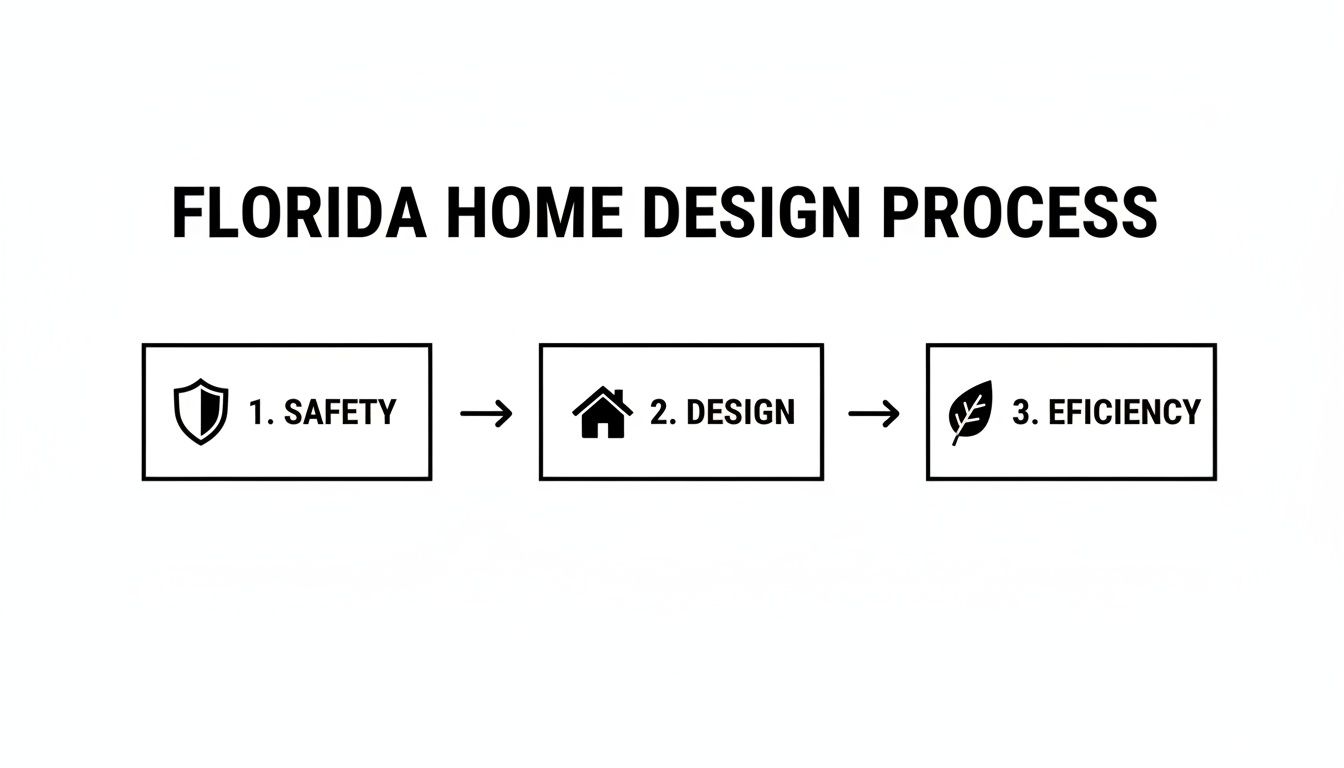
This approach makes it clear that building a strong home isn't an afterthought; it's woven into every single step of the process.
Your New Construction Closing Day Checklist
Closing day is when it all becomes official. With new construction, the process includes a few unique documents.
Here’s a quick checklist to keep you organized:
- Final Walkthrough: Before closing, you’ll walk through the finished home with your builder to create a "punch list" of any minor items needing a final touch-up.
- Certificate of Occupancy (CO): This is the official document from the city or county declaring your home is safe and legal to live in. Your lender will not close without it.
- Final Appraisal: The lender will order a final appraisal to confirm the home was built to the agreed-upon specifications and that its value supports the loan amount.
- Review the Closing Disclosure (CD): You'll receive this at least three business days before closing. It details your loan terms and final costs. Compare it carefully with your initial Loan Estimate.
- Gather Warranty Documents: Your builder will provide a packet with all warranties for the home itself and for individual components like appliances and your HVAC system.
This final stage can feel overwhelming, but with the right team, it’s just the last exciting step. Today's market really shines a light on the value of working with a dedicated custom builder. First-time homebuyers in Florida are finding it tough, making up just 21% of national purchases as equity-rich buyers dominate the market. In Southwest Florida, this climate gives an edge to builders like Sinclair Custom Homes, where constant on-site oversight results in over-engineered homes built on quality and integrity. You can learn more about Florida's housing market trends on floridarealtors.org. With a bit of prep, your closing day will be nothing but a celebration.
Common Questions from First-Time Florida Home Buyers
Jumping into the world of new construction, especially as a first time home buyer in Florida, is exciting, but it definitely brings up a lot of questions. Getting straight answers is the best way to feel confident about the process. We get it, and we've heard them all. Here are a few of the most common things people want to know when they're thinking about building a custom home in Southwest Florida.
Most of the time, the big questions are about how long it takes, what it really costs, and what happens after you move in. Let's clear those up.
How Long Does It Take to Build a Custom Home in Southwest Florida?
This is easily the first question everyone asks. While no two custom homes are exactly alike, we can give you a solid idea of what to expect for planning purposes.
From the day you sign the contract to the day we hand over the keys, you're generally looking at a 12 to 18 month timeframe. This isn't just construction; it's the whole shebang. The process breaks down into a few key stages:
- Architectural Planning and Design: This is the fun part where we nail down your floor plans, the look of the exterior, and all the personal touches that make it your home.
- Permitting: We take the detailed plans to the local powers-that-be, like the City of Cape Coral or Lee County, and get the official green light to start digging.
- Physical Construction: This is what most people picture when they think of building. We're pouring the foundation, framing the walls, and bringing everything to life, right down to the final finishes.
- Final Inspections and Walkthrough: Before you move in, the home has to pass all city and county inspections. Then, we do a final walkthrough with you to make sure every single detail is perfect.
Working with a builder who has solid, long-standing relationships with local permitting offices and suppliers can make a real difference here, helping keep things moving smoothly.
Are There Hidden Costs When Building a New Home?
No one likes surprises when it comes to money. A good builder is transparent and will give you a detailed contract that spells everything out. But it's smart to know what's typically not included in the main build contract so you can plan for it.
We always tell our clients to set aside a budget for the things that make the property complete after we're done. Think about items like:
- Upgraded landscaping or an irrigation system.
- A fence for the dog or for privacy.
- Blinds, shades, or shutters for the windows.
- Any initial Homeowners' Association (HOA) fees.
Our advice? Always have a contingency fund. Setting aside an extra 5% to 10% of the total build cost gives you a safety net for any unexpected site issues or lets you splurge on that one upgrade you decide you can't live without mid-build.
What Kind of Warranties Come with a New Construction Home?
One of the best parts of building new is the peace of mind that comes with a solid warranty. It's your protection. In Florida, new homes typically come with what’s known as a "1-2-10" warranty, which covers different parts of your home for different lengths of time.
It’s designed to give you confidence from day one. Here’s how it usually works:
- One-Year Workmanship Warranty: This covers the fit and finish—things like paint, drywall, flooring, and fixtures.
- Two-Year Systems Warranty: This protects the workhorses of your home: the plumbing, electrical, and HVAC (heating and cooling) systems.
- Ten-Year Structural Warranty: This is the big one. It covers the home's skeleton, like the foundation and frame, against any major structural defects.
Before you sign anything, make sure you review the warranty documents from your builder. A builder who stands behind their work will have a robust warranty to prove it.
Your dream home in Southwest Florida is closer than you think. At Sinclair Custom Homes Inc, we're hands-on builders with a serious commitment to quality, ensuring your first home is built to last. Start your custom home journey with us today.