
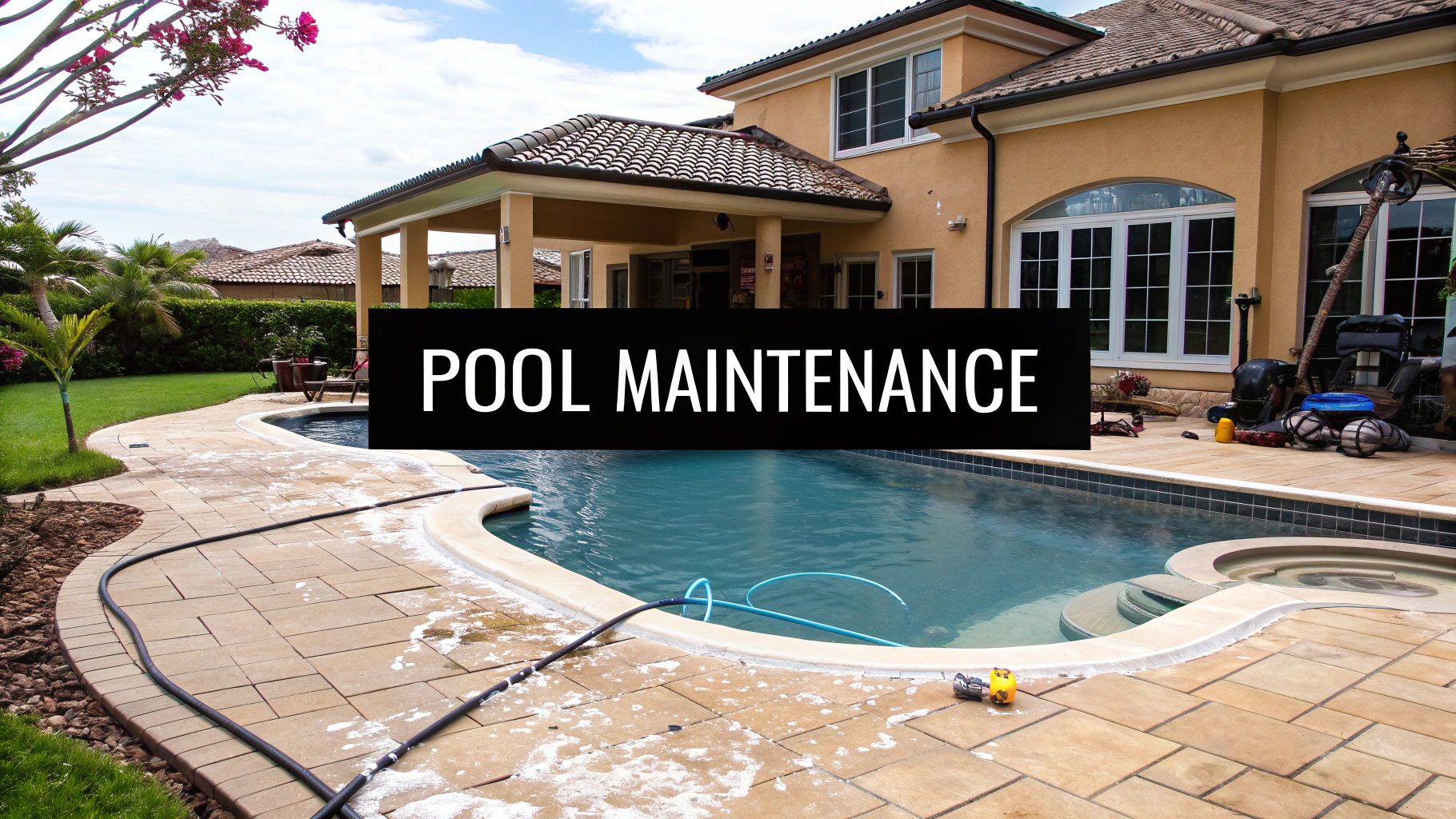
When you own a saltwater pool in Florida, you quickly realize maintenance isn't about the daily grind of adding chemicals. It's a much smarter rhythm of consistent monitoring and taking care of the system itself.
For us here in Southwest Florida, that means a simple weekly check on water balance, cleaning the salt cell every few months, and just keeping an eye on the pump and filter. This simple routine is all it takes to keep your pool sparkling year-round, even when our intense sun and relentless summer rains try to throw things off balance.
Why Saltwater Pools Are a Smart Upgrade for Florida Custom Homes
In the custom home industry around Southwest Florida, a saltwater pool has gone from a luxury add-on to a signature feature of modern design and intelligent building. When homeowners choose to build with a saltwater system, it’s a clear move towards a lifestyle that values ease, comfort, and cutting-edge technology. It’s a world away from traditional chlorine pools that require constant handling and storage of harsh chemicals. A salt system is simply a gentler, more automated way to keep your pool pristine—a trend we see in nearly all new custom builds.
This whole trend is really driven by the desire for a better ownership experience. Anyone who’s taken a dip in a saltwater pool can tell you the water just feels different—it's softer, almost silky. You can say goodbye to the red eyes, itchy skin, and that overpowering chlorine smell. It’s a subtle but significant upgrade that aligns perfectly with the high standards and design features expected in a custom-built Florida home.
The Benefits of Building Salt
When you're planning a new custom home from the ground up, integrating a saltwater system from day one is a seriously strategic move. It allows the builder to design the entire pool area with the right materials from the start, like high-density sealed pavers and marine-grade stainless steel fixtures that won't corrode over time. A little foresight here goes a long way in protecting your investment and keeping your outdoor living space looking brand new for years.
Here are the core benefits that have made salt systems such a staple for custom home builders:
- Consistent Water Quality: Salt chlorinators produce a slow, steady stream of chlorine. You avoid the wild chemical swings—the peaks and valleys—that are so common when you're manually adding chlorine.
- Reduced Daily Workload: The system does the heavy lifting for you. That means you're freed from the daily chore of measuring and pouring in chlorine, a key design feature for modern convenience.
- Enhanced Comfort: The soft water is noticeably gentler on your skin, hair, and even your swimsuits. It just creates a more pleasant, resort-like swimming environment for your family and friends.
This isn’t just a local trend, either. It’s part of a bigger shift toward healthier, more convenient home features. In fact, the global market for pool salt chlorinators was valued at a massive USD 1,450 million in 2024 and is expected to hit USD 1,982.33 million by 2030. That growth is coming from families in the suburbs who are looking for safer options that can slash the time spent manually handling chemicals by up to 80%.
A common misconception is that saltwater pools are "chlorine-free." They're not. They actually use a salt chlorinator—a generator—to turn dissolved salt into chlorine right in the plumbing. It’s basically your own mini chlorine factory that makes sanitizer on demand. That's why we call it a smarter system, not a chlorine-free one.
At the end of the day, opting for a saltwater system in your new Florida home is an investment in a lifestyle of relaxation, not constant pool chores. If you want to dive deeper into the specifics, check out our guide on the differences between salt pools vs. traditional chlorine pools.
Building Your Year-Round Pool Maintenance Rhythm
Forget those rigid, complicated checklists. When it comes to taking care of a saltwater pool here in Florida, it’s all about getting into a simple, repeatable rhythm that works for our unique climate. The idea isn't to pile on more chores. It's about weaving a few quick, mindful checks into your week to stop small issues before they blow up—especially during a summer heatwave or hurricane season.
This way, your pool, often the centerpiece of your home's architectural design, stays a perfect oasis all year long. We’re aiming for smart, consistent care, not constant, back-breaking effort. By building a routine, you’re protecting the high-end equipment and beautiful finishes that make your lanai a true extension of your custom home.
Daily Glances: A Five-Minute Check-In
Your daily "to-do" shouldn't feel like work. Think of it as a quick walkthrough while you’re having your morning coffee on the lanai or before heading out. This isn't about breaking out the test kit; it's just about using your eyes and ears.
A simple glance is all it takes. Are the skimmer baskets full of palm fronds or hibiscus flowers, especially after a windy afternoon? Take a moment to listen to your pool pump—does it sound smooth and quiet? A quick visual sweep confirms that water is flowing properly through the system, which is non-negotiable for your salt chlorinator to do its job. This little five-minute habit is your absolute first line of defense against circulation problems.
The Essential Weekly Water Test
Once a week, it’s time to get a little more personal with your pool water’s health. This is your single most important maintenance task and the secret to keeping your saltwater system humming along perfectly. Testing weekly is how you get ahead of the chemical rollercoaster that Florida’s intense sun and pop-up thunderstorms can create.
Grab a quality test kit or some reliable test strips and check these core levels:
- Free Chlorine: Is your salt generator producing enough sanitizer? This tells you.
- pH and Alkalinity: These two are the foundation of balanced water. They affect everything from how the water feels on your skin to how long your equipment will last.
- Salt Level: You need to make sure it’s in the sweet spot for your specific salt chlorinator, which is usually between 3,000-4,000 ppm.
Making this a weekly ritual means you’re only making small, minor tweaks. It's so much easier to add a little pH increaser one week than it is to battle a full-blown algae bloom and cloudy water the next. This simple step is what keeps your water feeling silky-soft and protects your big investment.
If you're still wondering what makes a saltwater system so great, this graphic really breaks down the benefits, from comfort to long-term durability.
As you can see, the gentle feel of the water is a huge plus, but the automated system also delivers consistently clean water while being easier on your pool's components over the long haul.
Monthly and Seasonal System Wellness
About once a month, you'll want to give your pool's hardware a closer look. Check your salt chlorinator cell for any white, flaky stuff—that's calcium scaling, and it’s a common issue around here. Catching it early keeps the cell making chlorine efficiently and prevents permanent damage. While you're at it, glance at your filter's pressure gauge. If it's reading significantly higher than its normal "clean" pressure, that's your cue to backwash the filter or clean the cartridge.
Seasonally, your routine needs to adapt to Florida’s very distinct weather patterns.
- Hurricane Season (June-November): Your focus here is all about preparation. Make sure your equipment is secure and think about trimming back any nearby trees or bushes that could dump a mess into your pool during a storm. A whole-home generator ensures your pool pump continues to run even during a power outage, preventing stagnant water and algae growth.
- Dry Season (Winter/Spring): With less rain, you’ll notice evaporation picking up. You'll have to top off the pool with fresh water more often, which will dilute your salt levels a bit. Just keep a close eye on your weekly tests to stay on top of it.
To help you visualize this, here’s a quick-reference guide to staying on track, tailored specifically for our demanding Southwest Florida climate.
Your Southwest Florida Saltwater Pool Maintenance Rhythm
| Frequency | Task | Why It Matters in Florida's Climate |
|---|---|---|
| Daily (5 Mins) | Check skimmers, listen to pump, visually inspect water flow. | High winds and foliage mean baskets fill up fast, blocking circulation. |
| Weekly (15 Mins) | Test chlorine, pH, alkalinity, and salt levels. Brush walls. | Intense sun burns off chlorine, and heavy rain throws pH/alkalinity way off. |
| Monthly (30 Mins) | Inspect salt cell for calcium buildup, check filter pressure. | Our hard water leads to scaling, reducing chlorine output if not cleaned. |
| Seasonally | Prep for hurricane season, monitor evaporation in dry season. | Proactive steps prevent storm damage and manage water levels during droughts. |
Think of this table as your cheat sheet. Following this simple rhythm keeps your pool swim-ready and saves you from costly headaches down the road.
To really stay ahead of the game, it's smart to sync up your pool care with a broader home maintenance checklist that covers all the other seasonal demands of a Florida property. This way, everything from your roof to your pool deck is ready for whatever our climate decides to throw at us. It’s the best way to create a seamless, efficient plan for protecting your entire custom home.
Balancing Pool Chemistry in the Florida Climate
Keeping your saltwater pool balanced isn't about daily chores; it's about understanding the unique pressures of our Florida environment. The intense sunshine and sudden, torrential downpours are constantly trying to throw your water out of whack. Learning to manage a few key chemical levels is the real secret to protecting the beautiful finishes and high-end equipment that make up your custom outdoor living space.
This is about more than just clear water—it's about safeguarding your investment. Improperly balanced water turns corrosive, and it can start eating away at expensive pavers, tile, and even the internal parts of your pump and salt cell. Once you understand not just the target numbers but why they matter, you can make small, confident adjustments that keep your pool pristine for years.
Mastering the Six Pillars of Water Balance
Think of your pool as a tiny ecosystem where six key elements have to coexist perfectly. When one falls out of line, it creates a domino effect. Here’s a breakdown of what to monitor and why each one is so critical here in Southwest Florida.
1. Salt Level: The Fuel for Your System
The salt in your pool is just raw material for your salt chlorinator. It doesn't get "used up" like traditional chlorine, but it definitely gets diluted. When a classic Florida storm dumps inches of rain into your pool, your salt concentration drops.
Your system needs a specific salt level to work right, usually between 3,000 and 4,000 parts per million (ppm). Too low, and the chlorinator shuts down, often flashing an error light. Too high, and you risk corroding metal parts like ladders, handrails, and light fixtures.
2. Free Chlorine: The Active Sanitizer
This is the good stuff—the chlorine that’s actually available to kill bacteria and algae. Your salt system's whole job is to keep this level steady, ideally between 1 and 3 ppm.
The relentless Florida sun is chlorine's worst enemy; UV rays destroy it. That's why your system runs harder on bright, sunny days. Keeping a consistent free chlorine level is your number one defense against the algae blooms that can pop up overnight in our warm, humid climate.
3. pH: Potential of Hydrogen
pH simply measures how acidic or basic your water is. For a saltwater pool, you want it slightly alkaline, right in the 7.2 to 7.8 range.
Here’s the thing about salt systems: the process of making chlorine naturally makes the pH rise. If your pH creeps too high, your chlorine becomes lazy and ineffective. This is a classic recipe for cloudy water and scale formation on your pool surfaces and inside the salt cell.
4. Cyanuric Acid (CYA): The Chlorine Stabilizer
Think of Cyanuric Acid (CYA) as sunscreen for your chlorine. It protects the free chlorine from being vaporized by the sun's UV rays. Without enough CYA, the sun can burn off chlorine almost as fast as your system can make it.
You're shooting for a range of 30 to 50 ppm. Too little, and you're just wasting chlorine and electricity. But too much CYA can actually handcuff the chlorine, making it less effective at sanitizing.
5. Total Alkalinity (TA): The pH Buffer
Total Alkalinity is what keeps your pH from swinging wildly. It acts like an anchor. Keeping your TA between 80 and 120 ppm is key. If it's too low, your pH will bounce all over the place with every chemical addition or rainstorm. Too high, and you’ll find it nearly impossible to lower your pH when you need to.
Pro Tip: Always adjust your Total Alkalinity before touching your pH. Get the TA in range first, and dialing in your pH becomes infinitely easier.
6. Calcium Hardness (CH): Protecting Your Finishes
The last piece of the puzzle is Calcium Hardness, which is a big deal here because of Florida's water sources. We're aiming for a CH level between 200 and 400 ppm.
If your calcium level is too low, the water gets aggressive and starts pulling calcium from your plaster, grout, and concrete surfaces, causing permanent etching and damage. If it’s too high, you get scale—that chalky white residue—on your waterline tile, inside your salt cell, and all through your equipment.
The popularity of these systems is backed by some serious numbers. The global market for salt water chlorinators was worth $1.2 billion in 2023 and is expected to hit $2.1 billion by the early 2030s. In Florida's climate, the benefits are obvious, with systems cutting down skin irritation by 90% and eye issues by 75%. It all comes down to the salt cell, which can last 10,000-15,000 hours, generating chlorine as needed to keep the water perfect with minimal fuss. You can read the full research about these market trends and their drivers.
Maintaining Your System's Core Components
Think of your saltwater pool as a sophisticated little ecosystem. At its heart, you've got a trio of hardworking components: the salt chlorinator cell, the pump, and the filter. When we design custom homes here in Southwest Florida, these systems are our go-to for their sheer reliability and efficiency. But even the best equipment needs a little TLC to perform at its peak, protecting your investment and keeping your pool looking pristine.
Proper care isn't just about keeping the water clear—it's about the longevity of the whole system. A well-maintained pump and filter create strong circulation, which is absolutely critical for your salt cell to do its job and generate chlorine. Let these parts go, and you're inviting a cascade of problems, from stubborn algae blooms to premature equipment failure. And nobody building a custom home in Southwest Florida wants to deal with that.
Caring for Your Salt Chlorinator Cell
The salt cell is where the real magic happens, turning dissolved salt into pure, silky-smooth chlorine. But here in Florida, its biggest enemy is our hard water. That leads to calcium buildup, which forms a white, flaky scale on the cell's delicate metal plates. This scaling acts like armor, blocking the cell from working efficiently and forcing your whole system to work overtime.
About every three months, give your salt cell a quick visual inspection. If you see that chalky buildup, it’s time for a gentle acid wash. This is a simple but vital part of your salt water pool maintenance, and it's something you can easily do yourself.
Just make sure all power to your pool equipment is off, then unscrew the unions to remove the cell. Using a specialized cleaning stand, fill the cell with a mild solution of muriatic acid and water. Let it soak for five to ten minutes—you'll see it fizzing as it works. Once the fizzing stops, the scale is gone.
A crucial takeaway for any custom homeowner is to treat your pool equipment with the same care as any other high-end feature in your home. A salt cell, for instance, typically lasts 3 to 7 years, but its lifespan is directly tied to this simple cleaning routine. Skipping it can cut that lifespan in half, leading to a costly and avoidable replacement.
After the soak, give the cell a thorough rinse with a garden hose, reinstall it, and you're good to go.
Keeping the Pump and Filter in Prime Condition
Your pump and filter are the unsung heroes of your pool. They're the workhorses responsible for the circulation that keeps everything clean and balanced. The pump is the engine, pulling water through the skimmers, while the filter traps all the gunk before sending clean, sanitized water back to the pool. For your salt chlorinator to work properly, it needs a steady, powerful flow of water moving through it.
Keeping that flow strong is pretty straightforward:
- Clean Your Baskets: Empty the skimmer baskets and the pump basket regularly. Here in Southwest Florida, between our lush landscaping and windy afternoons, these can fill up fast with leaves and debris, choking off water flow in a hurry.
- Monitor Filter Pressure: Keep an eye on your filter's pressure gauge. Once it reads 8-10 PSI higher than its clean starting pressure, it's time for a cleaning. That means backwashing a sand or D.E. filter or cleaning out a cartridge filter. This simple step restores proper flow and takes a huge strain off your pump motor.
A struggling pump doesn't just mess with sanitation; it also drives up your energy bills—an important thing to watch when managing a custom home. It's worth learning what causes pump cavitation and how to prevent it to ensure your system has a long, healthy life.
If you're thinking about optimizing your entire pool system for efficiency, you might be interested in our guide on A Florida Homeowner's Guide to Pool Heat Pump Cost, which dives deeper into smart, cost-effective pool operation.
Solving Common Florida Saltwater Pool Problems
Even when you follow a perfect maintenance schedule, the Southwest Florida climate loves to throw curveballs at your saltwater pool. The good news? Most common issues are surprisingly easy to diagnose and fix on your own, no expensive service call needed.
Learning to read what your pool is telling you is the key to confident, stress-free ownership. Instead of guessing why the water is cloudy or a light is blinking, you can take direct, targeted action to get things back to pristine condition. This is what turns pool ownership from a chore into a source of pride.
Cloudy Water After a Storm
It’s a classic Florida scene: a massive downpour rolls through, and your once-sparkling pool now looks murky and uninviting. This happens because heavy rain is essentially distilled water. It's acidic and contains zero salt, which means it drastically dilutes your pool's carefully balanced chemistry.
When salt levels and pH plummet, your chlorinator often stops producing chlorine altogether. This gives microscopic debris and the beginnings of an algae bloom a perfect opportunity to take hold.
Your first move is to grab your test kit. Check the salt, pH, and alkalinity levels. You'll almost certainly need to add salt to get back into that ideal 3,000-4,000 ppm range. Once the salt is right, adjust your pH and alkalinity to restore stability. With the chemistry corrected, run your filter system continuously and hit your system’s "boost" or "super chlorinate" function for 24 hours. Having a whole-home generator is a huge advantage here, as it ensures your pump can keep running to clear the water, even if a storm knocks out the power.
Battling an Early Algae Bloom
You step out onto the lanai and spot it—that first hint of green on the steps or in a quiet corner. Don't panic. This is incredibly common in our warm, humid climate, especially if your chlorine levels dipped for a day or two. Your salt system gives you a powerful tool to fight back immediately.
Forget about lugging and pouring a heavy bucket of granular shock. Instead, just use your system's built-in "boost" feature. This handy function cranks up the chlorine production to its maximum setting for a full day, creating a surge of sanitizer that will knock out the bloom.
For the best results, do these things first:
- Brush Vigorously: Grab a good pool brush and scrub the algae off all the surfaces. This pushes the spores into the water where the fresh chlorine can eliminate them.
- Check Your Filter: Make sure the filter is clean and the pump is running properly. Good circulation is essential for distributing that extra chlorine.
- Engage Boost Mode: Now you can activate the "super chlorinate" or "boost" function. Just let it run for a full 24-hour cycle.
This automated shocking method is one of the biggest advantages of a modern saltwater system. It’s not just easier; it’s a more controlled approach that saves you from handling harsh chemicals. If you're curious about these benefits, you might want to check out our guide on switching from a traditional chlorine pool to saltwater.
Diagnosing Chlorinator Error Codes
Think of your salt chlorinator's display as a direct line of communication. Two of the most frequent error messages Florida homeowners see are "Low Salt" and "No Flow."
A "Low Salt" warning is usually exactly what it sounds like—a recent storm has diluted your pool, and it's time to add a few bags of salt. But what if you've tested the water and the salt level is perfectly fine? The issue is almost always a dirty salt cell. Calcium scale can build up on the internal plates, blocking the sensors from getting an accurate reading. A quick acid wash of the cell typically solves the problem instantly.
The "No Flow" error means water isn't moving through the system fast enough for the cell to run safely. Before you assume the worst about your pump, check the simple stuff first. Is the pump basket or skimmer basket clogged with palm fronds and leaves? Is the filter cartridge dirty and overdue for a cleaning? These simple blockages are the culprit 90% of the time.
Embracing these simple troubleshooting steps is a big part of why saltwater pools are so cost-effective. Owners often report 30-50% lower annual costs compared to traditional pools. This efficiency is a key reason the global pool equipment and maintenance market, valued at USD 21.72 billion in 2024, is projected to grow significantly, with saltwater systems reducing service calls by as much as 50-70%. Discover more insights about the pool maintenance market on Market Data Forecast.
Answering Your Saltwater Pool Questions
When you're building a custom home in Southwest Florida, the pool isn't just an afterthought—it’s the heart of your outdoor lifestyle. As builders, we get a lot of questions about how these fantastic saltwater systems really hold up in our local climate. This section answers the most common things we hear from homeowners in Cape Coral and Fort Myers.
Think of it as having an expert on call. We'll get straight to the practical concerns of owning a high-end pool, giving you the confidence to manage it and enjoy it for years to come.
How Does Florida's Rainy Season Impact My Saltwater Pool?
Heavy rain is just a part of life here, especially during hurricane season. A big downpour can seriously dilute your pool's salt levels and throw your pH and alkalinity way off. This isn't just a minor issue—if the chemistry is off, your salt chlorinator might stop producing chlorine entirely, leaving your beautiful pool unprotected.
After a big storm, testing your water is absolutely essential. You’ll almost certainly need to add more salt to get the concentration back into that sweet spot of 3,000-4,000 ppm. At the same time, you'll probably need to rebalance the water with a pH and alkalinity increaser, like sodium bicarbonate. Don't forget to empty those skimmer baskets, either; they'll be full of debris, and you need good water flow for your system to work right.
Do I Still Need to Shock a Saltwater Pool?
Yes, you do, but it’s a whole lot easier. Forget about lugging around and pouring in harsh liquid or granular chlorine. Most modern salt systems we install in our custom homes have a "super chlorinate" or "boost" function built right in. Just push a button, and the system cranks the salt cell to maximum output for about 24 hours.
This feature effectively "shocks" the pool by generating a powerful, controlled burst of chlorine. We tell our clients to use it after a big pool party, after a major storm, or if they see even the slightest hint of algae. It gives you the same sanitizing power without the hassle of buying, storing, and handling corrosive chemicals on your property.
A key advantage in modern pool design is automation. The 'boost' function is a perfect example of a builder trend that prioritizes owner convenience. It leverages the system's own technology to perform a critical maintenance task, reducing manual labor and the need for storing hazardous materials on your property.
Will Salt Damage My Premium Pavers and Pool Deck?
This is a great question, and it's a critical one when you're investing in high-end exterior finishes. While the salt level in the water is actually quite low (less than a human teardrop), years of splash-out can take a toll on porous materials like unsealed natural stone. You might see some pitting or a white, powdery residue called efflorescence.
To get ahead of this, we recommend specific materials during the design phase. We always push for high-density, sealed pavers or travertine for the pool deck and coping, as they hold up beautifully. For any metal components like ladders, handrails, or water features, they must be marine-grade (316L) stainless steel or another corrosion-resistant material.
A simple habit can make all the difference: give your deck, metal fixtures, and even nearby hurricane impact windows a quick rinse with a garden hose every now and then. It’s an easy way to protect your investment and keep your entire outdoor living space looking brand new.
Ready to build a custom home where every detail, including a state-of-the-art saltwater pool, is designed for luxury and longevity? At Sinclair Custom Homes Inc, we combine European craftsmanship with an over-engineered approach to build homes that stand the test of time in Southwest Florida. Start planning your dream home with us today.