


If you're trying to nail down the cost to build a home in Florida, you'll quickly find that broad, statewide averages can be pretty misleading. You might see numbers floating around $300,000, but that figure doesn't tell the whole story, especially when you start looking at a custom home in a beautiful coastal area like Cape Coral or Fort Myers.
Down here in Southwest Florida, the game changes. Factors like hurricane-rated construction, the specific elevation of your lot, and the custom finishes you choose are what really shape your final budget—not some generic state average. In the custom home industry, builder trends are shifting towards creating resilient, high-performance homes designed to withstand Florida's unique challenges, from hurricanes to high humidity.
Your Quick Guide to Florida Home Building Costs
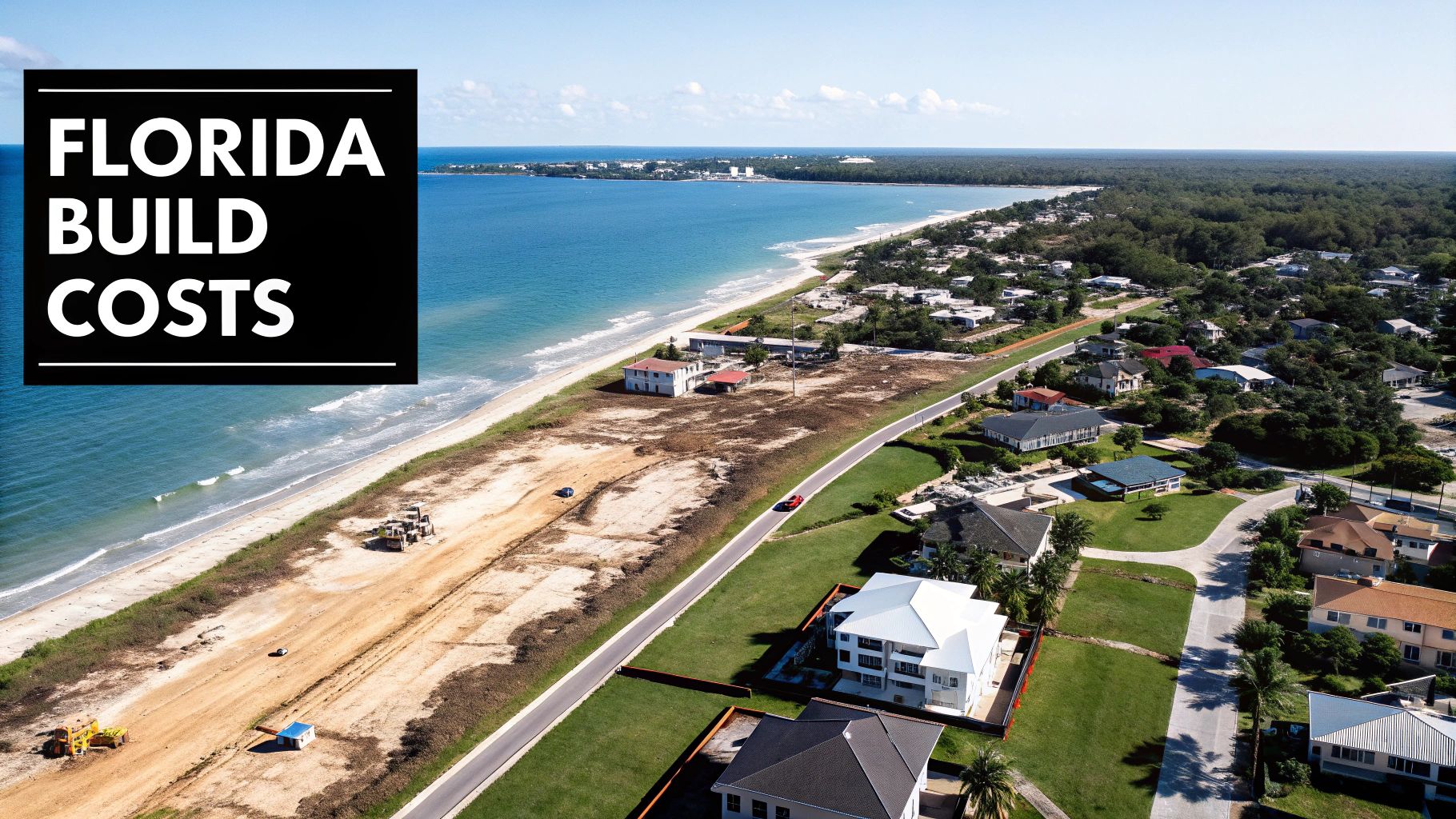

Pinpointing a single price for a new Florida home is a bit like trying to name the price of a car without knowing the make, model, or any of the features. A simple number just can't account for the huge difference between building on an inland property versus a premium waterfront lot in Cape Coral.
Your location is, without a doubt, the single biggest driver of your total cost.
This is especially true for us in Southwest Florida. Our building codes are stricter, and the coastal environment simply demands a more robust, resilient home. The conversation quickly shifts from generic square-foot pricing to the specific, real-world costs of building for the Florida lifestyle, incorporating the latest design trends and storm-ready features.
Why Coastal Building Costs More
Building on the coast is about so much more than securing a great view. The initial investment is naturally higher because of several non-negotiable factors that keep your home safe, insurable, and built to stand the test of time. Recent news and building code updates in Florida continue to reinforce the need for stronger, more resilient construction methods.
Here are the key cost drivers you'll see in coastal areas:
- Hurricane-Resilient Features: Things like impact-rated windows and doors, reinforced roofing systems, and stronger structural connections aren't luxury upgrades here—they are foundational requirements.
- Elevation and Site Work: Many coastal lots sit in FEMA flood zones, which means homes often need to be built on elevated foundations. This requires extensive site preparation, including bringing in truckloads of fill dirt to meet specific elevation mandates, which adds a significant expense.
- Material and Labor Premiums: In coastal markets, there’s high demand for skilled labor and high-performance materials. That demand naturally drives up costs.
Building in a high-velocity wind zone isn't just about meeting code; it's about investing in peace of mind. Features like a whole-home generator move from being a convenience to a critical asset during storms, ensuring your family's comfort and safety when the grid goes down.
Understanding Per-Square-Foot Averages
While per-square-foot costs can be a useful starting point, they need the right context to be meaningful. For instance, in 2025, the average cost for a house in Florida might hover around $300,000, but that number can easily climb to $450,000–$1,200,000+ for a 3,000 sq ft home. The final price tag depends heavily on whether you're inland or on the coast, where hurricane-proofing measures significantly increase costs.
To give you a clearer picture, here’s a quick breakdown of what you can expect across different parts of the state.
Estimated Cost Per Square Foot by Florida Region
| Region | Average Cost Per Sq. Ft. (Standard Build) | Average Cost Per Sq. Ft. (Custom/Luxury Build) |
|---|---|---|
| North Central Florida | $150–$225 | $225–$300+ |
| Central Florida (Orlando Area) | $175–$250 | $250–$350+ |
| Southwest Florida (Cape Coral, Fort Myers) | $200–$350 | $350–$500+ |
| Southeast Florida (Miami, Fort Lauderdale) | $225–$400 | $400–$600+ |
As you can see, building in coastal hotspots like Cape Coral or Fort Myers Beach pushes costs higher, often starting at $200–$350 per sq ft even for a standard build. This is a direct result of stricter wind-load codes, flood elevation requirements, and the premium materials needed to do it right.
Of course, beyond the direct construction expenses, it's crucial to have your financing in order. Taking the time to explore available financing solutions early on can help you manage your budget and secure your investment with confidence.
In this guide, we'll break down all of these variables to give you a clear, honest picture of what truly goes into your budget.
Breaking Down Your Custom Home Building Budget
Going beyond a simple price-per-square-foot number is the first step to truly understanding what it takes to build a custom home. It’s not about one big price tag; it's about a collection of distinct costs, each playing a critical role in bringing your vision from a blueprint to your front door. From the raw land to the final coat of paint, every dollar has a job to do.
When we break down the cost to build a home in Florida, it takes the mystery out of the process and puts you in the driver's seat. Let’s walk through this financial journey, separating the major cost centers so you can see exactly where your investment is going at every single stage.
From the Ground Up: Land and Site Preparation
Before a single wall ever goes up, your first major investment is the land itself. Here in Southwest Florida, securing a lot is a huge piece of the budget puzzle. Prices can swing wildly depending on whether you're looking at an inland lot or a premium waterfront property in a place like Cape Coral. This is your project's foundation—both literally and financially.
But buying the lot is just the first step. The next phase, site preparation, is an often-underestimated expense that gets your property ready for construction. This work can include:
- Land Clearing: Getting rid of trees, brush, and any old structures to give us a clean slate.
- Fill and Grading: In many parts of Florida, especially low-lying coastal areas, we need to bring in truckloads of fill dirt to raise the lot's elevation. This is non-negotiable for flood mitigation and meeting local and FEMA building codes.
- Utility Connections: Running the essential lines for water, sewer, and electricity from the street to your build site.
The cost of site preparation can really fluctuate. A flat, clear lot will be far less expensive to prep than a densely wooded one or a property that needs a ton of elevation work to satisfy FEMA flood requirements.
Hard Costs: The Physical Structure of Your Home
With the site prepped, we move into the "hard costs"—all the tangible materials and labor needed to actually build your home. This is usually the biggest chunk of the budget, covering everything that makes your house a standing structure. Think of it as the skeleton and skin of your new home.
Key hard cost categories include:
- Foundation: In Florida, this is almost always a monolithic concrete slab, engineered specifically for our sandy soil. Costs typically run from $5 to $14 per square foot.
- Framing: This is the lumber and labor that create the home's "bones"—the walls, floors, and roof structure.
- Exterior Finishes: This covers your roofing (from standard asphalt shingles to durable metal or tile), stucco, and the all-important hurricane-impact windows and doors. In Southwest Florida, these aren't optional.
- Interior Finishes: This is where new design features and personal style come to life. We're talking flooring, custom cabinetry, countertops, paint, and all the trim work.
- Mechanical, Electrical, and Plumbing (MEP): These are the critical systems that make your home livable—the HVAC unit, all the wiring, and the complete plumbing infrastructure.
When you're mapping out the budget, big additions like a pool need careful planning. A resource on swimming pool construction can offer some great insights into that process. And while we specialize in custom site-built homes, it's also worth comparing these costs to the cost of modular homes in Florida to understand all your options.
Soft Costs: The Invisible Essentials
Finally, we have "soft costs." These are the necessary expenses that aren't physically part of the house but are absolutely vital to getting the project done right. Think of them as the professional services and administrative fees that keep your project compliant, legal, and moving forward smoothly.
These often-overlooked costs include:
- Architectural and Engineering Fees: The cost to design your custom home plans and ensure they're structurally perfect.
- Permits and Impact Fees: Every city and county charges these to cover their costs. In Florida, permits alone can run between $1,000 and $4,000.
- Insurance: Builder's Risk insurance is a must-have to protect your investment while the home is under construction.
- Contingency Fund: Any smart, experienced builder will include a contingency fund—usually 10-15% of the total cost—to handle any surprises. This ensures your project stays on track without last-minute financial stress.
The Hidden Factors Driving Up Your Final Build Cost

Ever wonder how two custom homes in Southwest Florida, both sitting at 2,500 square feet, can end up with price tags that are hundreds of thousands of dollars apart? It's not a mistake or some fuzzy math. It's a perfect example of how the real drivers of cost go way beyond just the size of the house.
To create a budget that doesn't fall apart halfway through, you have to get a handle on these variables. The specific lot you choose, your design preferences, and the level of storm resilience you build in are what truly shape the final number.
Waterfront Living and Elevation Mandates
That dream of a waterfront lot in Cape Coral or Fort Myers is beautiful, but it comes with its own price tag. These properties introduce layers of complexity that a standard inland lot just doesn't have. For starters, the site work is often far more extensive, demanding specialized engineering to make sure the foundation can handle the unique coastal environment.
This complexity gets magnified by FEMA flood zone requirements. To protect your investment (and get affordable insurance), your home's finished floor has to be built above the Base Flood Elevation (BFE). Hitting that target often means a serious upfront investment before we even pour the concrete.
- Engineered Fill Dirt: We might need to truck in and compact thousands of cubic yards of fill dirt just to raise the home pad. That alone can add tens of thousands to your site prep budget.
- Stem Wall Foundations: Instead of a basic monolithic slab, your home will likely need a more robust (and expensive) stem wall foundation, which elevates the entire structure on concrete block walls.
Hurricane Resilience Is Not an Upgrade
Here in Southwest Florida, building for hurricane resistance isn't some luxury add-on—it's a fundamental part of the budget. These features are non-negotiable investments in your family's safety, the long-term integrity of your home, and your ability to secure decent insurance rates. In fact, a major new trend in the custom builder industry is engineering homes that don't just meet code, but blow past it for storm safety.
Investing in these resilient features delivers long-term value that far outweighs the initial cost. For a deeper look at how these decisions impact your recurring costs, our guide on how much hurricane insurance is in Florida breaks it all down.
A resilient home is a fortress built for peace of mind. Features like impact-rated windows, reinforced roofing, and a whole-home generator aren't just line items on a budget; they are critical systems that protect your family and your investment when a storm hits.
A whole-home generator is a perfect example. It's quickly becoming a standard feature in new custom builds. When the power is out for days after a hurricane, a generator keeps the AC running, saves all the food in your fridge, and makes sure your home stays a safe, livable shelter. It’s moved from a "nice-to-have" to an absolute essential, especially in the face of stronger storms.
The Impact of Customization and Finishes
Finally, the biggest variable of all: your personal taste. A standard-spec home uses materials chosen for one reason—to keep costs down. A true custom home, on the other hand, is a direct reflection of you, and that level of personalization has a different price point. This is where you incorporate the latest new design features that make a house a home.
This is where that per-square-foot number can really climb. The gap between standard builder-grade tile and imported Italian marble, or between basic laminate counters and a high-end quartzite slab, can easily add tens of thousands to the bottom line.
In coastal Florida, especially in places like Cape Coral and Fort Myers, new builds in 2025-2026 are often in the $185–$295 per square foot range. This is partly because of the tough High Velocity Hurricane Zone (HVHV) codes down in Miami-Dade influencing standards everywhere, but even in Lee County, costs are pushed up by the need for elevated concrete, stronger roofing, and beefier framing.
To give you some perspective, inland areas like Orange County might see costs closer to $165–$255 per square foot, while Hillsborough County is around $170–$265. The demand in those markets is high, but the building codes for wind and water are often less strict.
Of all the questions we get, "How much will it cost?" is the one with the most moving parts. Building a custom home in Florida today means navigating a market that can feel like a moving target. The price you're quoted for lumber in January might be completely different by the time June rolls around.
This is the new reality. The cost to build a home in Florida isn't a static number. It’s constantly influenced by a complex web of global supply chains, local labor demands, and the broader economy. We see it every day—essentials like concrete, steel, and electrical components can see significant price swings over the course of a single project.
Dealing with this volatility is where an experienced builder really shows their worth. We don't just react to these changes; we anticipate them. It's about having strong, long-standing relationships with suppliers to lock in materials and using meticulous project management to keep your build on track, even when the market throws a curveball.
The Forces Behind Fluctuating Costs
The last few years have been a masterclass in just how interconnected our world is. A supply chain hiccup on the other side of the globe can create a ripple effect here, delaying multiple phases of construction because a single material is held up.
At the same time, Florida's incredible population boom has created intense demand for skilled tradespeople, from framers to electricians. It’s simple economics—when demand outstrips supply, labor rates go up. News about continued growth in Southwest Florida confirms this trend isn't slowing down.
This dynamic has created a new financial reality for home construction. For example, Florida's homebuilding costs have surged dramatically since 2020, with material prices alone jumping by as much as 82.5%. This has pushed the average cost per square foot for a traditional build into the $160–$295 range for 2025-2026. That's a huge leap from the $153 per square foot we saw back in 2019. You can read a detailed report about these rising construction costs to get a sense of the broader economic impact.
These factors combine to create a challenging environment, but it’s one that a seasoned local builder in Southwest Florida knows how to navigate.
Positive Trends and Smart Investments
While market volatility is a challenge, it's also pushed the custom home industry to innovate in some really exciting ways. The focus is shifting from simply building a beautiful house to constructing a high-performance, intelligent home that delivers real long-term value. This is a major trend among forward-thinking builders.
Instead of getting bogged down by rising costs, we're doubling down on advancements in:
- Energy-Efficient Materials: Innovations in insulation, high-performance windows, and next-generation HVAC systems are quickly becoming the new standard. Yes, they might have a higher upfront cost, but they can dramatically lower your utility bills for decades, offering an incredible return on your investment.
- Smart Home Technology: It's far more cost-effective to integrate smart thermostats, lighting, and security systems from the very beginning than to try and retrofit them later. These new design features don't just add convenience; they can also lead to lower insurance premiums.
- Resilient Building Practices: As we've discussed, things like whole-home generators and superior hurricane impact protection aren't just for weathering storms anymore. They provide year-round peace of mind and are now seen as essential components of a modern Florida home, protecting both your family and your property value.
A modern custom home is more than just sticks and bricks; it's a fully integrated system designed for efficiency, comfort, and resilience. By embracing new technologies and materials, a builder can deliver a home that is not only smarter but also more cost-effective to own and maintain over its entire lifespan.
Ultimately, navigating this market requires a partnership with a builder who understands both the pressures of today and the innovations of tomorrow. They can guide you toward smart investments that offset long-term expenses, ensuring your new home is a source of pride and financial stability for years to come.
Visualizing Your Southwest Florida Build Cost
Theory is one thing, but seeing how the numbers play out in the real world is another. Let's walk through two common—but very different—build scenarios to make these costs tangible.
Think of these as blueprints for understanding how your choices, from the lot you pick to the finishes you love, directly shape your final budget. By putting an inland build and a waterfront build side-by-side, you'll get a much clearer picture of what it really costs to build a custom home here in Cape Coral and Fort Myers.
Scenario A: The Inland Custom Home
First, imagine a beautiful 2,200 sq. ft. home on a standard dry lot in Cape Coral. This project is for a family that wants a high-quality, comfortable home without the extra engineering and site work that comes with building on the water.
The budget for this home is focused on high-quality yet sensible finishes. We're talking durable porcelain tile, solid wood cabinets, and granite countertops—materials that look great and are built to last. The layout is open and efficient, reflecting modern design trends. It will, of course, have hurricane-rated windows and meet all current building codes, but it won't need the added expense of an elevated foundation.
- Key Features: Standard slab-on-grade foundation, quality interior finishes, energy-efficient appliances, and code-compliant impact windows.
- Cost Focus: The budget prioritizes interior craftsmanship and quality materials over complex site engineering.
- Total Estimated Cost: A build like this would likely fall in the lower-to-mid range of Southwest Florida's per-square-foot costs.
Scenario B: The Resilient Waterfront Estate
Now, let's shift gears and picture a larger 3,000 sq. ft. home on a prime canal-front lot. Right away, this scenario brings in several major cost drivers that the inland home simply doesn't have. The lot itself is a premium investment, and preparing it for construction requires significant upfront work to meet FEMA flood elevation requirements.
This home is designed from the ground up for both luxury and ultimate resilience. It features a robust stem-wall foundation to achieve the required elevation, top-of-the-line impact-rated glass, a durable metal roof, and a whole-home generator to ensure the lights stay on during a storm. Inside, the finishes are high-end: custom cabinetry, striking quartzite countertops, and luxury vinyl plank flooring throughout—all popular new design features in the custom home industry.
Building on the water is an investment in both lifestyle and resilience. The added costs for elevation, seawall maintenance, and premium hurricane protection are what secure that investment against the unique challenges of the coastal environment.
No matter which scenario you choose, your builder has to navigate the constantly shifting costs of materials and labor. The market is always moving, which is why having an experienced builder is so critical.
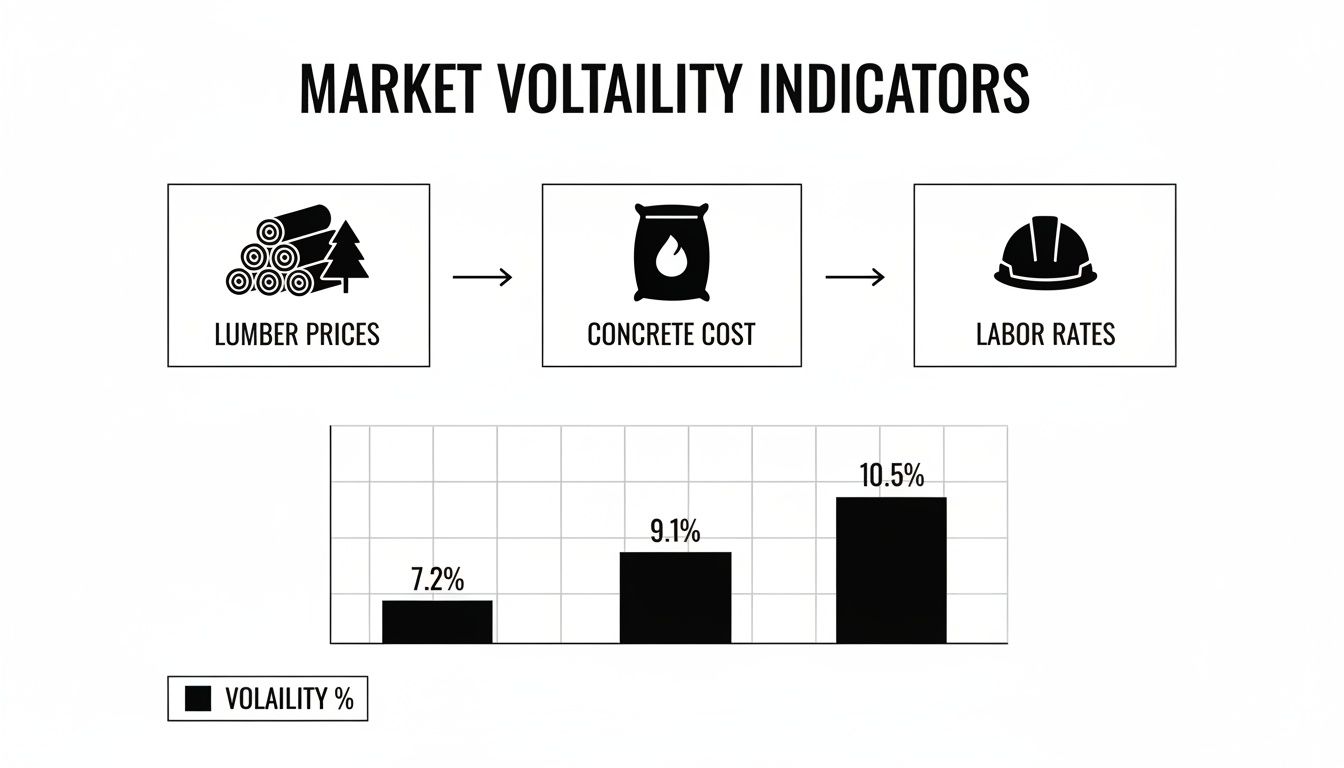

This chart gives you a quick look at how the core components of any build—lumber, concrete, and labor—can fluctuate, making solid project management an absolute must.
Sample Cost Breakdown for a Custom Home in Cape Coral
To really see where the money goes, it helps to put the numbers next to each other. This table compares our two hypothetical scenarios for a 2,500 sq. ft. home, illustrating how different a budget can look based on location and specifications.
| Cost Category | Scenario A: Inland Lot (Standard Finishes) | Scenario B: Waterfront Lot (Premium Finishes) |
|---|---|---|
| Land Acquisition | Standard Inland Lot Cost | Premium Waterfront Lot Cost |
| Site Prep & Foundation | $45,000 – $65,000 | $85,000 – $140,000+ |
| Hard Costs (Structure/Finishes) | $550,000 – $675,000 | $800,000 – $1,100,000+ |
| Resilience Features (Generator) | Optional Add-on | Included ($15,000 – $25,000) |
| Soft Costs (Permits/Fees) | Standard Fees | Higher Impact/Permit Fees |
| Total Estimated Project Cost | ~$650,000 – $800,000 | ~$1,000,000 – $1,500,000+ |
As you can see, the waterfront home’s price tag is pushed much higher by the intensive site prep, premium materials, and sheer scale of the project. These examples make it clear: your final cost is a direct reflection of the choices you make, from the ground up.
Choosing a Builder Who Protects Your Investment
Understanding the numbers is the first step, but who you choose to manage those numbers will make or break your project. Once you shift your focus from what it costs to who you can trust, the right choice for a custom home builder in Southwest Florida becomes crystal clear. Make no mistake, this is the single most important decision you'll make.
The right builder is the guardian of your investment. This is about so much more than just lining up subcontractors; it's a deep, hands-on commitment to protecting your budget, your schedule, and the long-term integrity of your home. A builder's reputation is everything—it tells you everything you need to know about their transparency, how often they're actually on the job site, and how well they communicate.
The Value of Over-Engineering and Transparency
Here in Florida, "built to code" is the absolute bare minimum. It should be the starting line, not the goal. A truly exceptional builder believes in "over-engineering"—a proactive philosophy of building homes that don't just meet hurricane standards but blow right past them. This means using better materials, stronger connections, and more robust construction methods than the law requires. It's a key trend that sets top-tier custom builders apart.
This commitment to building tougher has a direct impact on your investment:
- Enhanced Storm Protection: We're talking about advanced roofing systems, premium impact windows, and strategic reinforcements that create a fortress against hurricanes.
- Long-Term Resilience: An over-engineered home isn't just built for the big storm; it's built to handle the daily grind of Florida's climate, from the intense sun to the thick humidity.
- Peace of Mind: There's a priceless confidence that comes from knowing your home was built with an uncompromising focus on quality.
A builder's dedication to this higher standard has to be matched by total financial transparency. You have every right to see a clear, itemized budget and know exactly where every single dollar is going. This kind of openness builds trust and stops the nasty surprises that can derail a project dead in its tracks.
Choosing a builder is like hiring a CEO for your home. You need someone with a rock-solid strategy for managing costs, a hands-on approach to quality control, and the integrity to always act in your best interest.
Building a Partnership, Not Just a House
Ultimately, you shouldn't just be hiring a builder; you should be gaining a partner. This is the expert you'll lean on to navigate the maze of permitting, manage the chaos of market volatility, and bring your vision to life. The whole relationship is built on communication, from the first design meeting to the final walkthrough. For some extra tips, our guide on how to negotiate with contractors can help you set the right tone from the very beginning.
When a builder is physically on your job site every single day, personally overseeing every detail, they're making a powerful statement: your home is their priority. This constant, hands-on supervision is the only real way to guarantee the highest level of craftsmanship. It’s not just about putting up walls; it’s about crafting a lasting legacy and a smart investment that will stand the test of time.
Of course. Here is the rewritten section, crafted to sound like an experienced human expert while adhering to all the specified requirements.
Common Questions About Building a Home in Florida
When you’re thinking about building a custom home, a few key questions always pop up. Getting clear, honest answers is the first step toward moving forward with confidence. The process can seem like a lot, but understanding a few fundamentals about building in Southwest Florida makes the whole journey much clearer. It helps you set realistic expectations for both the timeline and your budget.
Let’s tackle some of the most common questions we hear from people just starting out.
How Long Does It Really Take to Build a Custom Home in Southwest Florida?
This is the big one, and the honest answer is: it depends. Factors like permitting, the infamous Florida weather, and supply chain availability all play a role. Generally speaking, once we break ground, you can expect the process to take anywhere from 12 to 18 months to get you to move-in day. That timeline covers everything from preparing the site and pouring the foundation to construction, inspections, and all the final finishing touches. A good, transparent builder will give you a detailed schedule upfront and keep you in the loop about any potential hiccups along the way.
Are Impact Fees a Big Deal in Coastal Areas?
Yes, they absolutely are. Impact fees are a significant line item you need to plan for, especially in fast-growing areas like Cape Coral and Fort Myers. Think of them as a one-time fee that municipalities charge to help pay for the new infrastructure—roads, schools, parks, and utilities—your new home will rely on. The exact amount changes from one county or city to the next, but it's a non-negotiable part of the total cost to build a home in Florida. Your builder should be able to give you a very accurate estimate for your specific lot early in the process.
One of the most common and significant 'hidden' costs is site preparation, especially for lots in flood zones or with challenging soil. The expense of bringing in fill dirt to meet elevation requirements can add tens of thousands of dollars to a project.
Is a Whole-Home Generator a Smart Investment Here?
We think so. Given Florida’s hurricane season and our daily summer thunderstorms, power outages are just a fact of life. A whole-home generator isn't just a luxury; it's about peace of mind. It ensures your air conditioning keeps running (a must!), your food stays cold, and your lights stay on, providing real safety and comfort during an outage that could last for days. It’s a key feature for resilience and is quickly becoming a standard for new custom homes in our storm-prone region. It protects not just your comfort, but your entire investment.
Building a custom home is one of life's most rewarding experiences, but who you build with makes all the difference. At Sinclair Custom Homes Inc, we’re on-site every day, combining hands-on supervision with an unwavering commitment to quality to make sure your investment is protected and your vision comes to life exactly as you imagined.
If you’re ready to build a home that stands for quality, integrity, and superior craftsmanship in Southwest Florida, we invite you to start the conversation. Learn more about our process at https://sinclaircustomhome.com.